Glossary term: 彗核
Description: 彗核是彗星的核心。它是一個類似臟雪球的固體,由冰和岩石、塵埃顆粒組成。在遠離太陽的地方,彗核是彗星的唯一組成部分。靠近太陽時,彗核會被陽光加熱。這導致表面的冰升華。升華後的冰及其中的塵埃被噴射出來,以彗尾的形式圍繞著彗核,彗尾指向遠離太陽的方向。
Related Terms:
See this term in other languages
Term and definition status: The original definition of this term in English have been approved by a research astronomer and a teacher The translation of this term and its definition is still awaiting approval
This is an automated transliteration of the simplified Chinese translation of this term
The OAE Multilingual Glossary is a project of the IAU Office of Astronomy for Education (OAE) in collaboration with the IAU Office of Astronomy Outreach (OAO). The terms and definitions were chosen, written and reviewed by a collective effort from the OAE, the OAE Centers and Nodes, the OAE National Astronomy Education Coordinators (NAECs) and other volunteers. You can find a full list of credits here. All glossary terms and their definitions are released under a Creative Commons CC BY-4.0 license and should be credited to "IAU OAE".
If you notice a factual or translation error in this glossary term or definition then please get in touch.
In Other Languages
- 阿拉伯語: نواة المذنب
- 德語: Kometenkern
- 英語: Comet Nucleus
- 西班牙語: Núcleo del cometa
- 法語: Noyau de la comète
- 義大利語: Nucleo della cometa
- 韓語: 혜성핵
- 巴西葡萄牙語: Núcleo cometário
- 簡體中文: 彗核
Related Media

67P/丘留莫夫-格拉西緬科彗星
Caption: 67P/Churyumov-Gerasimenko 彗星的彗核是一個由冰凍物質和塵埃混合而成的 "臟雪球"。它的形狀像兩個大耳葉:一個體積為4.1 千米 × 3.3 千米 × 1.8 千米,另一個為 2.6 千米 × 2.3 千米 × 1.8 千米。這些耳葉由一座小橋連接在一起。當這樣的彗星核接近太陽時,它的冰凍物質會被加熱,變成氣體。這些氣體與內部的塵埃共同組成了彗星特有的彗發和彗尾。
Credit: 歐空局/Rosetta/NAVCAM
credit link
License: CC-BY-SA-3.0-IGO Creative Commons Attribution-ShareAlike 3.0 IGO icons
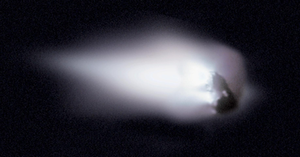
An Encounter With Halley's Comet
Caption: This image shows the solid core, or nucleus, of Halley’s Comet, captured in 1986 by the European Space Agency spacecraft Giotto during its flyby of the comet in the inner Solar System. The nucleus appears irregular and potato-shaped, measuring roughly 15 kilometers (about 9 miles) across, and is composed of a mixture of ice, dust, and rock. Unlike the glowing fuzzy cloud (coma) and long tail that make comets visible from Earth, the nucleus itself is dark and difficult to see until a spacecraft passes close enough to take detailed images.
Halley’s Comet is one of the best-known comets because it returns to the inner Solar System approximately every 76 years, allowing generations of astronomers to observe it repeatedly. The material that is released from the nucleus as the comet warms near the Sun forms a glowing coma and long tails of gas and dust, and over many returns leaves trails of debris that produce meteor showers on Earth, such as the Eta Aquarids in May and the Orionids in October.
Credit: NASA/ESA/Giotto Project
credit link
License: PD Public Domain icons