Glossar-Begriff: Kometenkern
Beschreibung: Ein Kometenkern wird auch als Nukleus eines Kometen bezeichnet. Dieser Kometenkern ist ein festes Objekt, ähnlich einem schmutzigen Schneeball: Er besteht aus Eis und felsigen, staubigen Teilchen. In großer Entfernung von der Sonne besteht ein Komet nur aus seinem Kern. Erst wenn er sich der Sonne annähert, erhitzt das Sonnenlicht den Kometenkern. Dadurch sublimiert das Oberflächeneis, d.h. es geht sofort von einem festen in einen gasförmigen Zustand über. Das sublimierte Eis und der darin eingebettete Staub werden vom Kometenkern ausgestoßen. Dadurch umgeben sie den Kern mit einer Koma und es entsteht ein Kometenschweif, der von der Sonne weg zeigt.
Ähnliche Begriffe:
Dieser Begriff in anderen Sprachen
Begriffs- und Definitionsstatus Die Originaldefinition dieses Begriffes auf Englisch wurden von einem forschenden Astronom und einer Lehrkraft bestätigt Die Übersetzung dieses Begriffs und seiner Definition warten auf Prüfung und Bestätigung
The OAE Multilingual Glossary is a project of the IAU Office of Astronomy for Education (OAE) in collaboration with the IAU Office of Astronomy Outreach (OAO). The terms and definitions were chosen, written and reviewed by a collective effort from the OAE, the OAE Centers and Nodes, the OAE National Astronomy Education Coordinators (NAECs) and other volunteers. You can find a full list of credits here. All glossary terms and their definitions are released under a Creative Commons CC BY-4.0 license and should be credited to "IAU OAE".
Wenn dir ein inhaltlicher oder Übersetzungsfehler in diesem Glossarbegriff oder dieser Definition auffallen, bitte kontaktiere uns.
Auf anderen Sprachen
- Arabisch: نواة المذنب
- Englisch: Comet Nucleus
- Spanisch: Núcleo del cometa
- Französisch: Noyau de la comète
- Italienisch: Nucleo della cometa
- Koreanisch: 혜성핵
- Brasilianisches Portugiesisch: Núcleo cometário
- Vereinfachtes Chinesisch: 彗核
- Traditionelles Chinesisch: 彗核
Ähnliche Medien
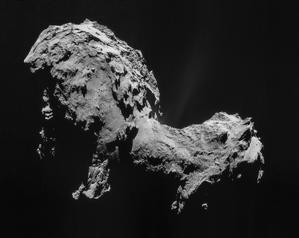
Komet 67P/Tschurjumow-Gerassimenko
Unterschrift: Der Kern des Kometen 67P/Tschurjumow-Gerassimenko (im Englischen Churyumov-Gerasimenko) ist ein "schmutziger Schneeball", der aus einer Mischung aus gefrorenem Material und Staub besteht. Er setzt sich zusammen aus zwei großen, flachen Teilkomponenten: eine 4,1 km × 3,3 km × 1,8 km, die andere 2,6 km × 2,3 km × 1,8 km groß. Diese Teilkomponenten sind durch eine kleine Brücke miteinander verbunden. Wenn sich ein Kometenkern wie dieser der Sonne nähert, wird sein gefrorenes, eisiges Material erwärmt und verdampft zu Gas. Dieses Gas, zusammen mit dem eingebetteten Staub, bildet die charakteristische Koma und den Schweif des Kometen.
Bild: ESA/Rosetta/NAVCAM
Quellenlink
License: CC-BY-SA-3.0-IGO Creative Commons Namensnennung - Weitergabe unter gleichen Bedingungen 3.0 IGO Symbole
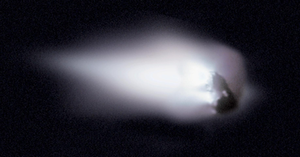
Eine Begegnung mit dem Halleyschen Kometen
Unterschrift: Dieses Bild zeigt den festen Kern des Halleyschen Kometen, aufgenommen im Jahr 1986 von der Sonde „Giotto“ der Europäischen Weltraumorganisation (ESA) während ihres Vorbeiflugs am Kometen im inneren Sonnensystem. Der Kern erscheint unregelmäßig und kartoffelförmig, hat einen Durchmesser von etwa 15 Kilometern und besteht aus einer Mischung aus Eis, Staub und Gestein. Im Gegensatz zu der leuchtenden, diffusen Wolke (Koma) und dem langen Schweif, die Kometen von der Erde aus sichtbar machen, ist der Kern selbst dunkel und schwer zu erkennen, bis ein Raumschiff nahe genug heranfliegt, um detaillierte Aufnahmen zu machen.
Der Halleysche Komet ist einer der bekanntesten Kometen, da er etwa alle 76 Jahre in das innere Sonnensystem zurückkehrt und es so Generationen von Astronomen ermöglicht, ihn wiederholt zu beobachten. Das Material, das beim Erwärmen des Kometen in der Nähe der Sonne aus dem Kern freigesetzt wird, bildet eine leuchtende Koma und lange Gas- und Staubschweife. Im Laufe vieler Umläufe hinterlässt es Staubspuren, die auf der Erde Meteoritenschauer hervorrufen, wie beispielsweise die Eta-Aquariden im Mai und die Orioniden im Oktober.
Bild: NASA/ESA/Giotto-Projekt
Quellenlink
License: PD Gemeinfrei Symbole