Glossary term: Mirror
Description: A mirror is an optical device that reflects light from its surface. Convex mirrors spread beams of light out, and concave mirrors concentrate light beams. Concave mirrors can be shaped to focus parallel beams of light to a point. Most modern telescopes use large concave mirrors as their primary collecting area.
The main body of most mirrors used in astronomical telescopes is made of glass. Other materials sometimes used for the mirror body include ceramics and metals. The mirror body is ground (or otherwise shaped) and polished, and if the material is not already reflective, a thin metal coating is applied to the surface. Aluminum is the most common coating material, but gold or silver are alternatives.
For telescopes larger than about 6 meters in diameter, casting and supporting such huge glass mirrors is difficult. As a result, some of the largest telescopes in the world now use many smaller mirrors that are arranged together to focus light as if they were one giant mirror.
Related Terms:
See this term in other languages
Term and definition status: This term and its definition have been approved by a research astronomer and a teacher
The OAE Multilingual Glossary is a project of the IAU Office of Astronomy for Education (OAE) in collaboration with the IAU Office of Astronomy Outreach (OAO). The terms and definitions were chosen, written and reviewed by a collective effort from the OAE, the OAE Centers and Nodes, the OAE National Astronomy Education Coordinators (NAECs) and other volunteers. You can find a full list of credits here. All glossary terms and their definitions are released under a Creative Commons CC BY-4.0 license and should be credited to "IAU OAE".
If you notice a factual error in this glossary definition then please get in touch.
Related Media
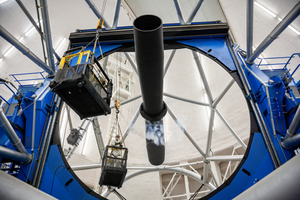
Gemini South's primary mirror and telescope structure
Caption: This is the primary mirror and supporting structure of a large optical telescope at the Gemini South Observatory in Chile. The primary mirror is the largest and most important mirror in a reflecting telescope: its gently curved surface gathers light from faint stars, galaxies, and nebulae and reflects that light to a focal point. At this focal point light is either fed directly in to an instrument to record spectra and images or redirected to such an instrument by a series of further mirrors. The sturdy metal framework around the primary mirros keeps the mirror precisely aligned and protected while the telescope moves to track objects across the sky.
In telescopes that use mirrors instead of lenses, such as this one, the mirror is what collects and focuses the light from distant celestial objects. Larger mirrors can capture more light, allowing astronomers to see fainter and more distant objects. A larger primary mirror can also take sharper images of the sky, but this is often negated by the blurring effect of the Earth's atmopshere. A primary mirror must be perfectly smooth to tolerances of fractions of a wavelength of light so that it produces sharp, clear images. We can think of the primary mirror as the “eye” of the telescope that looks out into space, with its shape and support enabling powerful astronomical observations.
Credit: International Gemini Observatory/NOIRLab/NSF/AURA/M. Paredes
credit link
License: CC-BY-4.0 Creative Commons Attribution 4.0 International (CC BY 4.0) icons








.jpg)
