This page describes an image Comet Shoemaker-Levy After Crossing Jupiter's Roche Limit
Download File ( image 507.00 kB)
Image caption:
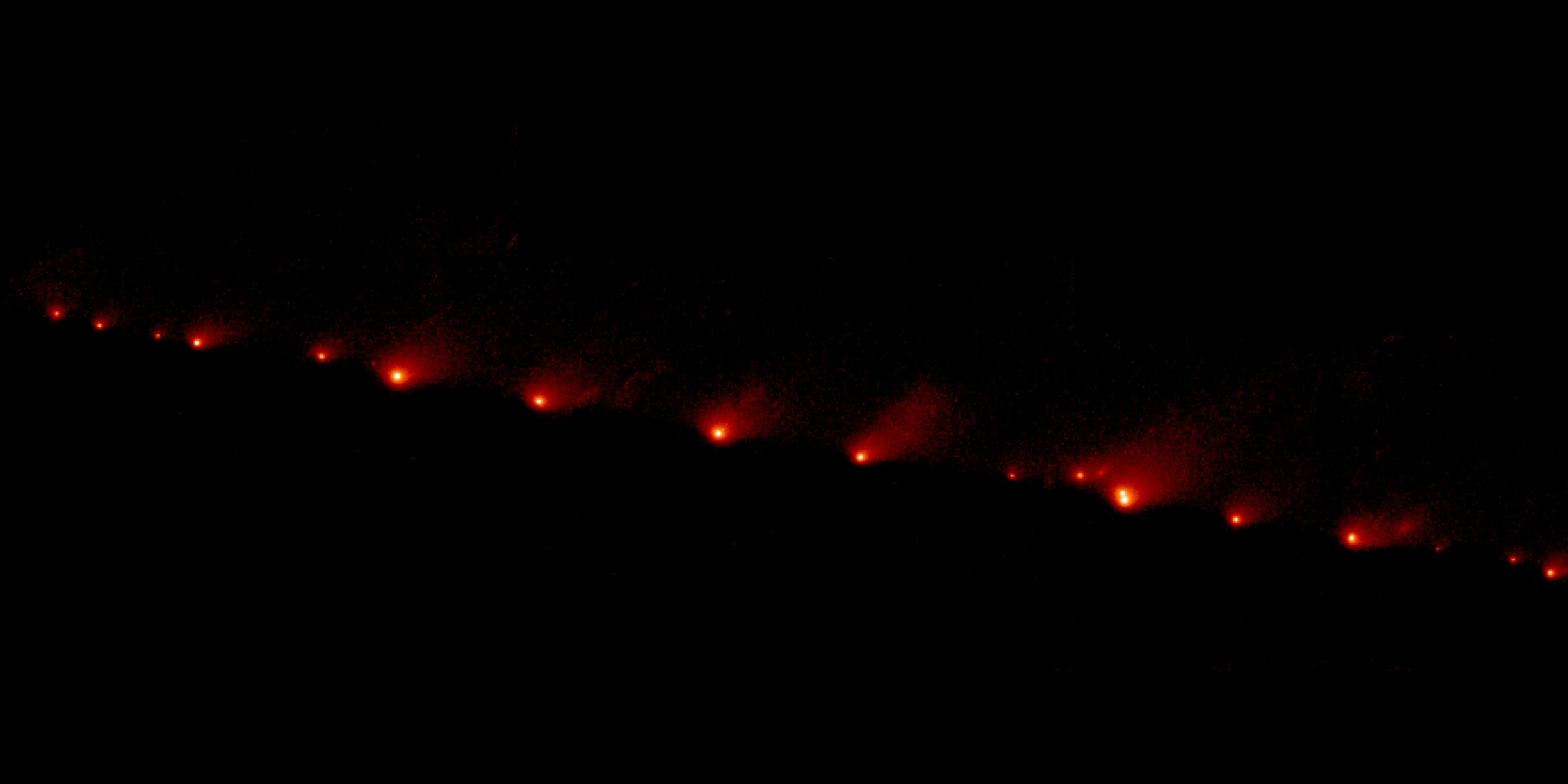
This panoramic image captured by the Hubble Space Telescope shows fragments of Comet Shoemaker–Levy 9. This comet was discovered in 1993 as the series of fragments you see here. These fragments were orbiting Jupiter. It is thought that at some point in the previous few decades the whole, unfragmented comet had been gravitationally captured by Jupiter. Then in 1992 the comet passed within Jupiter’s Roche limit.
Astronomical objects exert gravitational forces on each other. The closer one is to an object, the larger the force. Astronomical objects have a real physical size and thus the gravitational force exerted on the object will vary across the object, the side of an object closer to another object will feel a stronger gravitational force from that other object than the more distant side. The gravitational stretching distorts the object. This gravitational stretching force is known as the tidal force. When an object is close enough to a large body like Jupiter, the object will feel such a large tidal stretching force that it will overcome the internal gravitational force holding the object together, ripping it to shreds. The distance from the larger body within which this occurs is known as the Roche limit.
When Shoemaker–Levy 9 crossed Jupiter's Roche limit in 1992, the tidal force pulled the comet into separate fragments. Here we see these fragments in a chain as they orbited Jupiter in May 1994. Later in July 1994 the comet fragment plunged into Jupiter’s atmosphere over the course of a week in a spectacular series of impacts. This event provided scientists with a rare opportunity to witness an impact unfolding in real time.
Scroll to captions in other languages
Image credit: NASA, ESA, and H. Weaver and E. Smith (STScI) Credit Link
Related glossary terms:
Roche Limit
, Tidal Force
Image license: Public Domain Public Domain icons
The media file captions presented on the OAE website were written, translated and reviewed by a collective effort from the OAE, the OAE Centers and Nodes, the OAE National Astronomy Education Coordinators (NAECs) and other volunteers. You can find a full list of credits for our translation project here. All media file captions are released under a Creative Commons CC BY-4.0 license and should be credited to "IAU OAE". The media files themselves may have different licenses (see above) and should be credited as listed above under "credit".
If you notice a factual error in this caption or an error in any of its translations then please get in touch.
Captions in Different Languages:
Image caption: Dieses vom Hubble-Weltraumteleskop aufgenommene Panoramabild zeigt Fragmente des Kometen Shoemaker–Levy 9. Dieser Komet wurde 1993 als die hier zu sehende Reihe von Fragmenten entdeckt. Diese Fragmente umkreisten den Jupiter. Man nimmt an, dass der noch unfragmentierte Komet irgendwann in den vorangegangenen Jahrzehnten durch die Schwerkraft des Jupiter eingefangen worden ist. Im Jahr 1992 passierte der Komet dann die Roche-Grenze des Jupiters.
Astronomische Objekte üben gegenseitig Gravitationskräfte aufeinander aus: Je näher man einem Objekt ist, desto größer ist diese Kraft. Da es sich bei den beteiligten Körpern um ausgedehnte Objekte handelt, ist die Gravitationskraft die das eine auf das andere Objekt ausübt, auf der zu- und abgewandten Seite unterschiedlich groß. Die so verursachte Dehnung verformt das Objekt und ihre Ursache wird als Gezeitenkraft bezeichnet. Befindet sich ein Objekt nahe genug an einem großen Himmelskörper wie dem Jupiter, wirkt auf das Objekt eine so große Gezeitenkraft, dass diese die innere Gravitationskraft, die das Objekt zusammenhält, übersteigt und es in Stücke reißt. Die Entfernung zum größeren Himmelskörper, innerhalb derer dies geschieht, wird als Roche-Grenze bezeichnet.
Als Shoemaker–Levy 9 1992 die Roche-Grenze des Jupiters überschritt, riss die Gezeitenkraft den Kometen in einzelne Fragmente auseinander. Hier sehen wir diese Fragmente aufgereiht in einer Kette, während sie im Mai 1994 den Jupiter umkreisten. Im Juli 1994, stürzten die Kometenfragmente dann im Laufe einer Woche in einer spektakulären Serie von Einschlägen in die Jupiteratmosphäre. Dieses Ereignis bot Wissenschaftlern die seltene Gelegenheit, einen solchen Einschlag in Echtzeit mitzuerleben.
Image credit: NASA, ESA sowie H. Weaver und E. Smith (STScI)
Related glossary terms: Gezeitenkraft , Roche-Grenze Caption translation status: Not yet approved by a reviewer
Caption translators: Simon Kraus
Image caption: Questa immagine panoramica ripresa dal telescopio spaziale Hubble mostra i frammenti della cometa Shoemaker–Levy 9. Questa cometa fu scoperta nel 1993 sotto forma della serie di frammenti che vedete qui. Questi frammenti orbitavano attorno a Giove. Si ritiene che, in un momento imprecisato nei decenni precedenti, la cometa, allora ancora intera e non frammentata, fosse stata catturata gravitazionalmente da Giove. Successivamente, nel 1992, la cometa passò all’interno del limite di Roche di Giove.
Gli oggetti astronomici esercitano forze gravitazionali gli uni sugli altri. Più ci si avvicina a un oggetto, maggiore è la forza. Gli oggetti astronomici hanno dimensioni fisiche reali e quindi la forza gravitazionale esercitata su di essi varia a seconda della posizione; il lato di un oggetto più vicino a un altro subirà una forza gravitazionale maggiore rispetto al lato più distante. L’allungamento gravitazionale deforma l’oggetto. Questa forza di allungamento gravitazionale è nota come forza di marea. Quando un oggetto si trova sufficientemente vicino a un corpo di grandi dimensioni come Giove, subisce una forza di allungamento di marea talmente grande da superare la forza gravitazionale interna che tiene insieme l’oggetto, facendolo a pezzi. La distanza dal corpo più grande entro la quale ciò avviene è nota come limite di Roche.
Quando Shoemaker–Levy 9 superò il limite di Roche di Giove nel 1992, la forza di marea frantumò la cometa in frammenti separati. Qui vediamo questi frammenti disposti in una catena mentre orbitavano attorno a Giove nel maggio 1994. Successivamente, nel luglio 1994, i frammenti della cometa si sono tuffati nell’atmosfera di Giove nel corso di una settimana, in una spettacolare serie di impatti. Questo evento ha offerto agli scienziati una rara opportunità di assistere in tempo reale allo svolgersi di un impatto.
Image credit: NASA, ESA, H. Weaver ed E. Smith (STScI)
Related glossary terms: Forza di marea , Limite di Roche Caption translation status: Not yet approved by a reviewer
Caption translators: Giuliana Giobbi