Terme du glossaire : Transit
Description : Un transit se produit lorsqu'un corps céleste passe entre un autre corps céleste de taille angulaire plus importante et l'observateur. Du point de vue de l'observateur, le corps céleste obscurcissant se déplace devant le corps obscurci, bloquant la vue d'une fraction de la surface de l'objet obscurci. Si le corps obscur qui passe entre l'observateur et l'objet obscurci a une taille angulaire supérieure à celle de ce dernier, on parle d'occultation plutôt que de transit. Un transit observé par un observateur peut ne pas être vu par un autre observateur regardant le même système sous un angle différent.
Dans le système solaire, Mercure et Vénus peuvent parfois transiter sur la face du Soleil lorsqu'elles sont observées depuis la Terre. Les lunes en orbite autour des planètes du système solaire sont souvent vues en train de transiter sur la face de leur planète hôte lorsqu'elles sont observées depuis la Terre.
Les planètes en orbite autour d'autres étoiles (exoplanètes) sont souvent découvertes lorsqu'elles transitent devant leur étoile hôte depuis l'endroit où se trouve l'observateur. Elles bloquent ainsi une partie de la lumière de l'étoile, la faisant paraître légèrement moins lumineuse pour l'observateur. Une planète en orbite autour d'une étoile ne transitera, vue de la Terre, que si le plan de son orbite croise la ligne de visée terrestre. Ainsi, la recherche de planètes par la méthode du transit ne permet de détecter qu'une fraction des planètes de la galaxie. Les transits peuvent également être utilisés pour estimer la taille d'une exoplanète.
Termes associés :
Voir ce terme dans d'autres langues
Statut du terme et de sa définition : La définition initiale de ce terme en anglais a été aprouvée par un·e spécialiste de la recherche en astronomie et un·e spécialiste de l’éducation La traduction de ce terme et de sa définition n'ont pas encore été aprouvées
Le glossaire multilangue de l'OAE est un projet du Bureau de l'IAU de l'Astronomie pour l'Education (OAE) en collaboration avec le Bureau de l'IAU de diffusion de l'Astronomie (OAO). Les termes et définitions ont été choisis, écrits et relues grâce à un effort collectif de l'OAE, les Centres et les Noeuds de l'OAE, les Coordinateurs Nationaux de l'Astronomie pour l'Education de l'OAE(NAECs) et d'autres volontaires. La liste complète des crédits pour ce projet est disponible ici . Tous les termes du glossaire et leur définition sont déposés sous licence Creative Commons CC BY-4.0 et doivent être créditées au nom de "IAU OAE".
Si vous constatez une erreur dans ce terme ou sa définition, veuillez nous contacter .
Media associé
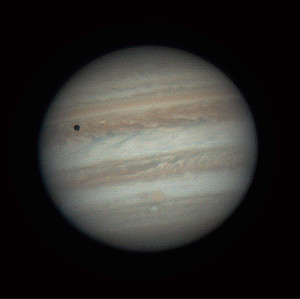
Jupiter, Io and its shadow, by Ralf Burkart, Germany
Légende : First place in the 2021 IAU OAE Astrophotography Contest, category Galilean moons.
This time-lapse of Jupiter taken in 2017 from Germany beautifully illustrates the transit of one of the Galilean moons, Io, in front of Jupiter. As this is simply a moon casting a shadow on a planet it is equivalent to a lunar eclipse on Earth observed from further away. While the shadow of the moon is clearly visible from the beginning, it might be difficult to spot the moon itself against the background of the beautiful atmospheric bands of Jupiter the first time the video is seen. Watching it repeatedly allows appreciating the rapid motion and rotation in this fantastic observation.
Crédit : Ralf Burkart/IAU OAE
License: CC-BY-4.0 Creative Commons (CC) Attribution 4.0 International (CC BY 4.0) Icônes

Venus Transit from Tempe, AZ, USA , June 5, 2012
Légende : While the planet Venus regularly passes between the Sun and the Earth, most of the time it passes above or below the Sun when observed from Earth. On rare occasions, the planet Venus passes directly in front of the Sun for observers on Earth. The last such Venus transits were in 2004 and 2012, respectively. The next such transit will be in 2117. The picture was taken at 18:54 PDT on June 5, 2012, from Tempe, Arizona, US. The telescope used was an 8" Schmidt-Cassegrain with ND5 filter; the camera was a Sony NEX5N with the APS sensor placed at prime focus. Clearly visible are the disk of the Sun, Venus as a prominent round spot. Several sun spots also appear on the solar disk.
Crédit : Stephen Rector
Lien vers les crédits
License: CC-BY-SA-3.0 Creative Commons (CC) Attribution - Partage dans les Mêmes Conditions 3.0 non transposé Icônes

Transit of Phobos from Mars
Légende : This video shows the Sun viewed from Mars as Mars’ moon Phobos transits across the solar disk. This video is composed of images taken from the Martian surface on the 30th of September 2024 by the Mastcam-Z camera of NASA’s Perseverance Mars rover. While our Moon is perfectly sized to eclipse the Sun when seen from the Earth’s surface, Phobos’s size and orbit mean that it cannot cover the solar disk completely. This means that this event is a transit and not an eclipse.
This video is in real time, with the entire transit lasting just 32 seconds. This compares with the several hours a solar eclipse on Earth takes from the Moon first obscuring part of the Sun to the Sun being completely visible again. This is due to Phobos’ much shorter orbital period of just over seven and a half hours compared to the Moon’s orbital period of 27 days as well as the solar disk appearing slightly smaller from Mars than it does from Earth. Note the non-spherical shape of Phobos as it crosses the solar disk.
Crédit : NASA/JPL-Caltech/ASU/MSSS
Lien vers les crédits
License: PD Domaine Public Icônes
Activités associées

Hunting for exoplanets with Arduino
astroEDU educational activity (links to astroEDU website) Description: Become a planet hunter with an Arduino kit and some simple components
License: CC-BY-4.0 Creative Commons (CC) Attribution 4.0 International (CC BY 4.0) Icônes
Tranches d'âge :
14-16
, 16-19
, 19+
Niveau scolaire :
Secondaire
, Université
Domaines d'apprentissage :
Modélisation
, Basée sur l'observation
, Axée sur la simulation
, Apprentissage par enquête
, Utilisation de technologies
Coûts :
Moyen
Durée :
3h
Taille du groupe :
Par groupe
Compétences :
Analyser et interpréter des données
, Poser des questions
, Développer et utiliser des modèles








- Ressources
- Moteur de recherche des ressources pédagogiques
- Parcourir les ressources pédagogiques par Sujet
- Parcourir les images
- AstroEdu - Activités en classe
- Grandes Idées - Littéracie en astronomie
- Glossaire
- Rapports de l'OAE
- L'astronomie pour l'Education à travers le monde
- Sélection de ressources externes