وسائط ذات صلة
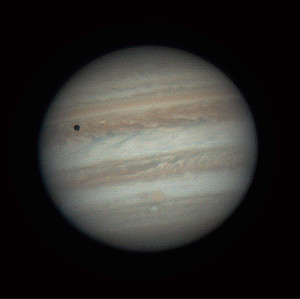
Jupiter, Io and its shadow, by Ralf Burkart, Germany
الشرح: First place in the 2021 IAU OAE Astrophotography Contest, category Galilean moons.
This time-lapse of Jupiter taken in 2017 from Germany beautifully illustrates the transit of one of the Galilean moons, Io, in front of Jupiter. As this is simply a moon casting a shadow on a planet it is equivalent to a lunar eclipse on Earth observed from further away. While the shadow of the moon is clearly visible from the beginning, it might be difficult to spot the moon itself against the background of the beautiful atmospheric bands of Jupiter the first time the video is seen. Watching it repeatedly allows appreciating the rapid motion and rotation in this fantastic observation.
المصدر: Ralf Burkart/IAU OAE
License: CC-BY-4.0 المشاع الإبداعي نَسب المُصنَّف 4.0 دولي (CC BY 4.0) أيقونات

Venus Transit from Tempe, AZ, USA , June 5, 2012
الشرح: While the planet Venus regularly passes between the Sun and the Earth, most of the time it passes above or below the Sun when observed from Earth. On rare occasions, the planet Venus passes directly in front of the Sun for observers on Earth. The last such Venus transits were in 2004 and 2012, respectively. The next such transit will be in 2117. The picture was taken at 18:54 PDT on June 5, 2012, from Tempe, Arizona, US. The telescope used was an 8" Schmidt-Cassegrain with ND5 filter; the camera was a Sony NEX5N with the APS sensor placed at prime focus. Clearly visible are the disk of the Sun, Venus as a prominent round spot. Several sun spots also appear on the solar disk.
المصدر: Stephen Rector
رابط المصدر
License: CC-BY-SA-3.0 المشاع الإبداعي نَسب المُصنَّف - الترخيص بالمثل 3.0 غير موطَّنة أيقونات

Transit of Phobos from Mars
الشرح: This video shows the Sun viewed from Mars as Mars’ moon Phobos transits across the solar disk. This video is composed of images taken from the Martian surface on the 30th of September 2024 by the Mastcam-Z camera of NASA’s Perseverance Mars rover. While our Moon is perfectly sized to eclipse the Sun when seen from the Earth’s surface, Phobos’s size and orbit mean that it cannot cover the solar disk completely. This means that this event is a transit and not an eclipse.
This video is in real time, with the entire transit lasting just 32 seconds. This compares with the several hours a solar eclipse on Earth takes from the Moon first obscuring part of the Sun to the Sun being completely visible again. This is due to Phobos’ much shorter orbital period of just over seven and a half hours compared to the Moon’s orbital period of 27 days as well as the solar disk appearing slightly smaller from Mars than it does from Earth. Note the non-spherical shape of Phobos as it crosses the solar disk.
المصدر: NASA/JPL-Caltech/ASU/MSSS
رابط المصدر
License: PD الملكية العامة أيقونات
الأنشطة المرتبطة

Hunting for exoplanets with Arduino
astroEDU educational activity (links to astroEDU website) Description: Become a planet hunter with an Arduino kit and some simple components
License: CC-BY-4.0 المشاع الإبداعي نَسب المُصنَّف 4.0 دولي (CC BY 4.0) أيقونات
الفئات العمرية:
14-16
, 16-19
, 19+
المرحلة التعليمية:
المرحلة الثانوية
, الجامعة
مجالات التعلم:
النمذجة
, قائم على الملاحظة
, يركز على المحاكاة
, تعلم منظم قائم على الاستقصاء
, معتمد على التكنولوجيا
التكاليف:
تكلفة متوسطة
المدة:
3 ساعات
حجم المجموعة:
جماعي
المهارات:
تحليل البيانات وتفسيرها
, طرح الأسئلة
, تطوير النماذج واستخدامها