Glossary term: 淩
Description: 當一個天體穿過另一個角大小較大的天體和觀測者之間時,就發生了凌星。從觀測者的角度看,遮擋天體移動到被遮擋天體的前面,阻擋了被遮擋天體表面的一部分視線。如果從觀測者和被遮擋天體之間經過的遮擋天體的角大小大於後者,這種情況被稱為掩星,而不是凌星。對於同一系統,被一個觀測者看到的凌星現象,可能不會被另一個來自不同角度的觀測者看到。
在太陽系中,從地球上看水星和金星有時都會凌日。從地球上看,繞太陽系行星運行的衛星經常會穿過其所繞轉行星的表面。
環繞其他恆星運行的行星(系外行星)通常是在凌星時被髮現的,它們會遮擋住恆星的部分光線,從觀測者所在位置看去,恆星會顯得略微暗淡。只有當行星的軌道平面與地球的視線相交時,從地球上看繞恆星運行的行星才會凌星。因此,用凌星法尋找行星只能探測到銀河系中的一小部分行星。凌星還可以用來估計系外行星的大小。
Related Terms:
See this term in other languages
Term and definition status: The original definition of this term in English have been approved by a research astronomer and a teacher The translation of this term and its definition is still awaiting approval
This is an automated transliteration of the simplified Chinese translation of this term
The OAE Multilingual Glossary is a project of the IAU Office of Astronomy for Education (OAE) in collaboration with the IAU Office of Astronomy Outreach (OAO). The terms and definitions were chosen, written and reviewed by a collective effort from the OAE, the OAE Centers and Nodes, the OAE National Astronomy Education Coordinators (NAECs) and other volunteers. You can find a full list of credits here. All glossary terms and their definitions are released under a Creative Commons CC BY-4.0 license and should be credited to "IAU OAE".
If you notice a factual or translation error in this glossary term or definition then please get in touch.
Related Media
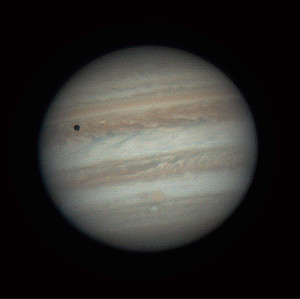
木星、木衛一及其陰影,作者:Ralf Burkart,德國
Caption: 2021 年國際天文學聯合會 OAE 天體攝影比賽伽利略衛星類第一名。
這幅木星的延時攝影是於2017 年從德國拍攝的,作品精美地展示了伽利略衛星之一木衛一在木星前的凌星現象。由於這只是衛星在行星上投下影子,因此相當於從更遠的地方觀測地球上的月食。雖然衛星的影子從一開始就清晰可見,但在木星美麗的大氣帶背景下,第一次觀看視頻時可能很難發現衛星本身。反復觀看可以欣賞到這一奇妙的快速運動和旋轉過程。
Credit: Ralf Burkart/IAU OAE
License: CC-BY-4.0 Creative Commons 姓名標示 4.0 國際 (CC BY 4.0) icons

Venus Transit from Tempe, AZ, USA , June 5, 2012
Caption: While the planet Venus regularly passes between the Sun and the Earth, most of the time it passes above or below the Sun when observed from Earth. On rare occasions, the planet Venus passes directly in front of the Sun for observers on Earth. The last such Venus transits were in 2004 and 2012, respectively. The next such transit will be in 2117. The picture was taken at 18:54 PDT on June 5, 2012, from Tempe, Arizona, US. The telescope used was an 8" Schmidt-Cassegrain with ND5 filter; the camera was a Sony NEX5N with the APS sensor placed at prime focus. Clearly visible are the disk of the Sun, Venus as a prominent round spot. Several sun spots also appear on the solar disk.
Credit: Stephen Rector
credit link
License: CC-BY-SA-3.0 Creative Commons Attribution-ShareAlike 3.0 Unported icons

Transit of Phobos from Mars
Caption: This video shows the Sun viewed from Mars as Mars’ moon Phobos transits across the solar disk. This video is composed of images taken from the Martian surface on the 30th of September 2024 by the Mastcam-Z camera of NASA’s Perseverance Mars rover. While our Moon is perfectly sized to eclipse the Sun when seen from the Earth’s surface, Phobos’s size and orbit mean that it cannot cover the solar disk completely. This means that this event is a transit and not an eclipse.
This video is in real time, with the entire transit lasting just 32 seconds. This compares with the several hours a solar eclipse on Earth takes from the Moon first obscuring part of the Sun to the Sun being completely visible again. This is due to Phobos’ much shorter orbital period of just over seven and a half hours compared to the Moon’s orbital period of 27 days as well as the solar disk appearing slightly smaller from Mars than it does from Earth. Note the non-spherical shape of Phobos as it crosses the solar disk.
Credit: NASA/JPL-Caltech/ASU/MSSS
credit link
License: PD Public Domain icons
Related Activities

Hunting for exoplanets with Arduino
astroEDU educational activity (links to astroEDU website) Description: Become a planet hunter with an Arduino kit and some simple components
License: CC-BY-4.0 Creative Commons 姓名標示 4.0 國際 (CC BY 4.0) icons
Age Ranges:
14-16
, 16-19
, 19+
Education Level:
Secondary
, University
Areas of Learning:
Modelling
, Observation based
, Simulation focussed
, Structured-inquiry learning
, Technology-based
Costs:
Medium Cost
Duration:
3 hours
Group Size:
Group
Skills:
Analysing and interpreting data
, Asking questions
, Developing and using models