Terme du glossaire : Photosphère
Description : La photosphère ("sphère de lumière") est la couche d'une étoile d'où émerge la lumière que nous observons. La lumière émise par les couches plus profondes et plus denses sera absorbée avant de pouvoir s'échapper de l'étoile. Les couches supérieures sont moins denses et n'émettent pas de lumière significative.
Termes associés :
Voir ce terme dans d'autres langues
Statut du terme et de sa définition : La définition initiale de ce terme en anglais a été aprouvée par un·e spécialiste de la recherche en astronomie et un·e spécialiste de l’éducation La traduction de ce terme et de sa définition n'ont pas encore été aprouvées
Le glossaire multilangue de l'OAE est un projet du Bureau de l'IAU de l'Astronomie pour l'Education (OAE) en collaboration avec le Bureau de l'IAU de diffusion de l'Astronomie (OAO). Les termes et définitions ont été choisis, écrits et relues grâce à un effort collectif de l'OAE, les Centres et les Noeuds de l'OAE, les Coordinateurs Nationaux de l'Astronomie pour l'Education de l'OAE(NAECs) et d'autres volontaires. La liste complète des crédits pour ce projet est disponible ici . Tous les termes du glossaire et leur définition sont déposés sous licence Creative Commons CC BY-4.0 et doivent être créditées au nom de "IAU OAE".
Si vous constatez une erreur dans ce terme ou sa définition, veuillez nous contacter .
Dans d'autres langues
- Arabe: الغلاف الضوئي
- Allemand: Photosphäre
- Anglais: Photosphere
- Espagnol: Fotosfera
- Italien: Fotosfera
- Japonais: 光球 (Liens externes)
- Coréen: 광구
- Portugais brésilien: Fotosfera
- Chinois simplifié: 光球
- Chinois traditionnel: 光球
Media associé

High-resolution image of the surface of the Sun
Légende : This high-resolution image of a small portion of the outermost visible "surface" of the Sun (the photosphere) covers an area 36,500 by 36,500 km. It was one of the first images taken by the Daniel K. Inouye Solar Telescope, as part of the telescope's Science Verification Phase. Each of the cells that are visible is about the size of the US state Texas, or of France, or of Afghanistan, or of Somalia. In the brighter centers of these cells, plasma from the underlying regions rises to the surface, cools off, and then sinks down again at the location of the darker lanes delineating the cells. In these dark lanes we can also see the tiny, bright markers of magnetic fields.
Crédit : NSO/NSF/AURA
Lien vers les crédits
License: CC-BY-4.0 Creative Commons (CC) Attribution 4.0 International (CC BY 4.0) Icônes

Close-up view of a sunspot
Légende : This image of a sunspot was taken by the Daniel K Inouye Solar Telescope (DKIST), operated by the U.S. National Science Foundation. It was taken only in light with a wavelength of 530 nanometers, within the greenish-yellow part of the visible spectrum.
The picture reveals the detail of the spot's structure and the Sun’s photosphere. The dark central region, known as the umbra, is surrounded by a lighter area called the penumbra with radially elongated features stretching towards the umbra. Note that the umbra and penumbra here are not the same as the umbra and penumbra that occur during an eclipse.
The sunspot measures approximately 5000 kilometres in diameter, roughly equivalent to the east-west span of China. While the umbra appears black, it is actually hot and bright. It only appears dark because it is a few thousand kelvin cooler than the surrounding solar photosphere. Surrounding the sunspot, granulation patterns of plasma are visible on the photospheric surface of the Sun.
Crédit : NSO/NSF/AURA
Lien vers les crédits
License: CC-BY-4.0 Creative Commons (CC) Attribution 4.0 International (CC BY 4.0) Icônes
Diagrammes associés
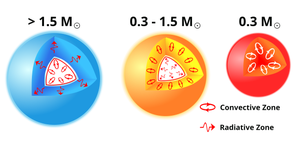
Stellar Structure
Légende : Stars are balls of plasma. For most of a star’s life it burns hydrogen into helium in its core. This phase of a star’s life is known as the main sequence. Burning hydrogen into helium produces heat, that heat travels out of the star’s core eventually reaching the star’s photosphere (often referred to as the “surface” of the star). From here the heat can radiate into space as various forms of electromagnetic radiation. However, how heat travels from the core to the photosphere depends on the star’s mass.
Imagine a parcel of gas rising inside a star. As it rises, it moves into an area of lower pressure, so it cools down and expands. If the parcel is still hotter, and therefore less dense than its surroundings, it keeps moving upward due to buoyancy. Eventually, it will rise far enough to cool and sink back down. This rising and sinking cycle is called convection. Whether convection occurs depends on how quickly temperature changes as you move away from the star’s core. If the temperature in a star drops rapidly, rising parcels of gas are more likely to stay hotter than their surroundings, so convection dominates as the mode of energy transfer in this part of the star. Conversely if the temperature drops more slowly (i.e. if the temperature gradient is small) then heat will mostly be transferred by radiation (photons).
In the most massive main sequence stars (more massive than about 1.5 times the mass of the Sun, seen here on the left), hydrogen is burned into helium using the CNO cycle. This is highly temperature dependent and thus energy production is concentrated near the center of the star. This leads to a larger temperature gradient and thus a convective core. Further out the temperature gradient becomes smaller and heat transport is dominated by radiation. This is called the radiative zone.
For lower mass stars like the Sun (between 0.3 and 1.5 solar masses, seen here in the middle) hydrogen is burned to helium using a different process (the pp chain). This depends less on the internal temperature than the CNO cycle and so energy production is more distributed in the star’s core. This leads to a smaller temperature gradient and thus a radiative core where convection occurs surrounded by a radiative zone. Going further out the gas becomes cool enough for some elements to hang to on some of their electrons, i.e. not being completely ionised. This partially ionised gas is more opaque to photons, trapping heat. This leads to a large temperature gradient and thus convection.
The lowest mass stars (below 0.3 solar masses, seen here on the right) have no radiative zone and are fully convective.
The arrows in the radiative zone are shown as wavy lines heading out of the star. However, a photon’s journey out of a star is much more complex with each individual photon travelling only a short distance before being deflected by some of the charged particles that make up the plasma of the star’s interior. This leads to a long and winding road that takes millennia instead of the few seconds it would take if the photon did not interact with particles in the plasma.
Crédit : Based on a vector diagram by Wikimedia user Д.Ильин which itself is based on a diagram from sun.org
License: CC-BY-4.0 Creative Commons (CC) Attribution 4.0 International (CC BY 4.0) Icônes
Ceci pourrait vous intéresser également









- Ressources
- Moteur de recherche des ressources pédagogiques
- Parcourir les ressources pédagogiques par Sujet
- Parcourir les images
- AstroEdu - Activités en classe
- Grandes Idées - Littéracie en astronomie
- Glossaire
- Rapports de l'OAE
- L'astronomie pour l'Education à travers le monde
- Sélection de ressources externes