This page describes a video Space debris orbiting the Earth
Descargar archivo ( vídeo 18.61 MB)
Leyenda del vídeo:
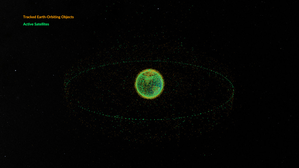
This animation shows objects orbiting the Earth. The data date from February 2024 and are taken from space-track.org which maintains a public catalogue of objects tracked by the United States Space Command (USSPACECOM).
At first in this video we see green dots, each representing one of the 31,000 human-made objects orbiting Earth. These include both operational and decommissioned satellites, used rocket stages from space launches, and fragments larger than 10cm created by collisions or explosions. Later in the video, some of the green dots are replace by orange dots, each of these representing one of the 9,300 operational satellites orbiting the Earth. Note that since February 2024 more satellites and rockets have been launched in to space and some objects will have fallen back to Earth, so these numbers will have changed.
We see two main groups of objects. The first are those objects orbiting close to the Earth, objects in low Earth orbit. These include communication satellites (many from the satellite constellations used to provide satellite internet services), Earth observation satellites, military satellites, two operational space stations and other objects such as rocket stages and other debris.
More distant from Earth we see a thin ring of satellites. These are in geostationary orbit. This is a special orbit where the orbital period matches the rotation period of the Earth. This means that a satellite in geostationary orbit stays above the same point on the equator and, when observed from the side of the Earth facing the satellite, will appear to stay at a position on the sky that does not change over time. Because of this, geostationary orbit is used by many communications satellites as a satellite dish on Earth used to receive or transmit a signal to that satellite can point in a fixed direction and does not need to dynamically track the satellite. Geostationary orbit is also used by weather observation satellites.
Desplázate hasta los subtítulos en otros idiomas
Crédito del vídeo: NASA's Scientific Visualization Studio Enlace del crédito
Términos relacionados del glosario:
Basura espacial
, Nave espacial
, Satélite Artificial
Categorías:
El planeta Tierra
, Exploración espacia
Licencia del vídeo: Dominio público Dominio público íconos
Las descripciones de los archivos multimedia que aparecen en la página web de la OAE han sido redactadas, traducidas y revisadas gracias al esfuerzo conjunto de la OAE y los Centros y Nodos de la OAE, los Coordinadores Nacionales de Educación Astronómica (NAECs) y otros voluntarios. Puedes consultar la lista completa de los créditos de nuestro proyecto de traducción aquí. Todos los pies de foto de los archivos multimedia se publican bajo una Creative Commons CC BY-4.0 licencia y deben atribuirse a la "IAU OAE". Los propios archivos multimedia pueden tener diferentes licencias (véase más arriba) y deben citarse tal y como se indica en "credit".
Pies de foto en diferentes idiomas:
Leyenda del vídeo: This animation shows objects orbiting the Earth. The data date from February 2024 and are taken from space-track.org which maintains a public catalogue of objects tracked by the United States Space Command (USSPACECOM).
At first in this video we see green dots, each representing one of the 31,000 human-made objects orbiting Earth. These include both operational and decommissioned satellites, used rocket stages from space launches, and fragments larger than 10cm created by collisions or explosions. Later in the video, some of the green dots are replace by orange dots, each of these representing one of the 9,300 operational satellites orbiting the Earth. Note that since February 2024 more satellites and rockets have been launched in to space and some objects will have fallen back to Earth, so these numbers will have changed.
We see two main groups of objects. The first are those objects orbiting close to the Earth, objects in low Earth orbit. These include communication satellites (many from the satellite constellations used to provide satellite internet services), Earth observation satellites, military satellites, two operational space stations and other objects such as rocket stages and other debris.
More distant from Earth we see a thin ring of satellites. These are in geostationary orbit. This is a special orbit where the orbital period matches the rotation period of the Earth. This means that a satellite in geostationary orbit stays above the same point on the equator and, when observed from the side of the Earth facing the satellite, will appear to stay at a position on the sky that does not change over time. Because of this, geostationary orbit is used by many communications satellites as a satellite dish on Earth used to receive or transmit a signal to that satellite can point in a fixed direction and does not need to dynamically track the satellite. Geostationary orbit is also used by weather observation satellites.
Crédito del vídeo: NASA's Scientific Visualization Studio
Términos relacionados del glosario: Artificial Satellite , Space Debris , Spacecraft
Leyenda del vídeo: Questa animazione mostra gli oggetti in orbita attorno alla Terra. I dati risalgono al febbraio 2024 e sono tratti dal sito space-track.org, che gestisce un catalogo pubblico degli oggetti monitorati dallo United States Space Command (USSPACECOM).
All'inizio del video si vedono dei punti verdi, ciascuno dei quali rappresenta uno dei 31.000 oggetti di origine antropica in orbita attorno alla Terra. Tra questi figurano sia satelliti operativi che dismessi, stadi di razzi usati provenienti da lanci spaziali e frammenti di dimensioni superiori a 10 cm generati da collisioni o esplosioni. Più avanti nel video, alcuni dei punti verdi vengono sostituiti da punti arancioni, ciascuno dei quali rappresenta uno dei 9.300 satelliti operativi in orbita attorno alla Terra. Si noti che, dal febbraio 2024, sono stati lanciati nello spazio altri satelliti e razzi e alcuni oggetti saranno ricaduti sulla Terra, quindi questi numeri saranno cambiati.
Si osservano due gruppi principali di oggetti. Il primo è costituito dagli oggetti che orbitano vicino alla Terra, ovvero quelli in orbita terrestre bassa. Tra questi figurano i satelliti di comunicazione (molti dei quali appartenenti alle costellazioni utilizzate per fornire servizi Internet via satellite), i satelliti di osservazione della Terra, i satelliti militari, due stazioni spaziali operative e altri oggetti, come stadi di razzi e detriti vari.
Più lontano dalla Terra si osserva un sottile anello di satelliti. Questi si trovano in orbita geostazionaria. Si tratta di un’orbita speciale in cui il periodo orbitale corrisponde al periodo di rotazione della Terra. Ciò significa che un satellite in orbita geostazionaria rimane sopra lo stesso punto sull’equatore e, se osservato dal lato della Terra rivolto verso il satellite, sembrerà rimanere in una posizione nel cielo che non cambia nel tempo. Per questo motivo, l’orbita geostazionaria è utilizzata da molti satelliti di comunicazione, poiché un’antenna parabolica sulla Terra, utilizzata per ricevere o trasmettere un segnale a quel satellite, può essere orientata in una direzione fissa e non ha bisogno di seguire dinamicamente il satellite. L’orbita geostazionaria è utilizzata anche dai satelliti di osservazione meteorologica.
Crédito del vídeo: Studio di visualizzazione scientifica della NASA
Términos relacionados del glosario: Detriti spaziali , Satellite artificiale , Veicolo spaziale Estado de la traducción de los subtítulos: Aún no ha sido aprobado por un revisor o revisora
Traductores de las leyendas: Giuliana Giobbi