This page describes an image An Encounter With Halley's Comet
Descargar archivo ( imagen 1.45 MB)
Pie de foto:
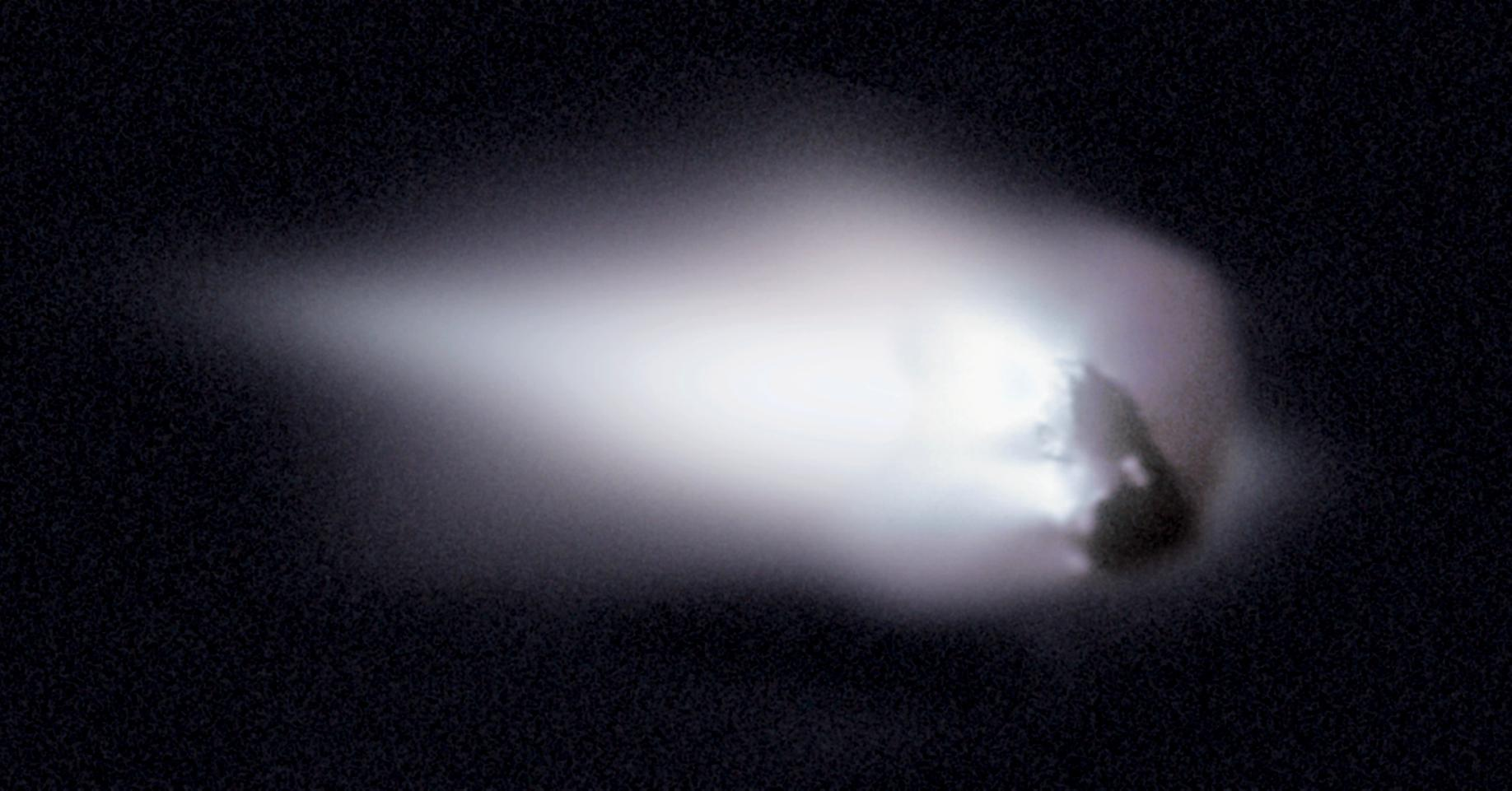
This image shows the solid core, or nucleus, of Halley’s Comet, captured in 1986 by the European Space Agency spacecraft Giotto during its flyby of the comet in the inner Solar System. The nucleus appears irregular and potato-shaped, measuring roughly 15 kilometers (about 9 miles) across, and is composed of a mixture of ice, dust, and rock. Unlike the glowing fuzzy cloud (coma) and long tail that make comets visible from Earth, the nucleus itself is dark and difficult to see until a spacecraft passes close enough to take detailed images.
Halley’s Comet is one of the best-known comets because it returns to the inner Solar System approximately every 76 years, allowing generations of astronomers to observe it repeatedly. The material that is released from the nucleus as the comet warms near the Sun forms a glowing coma and long tails of gas and dust, and over many returns leaves trails of debris that produce meteor showers on Earth, such as the Eta Aquarids in May and the Orionids in October.
Desplázate hasta los subtítulos en otros idiomas
Crédito de la imagen: NASA/ESA/Giotto Project Enlace del crédito
Términos relacionados del glosario:
Coma de un cometa
, Cometa
, El Cometa Halley
, Núcleo del cometa
Licencia de la imagen: Dominio público Dominio público íconos
Las descripciones de los archivos multimedia que aparecen en la página web de la OAE han sido redactadas, traducidas y revisadas gracias al esfuerzo conjunto de la OAE y los Centros y Nodos de la OAE, los Coordinadores Nacionales de Educación Astronómica (NAECs) y otros voluntarios. Puedes consultar la lista completa de los créditos de nuestro proyecto de traducción aquí. Todos los pies de foto de los archivos multimedia se publican bajo una Creative Commons CC BY-4.0 licencia y deben atribuirse a la "IAU OAE". Los propios archivos multimedia pueden tener diferentes licencias (véase más arriba) y deben citarse tal y como se indica en "credit".
Pies de foto en diferentes idiomas:
Pie de foto: Dieses Bild zeigt den festen Kern des Halleyschen Kometen, aufgenommen im Jahr 1986 von der Sonde „Giotto“ der Europäischen Weltraumorganisation (ESA) während ihres Vorbeiflugs am Kometen im inneren Sonnensystem. Der Kern erscheint unregelmäßig und kartoffelförmig, hat einen Durchmesser von etwa 15 Kilometern und besteht aus einer Mischung aus Eis, Staub und Gestein. Im Gegensatz zu der leuchtenden, diffusen Wolke (Koma) und dem langen Schweif, die Kometen von der Erde aus sichtbar machen, ist der Kern selbst dunkel und schwer zu erkennen, bis ein Raumschiff nahe genug heranfliegt, um detaillierte Aufnahmen zu machen.
Der Halleysche Komet ist einer der bekanntesten Kometen, da er etwa alle 76 Jahre in das innere Sonnensystem zurückkehrt und es so Generationen von Astronomen ermöglicht, ihn wiederholt zu beobachten. Das Material, das beim Erwärmen des Kometen in der Nähe der Sonne aus dem Kern freigesetzt wird, bildet eine leuchtende Koma und lange Gas- und Staubschweife. Im Laufe vieler Umläufe hinterlässt es Staubspuren, die auf der Erde Meteoritenschauer hervorrufen, wie beispielsweise die Eta-Aquariden im Mai und die Orioniden im Oktober.
Crédito de la imagen: NASA/ESA/Giotto-Projekt
Términos relacionados del glosario: Halleyscher Komet , Koma (Komet) , Komet , Kometenkern Estado de la traducción de los subtítulos: Aún no ha sido aprobado por un revisor o revisora
Traductores de las leyendas: Simon Kraus
Pie de foto: This image shows the solid core, or nucleus, of Halley’s Comet, captured in 1986 by the European Space Agency spacecraft Giotto during its flyby of the comet in the inner Solar System. The nucleus appears irregular and potato-shaped, measuring roughly 15 kilometers (about 9 miles) across, and is composed of a mixture of ice, dust, and rock. Unlike the glowing fuzzy cloud (coma) and long tail that make comets visible from Earth, the nucleus itself is dark and difficult to see until a spacecraft passes close enough to take detailed images.
Halley’s Comet is one of the best-known comets because it returns to the inner Solar System approximately every 76 years, allowing generations of astronomers to observe it repeatedly. The material that is released from the nucleus as the comet warms near the Sun forms a glowing coma and long tails of gas and dust, and over many returns leaves trails of debris that produce meteor showers on Earth, such as the Eta Aquarids in May and the Orionids in October.
Crédito de la imagen: NASA/ESA/Giotto Project
Términos relacionados del glosario: Comet , Comet Nucleus , Cometary Coma , Halley's Comet
Pie de foto: Questa immagine mostra il nucleo solido della cometa di Halley, ripreso nel 1986 dalla sonda spaziale Giotto dell’Agenzia Spaziale Europea durante il suo sorvolo della cometa nel Sistema Solare interno. Il nucleo appare irregolare e a forma di patata, con un diametro di circa 15 chilometri (circa 9 miglia), ed è composto da una miscela di ghiaccio, polvere e roccia. A differenza della nube sfocata e luminosa (la chioma) e della lunga coda che rendono le comete visibili dalla Terra, il nucleo stesso è scuro e difficile da vedere finché una sonda spaziale non si avvicina abbastanza da poter scattare immagini dettagliate.
La cometa di Halley è una delle comete più note perché ritorna nel Sistema Solare interno all’incirca ogni 76 anni, consentendo a generazioni di astronomi di osservarla ripetutamente. Il materiale che viene rilasciato dal nucleo man mano che la cometa si riscalda in prossimità del Sole forma una chioma luminosa e lunghe code di gas e polvere e, nel corso dei suoi numerosi ritorni, lascia scie di detriti che producono piogge di meteore sulla Terra, come le Eta Aquaridi a maggio e le Orionidi a ottobre.
Crédito de la imagen: NASA/ESA/Giotto Project
Términos relacionados del glosario: Chioma della cometa , Cometa , La cometa di Halley , Nucleo della cometa Estado de la traducción de los subtítulos: Aún no ha sido aprobado por un revisor o revisora
Traductores de las leyendas: Giuliana Giobbi