Término del glosario: Coma de un cometa
Descripción: A medida que un cometa se acerca al Sol, parte de las sustancias sólidas contenidas en su núcleo helado se convierten en gas. Este gas, compuesto principalmente por agua, pero que también contiene otras sustancias químicas como monóxido de carbono, dióxido de carbono, amoníaco, metano y metanol, así como partículas de polvo, rodea el núcleo como una nube esférica y difusa, denominada atmósfera cometaria o coma. A medida que el cometa se acerca al Sol, cada vez más moléculas se descomponen por los fotones ultravioleta del Sol, calentando la coma y haciendo que sus regiones exteriores se expandan. Finalmente, las regiones exteriores se ionizan, formando la cola iónica del cometa.
Términos relacionados:
Ver este término en otros idiomas
Estado del término y la definición: La definición original de este término en inglés ha sido aprobada por unastrónomo o astrónoma investigadora y un docente La traducción de este término y su definición aún están pendientes de aprobación
El Glosario multilingüe de la OAE es un proyecto de la Oficina de Astronomía para la Educación de la UAI (OAE) en colaboración con la Oficina de Divulgación de Astronomía de la UAI (OAO). Los términos y definiciones fueron seleccionados, redactados y revisados gracias al esfuerzo colectivo de la OAE, los Centros y Nodos de la OAE, los Coordinadores Nacionales de Educación Astronómica (NAECs) y otros voluntarios. Puedes encontrar una lista completa de créditos aquí. Todos los términos del glosario y sus definiciones se publican bajo la licencia Creative Commons CC BY-4.0 y deben atribuirse a la "IAU OAE".
Si detectas algún error de contenido o de traducción en este término del glosario o en ladefinición, ponte en contacto con nosotros.
En otros idiomas
- Árabe: هالة المذنب
- Alemán: Koma (Komet)
- Inglés: Cometary Coma
- Francés: La chevelure (ou coma) de comète
- Italiano: Chioma della cometa
- Japonés: コマ(彗星の) (enlace externo)
- Coreano: 혜성의 코마
- Maratí: धूमकेतूचे वातावरण (कोमा)
- Nepalí: धूमकेतुको कोमा
- Portugués de Brasil: Coma cometária
- Chino simplificado: 彗发
- Chino tradicional: 彗發
Contenidos relacionados
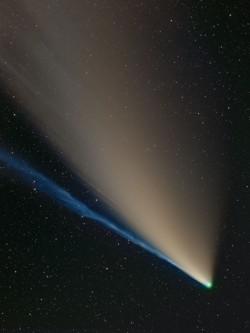
Comet C/2020F3 (Neowise) with separate dust and ion gas tails and a green glowing coma, by Dietmar Gutermuth, Germany
Pie de foto: Second place in the 2021 IAU OAE Astrophotography Contest, category Comets.
Comets have a very interesting structure comprising of four main parts: the nucleus, composed of rock, dust and frozen gases, typically spanning a few kilometres, although bigger ones have been observed; a small atmosphere of gas surrounding the nucleus (only present when the comet approaches its closest point to the Sun), called coma; and the two distinctive cometary tails (there is at times third tail). The green colour of the coma is due to carbon and nitrogen present in the coma reacting with the Sun’s ultraviolet radiation. The tail that we are mostly used to observing – dust tail and is composed of micron sized dust particles, the second tail composed of charged particles – ion or gas tail. The tails are released only when the comet approaches the Sun at a distance where the heat and radiation emanating from our star is intense enough to vaporize the frozen gases. The dust tail is curved, while the gas tail is straight and always points away from the Sun as this is carried by the solar wind - flow of charged particles emitted by the Sun. As comets are formed by leftover material, they carry with them important information about the early stages of the Solar System’s formation. This beautiful image shows the comet C/2020 F3 (Neowise), as seen from Germany in July 2020, with three of the four structures clearly visible – coma, gas, and dust tail.
Crédito: Dietmar Gutermuth/IAU OAE
License: CC-BY-4.0 Creative Commons Reconocimiento 4.0 Internacional (CC BY 4.0) íconos
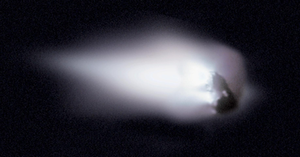
An Encounter With Halley's Comet
Pie de foto: This image shows the solid core, or nucleus, of Halley’s Comet, captured in 1986 by the European Space Agency spacecraft Giotto during its flyby of the comet in the inner Solar System. The nucleus appears irregular and potato-shaped, measuring roughly 15 kilometers (about 9 miles) across, and is composed of a mixture of ice, dust, and rock. Unlike the glowing fuzzy cloud (coma) and long tail that make comets visible from Earth, the nucleus itself is dark and difficult to see until a spacecraft passes close enough to take detailed images.
Halley’s Comet is one of the best-known comets because it returns to the inner Solar System approximately every 76 years, allowing generations of astronomers to observe it repeatedly. The material that is released from the nucleus as the comet warms near the Sun forms a glowing coma and long tails of gas and dust, and over many returns leaves trails of debris that produce meteor showers on Earth, such as the Eta Aquarids in May and the Orionids in October.
Crédito: NASA/ESA/Giotto Project
enlace de crédito
License: PD Dominio público íconos