Terme du glossaire : La chevelure (ou coma) de comète
Description : Lorsqu'une comète s'approche du Soleil, une partie des substances solides liées au noyau glacé de la comète se transforme en gaz. Ce gaz, qui se compose principalement d'eau mais aussi d'autres substances chimiques telles que le monoxyde de carbone, le dioxyde de carbone, l'ammoniac, le méthane et le méthanol, ainsi que des particules de poussière, entoure le noyau comme un nuage sphérique et flou, appelé atmosphère cométaire, chevelure de comète, ou encore coma. À mesure que la comète se rapproche du Soleil, de plus en plus de molécules sont scindées par les photons ultraviolets du Soleil, ce qui chauffe la coma et fait croître ses régions extérieures. Les régions extérieures finissent par être ionisées, formant la queue ionique de la comète.
Termes associés :
Voir ce terme dans d'autres langues
Statut du terme et de sa définition : La définition initiale de ce terme en anglais a été aprouvée par un·e spécialiste de la recherche en astronomie et un·e spécialiste de l’éducation La traduction de ce terme et de sa définition ont été aprouvées par un·e spécialiste de la recherche en astronomie et un·e spécialiste de l’éducation
Le glossaire multilangue de l'OAE est un projet du Bureau de l'IAU de l'Astronomie pour l'Education (OAE) en collaboration avec le Bureau de l'IAU de diffusion de l'Astronomie (OAO). Les termes et définitions ont été choisis, écrits et relues grâce à un effort collectif de l'OAE, les Centres et les Noeuds de l'OAE, les Coordinateurs Nationaux de l'Astronomie pour l'Education de l'OAE(NAECs) et d'autres volontaires. La liste complète des crédits pour ce projet est disponible ici . Tous les termes du glossaire et leur définition sont déposés sous licence Creative Commons CC BY-4.0 et doivent être créditées au nom de "IAU OAE".
Si vous constatez une erreur dans ce terme ou sa définition, veuillez nous contacter .
Dans d'autres langues
- Arabe: هالة المذنب
- Allemand: Koma (Komet)
- Anglais: Cometary Coma
- Espagnol: Coma de un cometa
- Italien: Chioma della cometa
- Japonais: コマ(彗星の) (Liens externes)
- Coréen: 혜성의 코마
- Marathi: धूमकेतूचे वातावरण (कोमा)
- Népalais: धूमकेतुको कोमा
- Portugais brésilien: Coma cometária
- Chinois simplifié: 彗发
- Chinois traditionnel: 彗發
Media associé
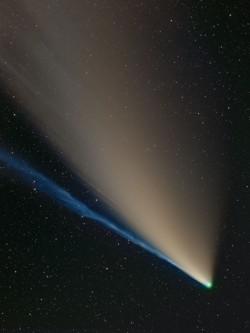
Comet C/2020F3 (Neowise) with separate dust and ion gas tails and a green glowing coma, by Dietmar Gutermuth, Germany
Légende : Second place in the 2021 IAU OAE Astrophotography Contest, category Comets.
Comets have a very interesting structure comprising of four main parts: the nucleus, composed of rock, dust and frozen gases, typically spanning a few kilometres, although bigger ones have been observed; a small atmosphere of gas surrounding the nucleus (only present when the comet approaches its closest point to the Sun), called coma; and the two distinctive cometary tails (there is at times third tail). The green colour of the coma is due to carbon and nitrogen present in the coma reacting with the Sun’s ultraviolet radiation. The tail that we are mostly used to observing – dust tail and is composed of micron sized dust particles, the second tail composed of charged particles – ion or gas tail. The tails are released only when the comet approaches the Sun at a distance where the heat and radiation emanating from our star is intense enough to vaporize the frozen gases. The dust tail is curved, while the gas tail is straight and always points away from the Sun as this is carried by the solar wind - flow of charged particles emitted by the Sun. As comets are formed by leftover material, they carry with them important information about the early stages of the Solar System’s formation. This beautiful image shows the comet C/2020 F3 (Neowise), as seen from Germany in July 2020, with three of the four structures clearly visible – coma, gas, and dust tail.
Crédit : Dietmar Gutermuth/IAU OAE
License: CC-BY-4.0 Creative Commons (CC) Attribution 4.0 International (CC BY 4.0) Icônes
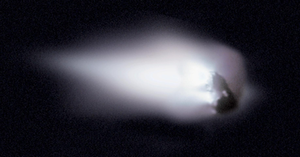
An Encounter With Halley's Comet
Légende : This image shows the solid core, or nucleus, of Halley’s Comet, captured in 1986 by the European Space Agency spacecraft Giotto during its flyby of the comet in the inner Solar System. The nucleus appears irregular and potato-shaped, measuring roughly 15 kilometers (about 9 miles) across, and is composed of a mixture of ice, dust, and rock. Unlike the glowing fuzzy cloud (coma) and long tail that make comets visible from Earth, the nucleus itself is dark and difficult to see until a spacecraft passes close enough to take detailed images.
Halley’s Comet is one of the best-known comets because it returns to the inner Solar System approximately every 76 years, allowing generations of astronomers to observe it repeatedly. The material that is released from the nucleus as the comet warms near the Sun forms a glowing coma and long tails of gas and dust, and over many returns leaves trails of debris that produce meteor showers on Earth, such as the Eta Aquarids in May and the Orionids in October.
Crédit : NASA/ESA/Giotto Project
Lien vers les crédits
License: PD Domaine Public Icônes
Ceci pourrait vous intéresser également








- Ressources
- Moteur de recherche des ressources pédagogiques
- Parcourir les ressources pédagogiques par Sujet
- Parcourir les images
- AstroEdu - Activités en classe
- Grandes Idées - Littéracie en astronomie
- Glossaire
- Rapports de l'OAE
- L'astronomie pour l'Education à travers le monde
- Sélection de ressources externes