Glossary term: 혜성의 코마
Description: 혜성이 태양에 가까워지면, 혜성의 얼음으로 된 핵에 붙어 있던 고체 물질의 일부가 기체로 변합니다. 이 기체는 대부분 물(H₂O)로 이루어져 있지만, 그 안에는 일산화탄소(CO), 이산화탄소(CO₂), 암모니아(NH₃), 메탄(CH₄), 메탄올(CH₃OH) 같은 다른 화학 물질과 먼지 입자도 함께 섞여 있습니다. 이 가스와 먼지는 혜성의 핵 주위를 희미한 구형 구름처럼 둘러싸며, 이것을 혜성의 대기 또는 코마(coma)라고 부릅니다. 혜성이 태양에 점점 더 가까워질수록, 코마 속의 분자들이 태양의 자외선을 받아 분해되고 가열되어, 코마의 바깥쪽 영역이 점점 확장됩니다. 결국 이 외부 영역이 이온화(전하를 띠게 되는 것)되면, 태양 바람에 의해 밀려나 혜성의 ‘이온 꼬리’가 형성됩니다.
Related Terms:
See this term in other languages
Term and definition status: The original definition of this term in English have been approved by a research astronomer and a teacher The translation of this term and its definition is still awaiting approval
The OAE Multilingual Glossary is a project of the IAU Office of Astronomy for Education (OAE) in collaboration with the IAU Office of Astronomy Outreach (OAO). The terms and definitions were chosen, written and reviewed by a collective effort from the OAE, the OAE Centers and Nodes, the OAE National Astronomy Education Coordinators (NAECs) and other volunteers. You can find a full list of credits here. All glossary terms and their definitions are released under a Creative Commons CC BY-4.0 license and should be credited to "IAU OAE".
If you notice a factual or translation error in this glossary term or definition then please get in touch.
In Other Languages
- 아랍어: هالة المذنب
- 독일어: Koma (Komet)
- 영어: Cometary Coma
- 스페인어: Coma de un cometa
- 프랑스어: La chevelure (ou coma) de comète
- 이탈리아어: Chioma della cometa
- 일본어: コマ(彗星の) (external link)
- 마라티어: धूमकेतूचे वातावरण (कोमा)
- 네팔어: धूमकेतुको कोमा
- 브라질 포르투갈어: Coma cometária
- 중국어 간체: 彗发
- 중국어 번체: 彗發
Related Media
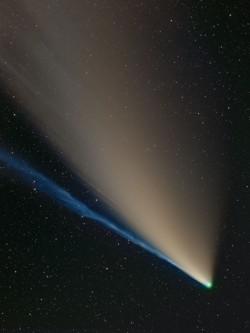
Comet C/2020F3 (Neowise) with separate dust and ion gas tails and a green glowing coma, by Dietmar Gutermuth, Germany
Caption: Second place in the 2021 IAU OAE Astrophotography Contest, category Comets.
Comets have a very interesting structure comprising of four main parts: the nucleus, composed of rock, dust and frozen gases, typically spanning a few kilometres, although bigger ones have been observed; a small atmosphere of gas surrounding the nucleus (only present when the comet approaches its closest point to the Sun), called coma; and the two distinctive cometary tails (there is at times third tail). The green colour of the coma is due to carbon and nitrogen present in the coma reacting with the Sun’s ultraviolet radiation. The tail that we are mostly used to observing – dust tail and is composed of micron sized dust particles, the second tail composed of charged particles – ion or gas tail. The tails are released only when the comet approaches the Sun at a distance where the heat and radiation emanating from our star is intense enough to vaporize the frozen gases. The dust tail is curved, while the gas tail is straight and always points away from the Sun as this is carried by the solar wind - flow of charged particles emitted by the Sun. As comets are formed by leftover material, they carry with them important information about the early stages of the Solar System’s formation. This beautiful image shows the comet C/2020 F3 (Neowise), as seen from Germany in July 2020, with three of the four structures clearly visible – coma, gas, and dust tail.
Credit: Dietmar Gutermuth/IAU OAE
License: CC-BY-4.0 Creative Commons 저작자표시 4.0 국제 (CC BY 4.0) icons
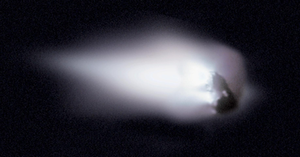
An Encounter With Halley's Comet
Caption: This image shows the solid core, or nucleus, of Halley’s Comet, captured in 1986 by the European Space Agency spacecraft Giotto during its flyby of the comet in the inner Solar System. The nucleus appears irregular and potato-shaped, measuring roughly 15 kilometers (about 9 miles) across, and is composed of a mixture of ice, dust, and rock. Unlike the glowing fuzzy cloud (coma) and long tail that make comets visible from Earth, the nucleus itself is dark and difficult to see until a spacecraft passes close enough to take detailed images.
Halley’s Comet is one of the best-known comets because it returns to the inner Solar System approximately every 76 years, allowing generations of astronomers to observe it repeatedly. The material that is released from the nucleus as the comet warms near the Sun forms a glowing coma and long tails of gas and dust, and over many returns leaves trails of debris that produce meteor showers on Earth, such as the Eta Aquarids in May and the Orionids in October.
Credit: NASA/ESA/Giotto Project
credit link
License: PD Public Domain icons