Término del glosario: Halo
Descripción: Un halo es un fenómeno óptico provocado por los cristales de hielo presentes en la atmósfera terrestre. Al igual que la refracción y la reflexión en las gotas de agua dan lugar a los arcoíris, la luz solar que atraviesa los cristales de hielo se refleja y se refracta en su interior, formando halos. Los halos pueden adoptar muchas formas diferentes y pueden estar provocados por la luz del Sol o de la Luna. El halo de 22 grados es un halo circular que se forma como una delgada banda de luz alrededor del Sol o de la Luna. La geometría de este halo es el resultado de las propiedades de los cristales de hielo por los que pasa la luz solar o lunar en la atmósfera.
El término «halo» también se utiliza en otros contextos astronómicos, como el halo galáctico, el halo de materia oscura y el halo estelar, todos ellos componentes fundamentales de la estructura de las galaxias.
Términos relacionados:
Ver este término en otros idiomas
Estado del término y la definición: La definición original de este término en inglés ha sido aprobada por unastrónomo o astrónoma investigadora y un docente La traducción de este término y su definición aún están pendientes de aprobación
El Glosario multilingüe de la OAE es un proyecto de la Oficina de Astronomía para la Educación de la UAI (OAE) en colaboración con la Oficina de Divulgación de Astronomía de la UAI (OAO). Los términos y definiciones fueron seleccionados, redactados y revisados gracias al esfuerzo colectivo de la OAE, los Centros y Nodos de la OAE, los Coordinadores Nacionales de Educación Astronómica (NAECs) y otros voluntarios. Puedes encontrar una lista completa de créditos aquí. Todos los términos del glosario y sus definiciones se publican bajo la licencia Creative Commons CC BY-4.0 y deben atribuirse a la "IAU OAE".
Si detectas algún error de contenido o de traducción en este término del glosario o en ladefinición, ponte en contacto con nosotros.
Contenidos relacionados
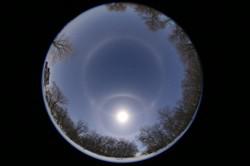
Selene meets the Moon, by Sheila Wiwchar, Canada
Pie de foto: First place in the 2021 IAU OAE Astrophotography Contest, category Sun/Moon haloes.
Photographed at Kaleida, Manitoba in Canada, this fisheye image beautifully captures the rare optical phenomena encircling the moon known as the “22° halo” and the horizontal white circle passing through the moon called the “paraselenic circle”. The white band circling the whole sky at the same altitude as the moon is named after Selene, the ancient Greek Titan, famously called the goddess of the moon. The more commonly observed counterpart produced by the sun is known as the parhelic circle, named after the Greek god of the sun, Helios. Both the 22° halo and the paraselenic circle are produced due to reflection of the moonlight from near vertical surfaces of ice crystals. Parts closer to the moon are caused due to external reflections, whereas those further away are created due to internal reflections. The constellation of the big dipper at the center makes this image even more spectacular. Can you spot it?
Crédito: Sheila Wiwchar/IAU OAE
License: CC-BY-4.0 Creative Commons Reconocimiento 4.0 Internacional (CC BY 4.0) íconos
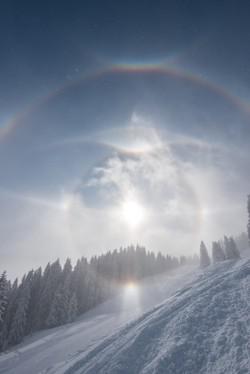
Winter Haloes, by Thomas Gigl, Germany
Pie de foto: Second place in the 2021 IAU OAE Astrophotography Contest, category Sun/Moon haloes.
Captured in Jochberg located in the famous Austrian ski-region of Tirol, this image shows multiple features related to ice halos, which are a more common appearance around the sun, due to its brightness, than the moon. External and internal reflection of sun rays from ice crystal faces and within different types of ice crystals lead to these halo related phenomena. The 22° halo encircles the sun, with two bright spots at the edge called Sundogs, Parhelia or Mock Suns observed to the left and right at the same height as the sun. The horizontal white band called the parhelic circle, named after the sun god Helios, passes through the sun and the Sundogs at the same angular elevation. An Upper tangent arc, a suncave parry arc and a lower tangent arc are also seen touching the top and bottom of the 22° halo. An upside down rainbow like arc or the circumzenithal arc is seen touching the bright supralateral arc, both of which are less frequently observed.
Crédito: Thomas Gigl/IAU OAE
License: CC-BY-4.0 Creative Commons Reconocimiento 4.0 Internacional (CC BY 4.0) íconos
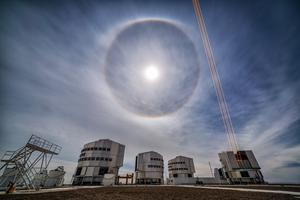
ESO's Very Large Telescope (VLT) at Paranal Observatory with a lunar halo
Pie de foto: The Very Large Telescope on Cerro Paranal in Chile has four reflecting telescopes each with a primary mirror 8.2m across. In this image one dome is open and firing laser beams into the sky. These lasers create artificial stars in the sky that can be used to adjust the telescope optics to remove the blurring effect of the Earth's atmosphere. This process is known as adaptive optics.
In the sky the Moon is surrounded by a bright halo. This is caused by light from the moon reflecting inside ice crystals in the Earth's atmosphere.
Crédito: Juan Carlos Muñoz-Mateos/ESO
enlace de crédito
License: CC-BY-4.0 Creative Commons Reconocimiento 4.0 Internacional (CC BY 4.0) íconos
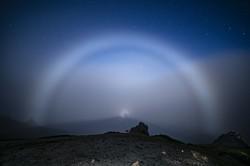
Lunar rainbow and lunar Brocken spectre, by Kouji Ohnishi, Japan
Pie de foto: Third place in the 2021 IAU OAE Astrophotography Contest, category Sun/Moon haloes.
This stunning photograph of the lunar rainbow and the lunar Brocken Spectre amidst the night sky was captured from Mount Tsubakuro located in Japan’s Hida Mountains in Nagano. Both these atmospheric occurrences are due to the moon’s light being reflected and refracted from water droplets. A lunar rainbow or a moonbow is a rare phenomenon that occurs with the right settings of a bright full moon which is less than 42° high, rain on the opposite side of the moon and a dark night sky. The Brocken Spectre is named after the highest peak of the Harz mountain range in Germany, where it was first recorded. Here it is seen from the summit as a magnified shadow of the observer cast onto the cloud surrounded by a glory consisting of concentric circles centered at the point directly opposite the bright moon in the background.
Crédito: Kouji Ohnishi/IAU OAE
License: CC-BY-4.0 Creative Commons Reconocimiento 4.0 Internacional (CC BY 4.0) íconos