Término del glosario: Arcoíris
Descripción: El enorme arco con franjas concéntricas en los colores violeta, índigo, azul, verde, amarillo, naranja y rojo, que se extiende por el cielo y suele verse después de llover, se denomina arcoíris. Cuando un observador ve un arcoíris, el Sol se encuentra a sus espaldas. Un arcoíris se produce porque las pequeñas gotas de agua en el aire descomponen la luz solar blanca en el espectro de colores mediante un proceso llamado dispersión debido a la refracción; esto es similar a cómo funciona un prisma. En un arcoíris normal, la luz se refleja una vez dentro de las gotas de agua, además de dispersarse mediante la refracción.
A veces se pueden ver dos arcoíris anidados, en los que los colores del segundo arcoíris aparecen en orden inverso. El interior, más brillante, se denomina arcoíris primario, mientras que el exterior, más tenue, es el arcoíris secundario. Este fenómeno del arcoíris doble es relativamente poco común. El arcoíris secundario se produce cuando la luz se refleja dos veces dentro de las gotitas de agua, además de refractarse.
Términos relacionados:
Ver este término en otros idiomas
Estado del término y la definición: La definición original de este término en inglés ha sido aprobada por unastrónomo o astrónoma investigadora y un docente La traducción de este término y su definición aún están pendientes de aprobación
El Glosario multilingüe de la OAE es un proyecto de la Oficina de Astronomía para la Educación de la UAI (OAE) en colaboración con la Oficina de Divulgación de Astronomía de la UAI (OAO). Los términos y definiciones fueron seleccionados, redactados y revisados gracias al esfuerzo colectivo de la OAE, los Centros y Nodos de la OAE, los Coordinadores Nacionales de Educación Astronómica (NAECs) y otros voluntarios. Puedes encontrar una lista completa de créditos aquí. Todos los términos del glosario y sus definiciones se publican bajo la licencia Creative Commons CC BY-4.0 y deben atribuirse a la "IAU OAE".
Si detectas algún error de contenido o de traducción en este término del glosario o en ladefinición, ponte en contacto con nosotros.
En otros idiomas
- Árabe: قوس قزح
- Alemán: Regenbogen
- Inglés: Rainbow
- Francés: Arc-en-ciel
- Italiano: Arcobaleno
- Portugués de Brasil: Arco-íris
- Chino simplificado: 彩虹
- Chino tradicional: 彩虹
Contenidos relacionados
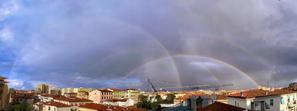
24 Hours of Rainbow
Pie de foto: Honorable mention in the 2023 IAU OAE Astrophotography Contest, category of Still images taken exclusively with smartphones/mobile devices.
This panoramic view taken with a smartphone of Livorno, Italy, showcases a series of vivid rainbows captured on three different days in December 2021. Rainbows are the result of sunlight being refracted by water droplets suspended in the air, typically after rainfall or during misty conditions. The water droplets act like a prism, breaking up (refracting) the sunlight into the various colours. The different wavelengths of light are refracted by different amounts, which is why we see this layering of colours. The photographer skillfully merged the most remarkable shots taken on different days to highlight the diverse sizes and brilliance of these rainbows. The locations at which the rainbows appear to be centred are different because each rainbow appeared when the Sun was at a different position in the sky. This composite image beautifully captures the transient yet mesmerising allure of rainbows, illustrating their fleeting appearance and gradual dissipation influenced by the shifting atmospheric conditions.
Crédito: Fabrizio Guasconi/IAU OAE (CC BY 4.0)
License: CC-BY-4.0 Creative Commons Reconocimiento 4.0 Internacional (CC BY 4.0) íconos
Actividades relacionadas
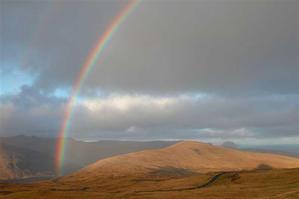
Reading the Rainbow
astroEDU educational activity (links to astroEDU website) Description: By understanding how rainbows work, you can discover about light and its properties, learning about stars, nebulae, galaxies, and our Universe.
License: CC-BY-4.0 Creative Commons Reconocimiento 4.0 Internacional (CC BY 4.0) íconos
Rango de edades:
14-16
, 16-19
, 19+
Nivel educativo:
Educación no forma
, Educación secundaria
, Secondary
, Universitario
Áreas de aprendizaje:
Clase interactiva
, Basado en la observación
, Aprendizaje basado en la investigación estructurada
Costos:
Bajo coste
Duración:
1 hora y 30 minutos
Tamaño del grupo:
Grupo
Competencias:
Analizar e interpretar datos
, Plantear preguntas
, Participar en debates basados en pruebas