Término del glosario: Trayectoria del Sol (arco diurno)
Descripción: La trayectoria del Sol, o arco diurno, describe el movimiento aparente del Sol en el cielo, tal y como lo observa un observador situado en un punto fijo de la Tierra. Cada día, esta trayectoria traza un arco que comienza con la salida del Sol en la parte oriental del cielo y termina con la puesta del Sol en la parte occidental. Solo en los equinoccios de primavera y otoño el Sol sale exactamente por el este y se pone exactamente por el oeste. En el solsticio de invierno, el arco es más corto y se sitúa más bajo en el cielo. A partir de entonces, la longitud de ese arco —y con ella la duración del día— aumenta, y cada arco sucesivo se sitúa más alto en el cielo que el del día anterior, alcanzando su máxima altura y la máxima duración del día en el solsticio de verano. Este proceso se repite luego en orden inverso, llegando de nuevo al arco más corto y más bajo en el solsticio de invierno.
Al norte del Círculo Polar Ártico y al sur del Círculo Polar Antártico, el Sol no sale durante largos períodos en invierno ni se pone durante largos períodos en verano. Por lo tanto, pueden tener noches que duran varios meses en invierno y días que duran varios meses en verano. Durante uno de estos días polares, el Sol recorre el cielo en un círculo, desplazándose desde un punto alto al mediodía hasta un punto bajo a medianoche sin cruzar nunca el horizonte.
El conjunto de arcos solares puede captarse en una imagen de exposición prolongada denominada «solarigrafía».
Términos relacionados:
Ver este término en otros idiomas
Estado del término y la definición: La definición original de este término en inglés ha sido aprobada por unastrónomo o astrónoma investigadora y un docente La traducción de este término y su definición aún están pendientes de aprobación
El Glosario multilingüe de la OAE es un proyecto de la Oficina de Astronomía para la Educación de la UAI (OAE) en colaboración con la Oficina de Divulgación de Astronomía de la UAI (OAO). Los términos y definiciones fueron seleccionados, redactados y revisados gracias al esfuerzo colectivo de la OAE, los Centros y Nodos de la OAE, los Coordinadores Nacionales de Educación Astronómica (NAECs) y otros voluntarios. Puedes encontrar una lista completa de créditos aquí. Todos los términos del glosario y sus definiciones se publican bajo la licencia Creative Commons CC BY-4.0 y deben atribuirse a la "IAU OAE".
Si detectas algún error de contenido o de traducción en este término del glosario o en ladefinición, ponte en contacto con nosotros.
En otros idiomas
- Árabe: مسار الشمس (قوس النهار)
- Alemán: Sonnenbahn (Tagbogen)
- Inglés: Sun Path (Day Arc)
- Persa: مسیر خورشید (قوس روزانه)
- Francés: Trajectoire du soleil (Arc diurne)
- Italiano: Percorso del sole (arco diurno)
- Coreano: 태양경로(일호)
- Nepalí: सूर्यपथः/ (दिवसचाप)
- Portugués de Brasil: Trajetória do Sol (Arco Diurno)
- Chino simplificado: 太阳路径(日弧)
- Chino tradicional: 太陽路徑(日弧)
Contenidos relacionados
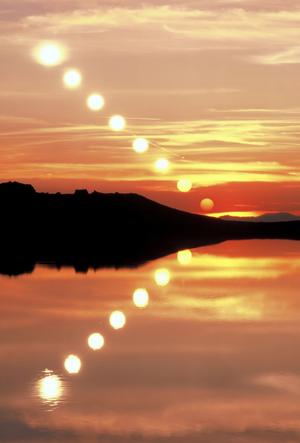
The Last Hour of the Day
Pie de foto: Honorable mention in the 2023 IAU OAE Astrophotography Contest, category of Still images of day arcs of the Sun and Solargraphs.
This image, taken on 2 May 1997 at Lake Scaffaiolo in Italy, masterfully captures the Sun's descent in a sequence of mirrored reflections on the placid waters. Its breathtaking representation of time showcases the serene beauty of the surroundings, and stands as a timeless testament to the fleeting moments of the day’s final hour.
Crédito: Fabrizio Melandri/IAU OAE (CC BY 4.0)
License: CC-BY-4.0 Creative Commons Reconocimiento 4.0 Internacional (CC BY 4.0) íconos
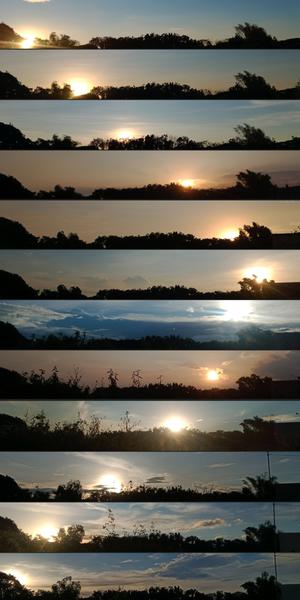
Where the Sun Sets Every Month
Pie de foto: Third place winner in the 2023 IAU OAE Astrophotography Contest, category of Still images of sunrise and sunset location over the year.
Taken with a smartphone from San Rafael, Bulacan, Philippines, this series of images capture the changing position of sunset over the year owing to Earth’s axial tilt and orbit around the Sun. From January to December 2022, each image reflects the changing backdrop and position of the Sun at dusk. Observe the changing foliage and the appearance of an electricity pole in October. This collection serves as a visual testament to the celestial dance between Earth and the Sun, and the natural transformations on the ground.
Crédito: John Paul Pile/IAU OAE (CC BY 4.0)
License: CC-BY-4.0 Creative Commons Reconocimiento 4.0 Internacional (CC BY 4.0) íconos
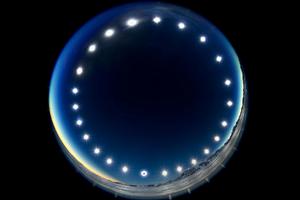
The Eclipse Clock-Eclipse on a Polar Day
Pie de foto: First place winner in the 2023 IAU OAE Astrophotography Contest, category of Still images of day arcs of the Sun and Solargraphs.
Constructed by combining multiple images over the course of a 24-hour period, the image was captured in Union Glacier, Antarctica, during the total solar eclipse of 4 December 2021, and showcases the day arc of the Sun. It illustrates the unique phenomenon of a polar day, during which the Sun travels around the sky without setting. During polar days, areas within the polar circles experience 24 hours of continuous daylight, and the Sun doesn’t set for an extended period. The image also offers a rare perspective of a solar eclipse, where the Moon passes between the Sun and Earth, and as viewed from Earth. This can be seen in the lower image of the Sun, where the Moon covers the solar disc.
Crédito: Stephanie Ziyi Ye/IAU OAE (CC BY 4.0)
License: CC-BY-4.0 Creative Commons Reconocimiento 4.0 Internacional (CC BY 4.0) íconos
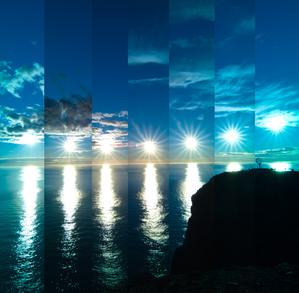
When the Sun Bounces
Pie de foto: First place winner in the 2023 IAU OAE Astrophotography Contest, category of Still images of sunrise and sunset location over the year.
This image was taken at Norway's North Cape. Owing to the latitude of this location, the Sun never truly sets during the summer months, from around April to August. This results in the unique spectacle of continuous daylight, known as a polar day. This captivating series of images, taken in 2022, showcases the Sun's relentless journey across the horizon every 30 minutes. At its lowest point in the sky, the Sun does not set, but appears to bounce off the horizon. The globe on the far right in the photo stands as a sentinel, marking the northernmost point of the European continental mainland.
Crédito: Milos Obert/IAU OAE (CC BY 4.0)
License: CC-BY-4.0 Creative Commons Reconocimiento 4.0 Internacional (CC BY 4.0) íconos
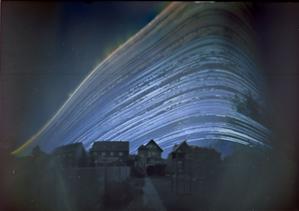
The Path of the Sun
Pie de foto: Second place winner in the 2023 IAU OAE Astrophotography Contest, category of Still images of day arcs of the Sun and Solargraphs.
This enchanting image, captured in Germany between 21 June 2018 and 21 December 2018, is a poetic blend of art and science, showcasing nature's rhythm and the passage of time. It combines images taken at different times of day over the course of six months. Each curve tracks the Sun’s path (or arc) across the sky on a particular day. The sweeping arc of the Sun is distorted here by the projection, making it appear like a curve. The position of the daily arc across the sky changes with the Sun’s seasonal movement in the sky. Captured using a simple pinhole camera fashioned from a coffee can, it shows the Sun's journey over the course of six months, and the gradual shift of the daily arc from the summer, when it is higher in the sky, to its lowest arc at the winter solstice. Gaps in the Sun’s path represent days or times of day when the Sun was obscured by clouds. This image is a vivid testament to the changing seasons, revealing the Sun's dance in the sky as days grow shorter or longer.
Crédito: Frank Niessen/IAU OAE (CC BY 4.0)
License: CC-BY-4.0 Creative Commons Reconocimiento 4.0 Internacional (CC BY 4.0) íconos