Glossary term: सूर्यपथः/ (दिवसचाप)
Description: सूर्यपथ वा दिन चापले पृथ्वीको एक निश्चित स्थानमा रहेको पर्यवेक्षकले देख्ने आकाशमा सूर्यको स्पष्ट गतिलाई जनाउँछ। प्रत्येक दिन, यो पथले एउटा चाप बनाउँछ, जुन आकाशको पूर्वी भागमा सूर्योदयबाट सुरु हुन्छ र पश्चिमी भागमा सूर्यास्तसँगै समाप्त हुन्छ। वसन्त र शरद विषुव (equinox) मा मात्र सूर्य ठ्याक्कै पूर्वबाट उदाउँछ र ठ्याक्कै पश्चिममा अस्ताउँछ। हिउँदको संक्रान्ति (winter solstice) मा, यो चाप सबैभन्दा छोटो र आकाशमा सबैभन्दा तल्लो हुन्छ। त्यसपछि, त्यो चापको लम्बाइ, र यससँगै दिनको लम्बाइ बढ्दै जान्छ, र प्रत्येक क्रमिक चाप अघिल्लो दिनको तुलनामा आकाशमा उच्च हुन्छ, गर्मीको संक्रान्ति (summer solstice) मा अधिकतम उचाइ र अधिकतम दिनको लम्बाइमा पुग्छ। यो प्रक्रिया त्यसपछि उल्टो क्रममा दोहोरिन्छ, फेरि हिउँदको संक्रान्तिमा सबैभन्दा छोटो, सबैभन्दा तल्लो चापमा पुग्छ।
आर्कटिक सर्कलको उत्तर र अन्टार्कटिक सर्कलको दक्षिणमा हिउँदमा लामो समयसम्म सूर्योदय हुँदैन वा गर्मीमा लामो समयसम्म सूर्यास्त हुँदैन। त्यसैले, तिनीहरूमा हिउँदमा धेरै महिनासम्म रात रहन्छ र गर्मीमा दिनहरूपनि धेरै महिनासम्म रहन सक्छन्। यी ध्रुवीय दिनहरूमध्ये एकमा सूर्य आकाशमा वृत्तमा यात्रा गर्छ, मध्यदिनमा उच्च बिन्दुबाट मध्यरातमा तल्लो बिन्दुमा सर्छ र कहिल्यै क्षितिज पार गर्दैन।
सौर्य चापहरूको समूहलाई सोलारग्राफ भनिने लामो अवधिको एक्सपोजर मा फोटो खिच्न सकिन्छ।
Related Terms:
See this term in other languages
Term and definition status: The original definition of this term in English have been approved by a research astronomer and a teacher The translation of this term and its definition is still awaiting approval
The OAE Multilingual Glossary is a project of the IAU Office of Astronomy for Education (OAE) in collaboration with the IAU Office of Astronomy Outreach (OAO). The terms and definitions were chosen, written and reviewed by a collective effort from the OAE, the OAE Centers and Nodes, the OAE National Astronomy Education Coordinators (NAECs) and other volunteers. You can find a full list of credits here. All glossary terms and their definitions are released under a Creative Commons CC BY-4.0 license and should be credited to "IAU OAE".
If you notice a factual or translation error in this glossary term or definition then please get in touch.
In Other Languages
- अरबिक: مسار الشمس (قوس النهار)
- जर्मन: Sonnenbahn (Tagbogen)
- अंग्रेजी: Sun Path (Day Arc)
- स्पेनिस: Trayectoria del Sol (arco diurno)
- फारसी: مسیر خورشید (قوس روزانه)
- फ्रान्सेली: Trajectoire du soleil (Arc diurne)
- ईटालियन: Percorso del sole (arco diurno)
- कोरियाली: 태양경로(일호)
- ब्राजिली पुर्तगाली: Trajetória do Sol (Arco Diurno)
- सरल चिनि: 太阳路径(日弧)
- प्राचिन चिनि: 太陽路徑(日弧)
Related Media
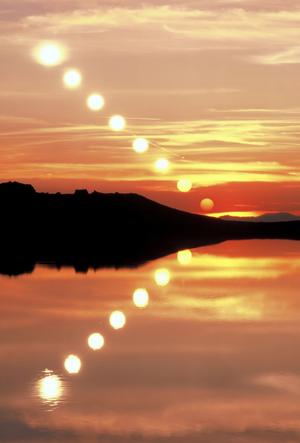
The Last Hour of the Day
Caption: Honorable mention in the 2023 IAU OAE Astrophotography Contest, category of Still images of day arcs of the Sun and Solargraphs.
This image, taken on 2 May 1997 at Lake Scaffaiolo in Italy, masterfully captures the Sun's descent in a sequence of mirrored reflections on the placid waters. Its breathtaking representation of time showcases the serene beauty of the surroundings, and stands as a timeless testament to the fleeting moments of the day’s final hour.
Credit: Fabrizio Melandri/IAU OAE (CC BY 4.0)
License: CC-BY-4.0 Creative Commons Attribution 4.0 International (CC BY 4.0) icons
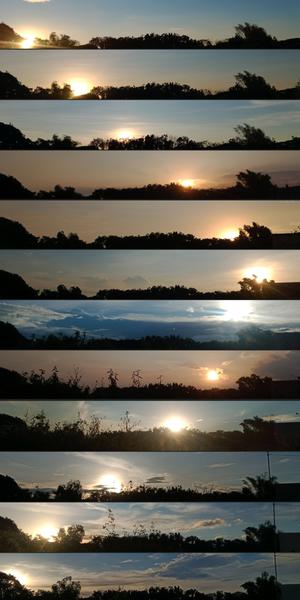
Where the Sun Sets Every Month
Caption: Third place winner in the 2023 IAU OAE Astrophotography Contest, category of Still images of sunrise and sunset location over the year.
Taken with a smartphone from San Rafael, Bulacan, Philippines, this series of images capture the changing position of sunset over the year owing to Earth’s axial tilt and orbit around the Sun. From January to December 2022, each image reflects the changing backdrop and position of the Sun at dusk. Observe the changing foliage and the appearance of an electricity pole in October. This collection serves as a visual testament to the celestial dance between Earth and the Sun, and the natural transformations on the ground.
Credit: John Paul Pile/IAU OAE (CC BY 4.0)
License: CC-BY-4.0 Creative Commons Attribution 4.0 International (CC BY 4.0) icons
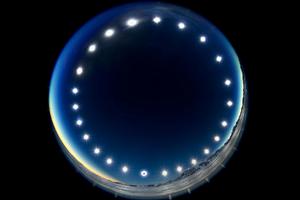
The Eclipse Clock-Eclipse on a Polar Day
Caption: First place winner in the 2023 IAU OAE Astrophotography Contest, category of Still images of day arcs of the Sun and Solargraphs.
Constructed by combining multiple images over the course of a 24-hour period, the image was captured in Union Glacier, Antarctica, during the total solar eclipse of 4 December 2021, and showcases the day arc of the Sun. It illustrates the unique phenomenon of a polar day, during which the Sun travels around the sky without setting. During polar days, areas within the polar circles experience 24 hours of continuous daylight, and the Sun doesn’t set for an extended period. The image also offers a rare perspective of a solar eclipse, where the Moon passes between the Sun and Earth, and as viewed from Earth. This can be seen in the lower image of the Sun, where the Moon covers the solar disc.
Credit: Stephanie Ziyi Ye/IAU OAE (CC BY 4.0)
License: CC-BY-4.0 Creative Commons Attribution 4.0 International (CC BY 4.0) icons

When the Sun Bounces
Caption: First place winner in the 2023 IAU OAE Astrophotography Contest, category of Still images of sunrise and sunset location over the year.
This image was taken at Norway's North Cape. Owing to the latitude of this location, the Sun never truly sets during the summer months, from around April to August. This results in the unique spectacle of continuous daylight, known as a polar day. This captivating series of images, taken in 2022, showcases the Sun's relentless journey across the horizon every 30 minutes. At its lowest point in the sky, the Sun does not set, but appears to bounce off the horizon. The globe on the far right in the photo stands as a sentinel, marking the northernmost point of the European continental mainland.
Credit: Milos Obert/IAU OAE (CC BY 4.0)
License: CC-BY-4.0 Creative Commons Attribution 4.0 International (CC BY 4.0) icons
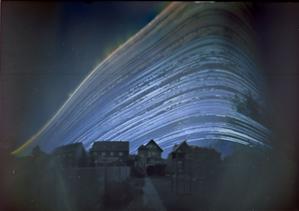
The Path of the Sun
Caption: Second place winner in the 2023 IAU OAE Astrophotography Contest, category of Still images of day arcs of the Sun and Solargraphs.
This enchanting image, captured in Germany between 21 June 2018 and 21 December 2018, is a poetic blend of art and science, showcasing nature's rhythm and the passage of time. It combines images taken at different times of day over the course of six months. Each curve tracks the Sun’s path (or arc) across the sky on a particular day. The sweeping arc of the Sun is distorted here by the projection, making it appear like a curve. The position of the daily arc across the sky changes with the Sun’s seasonal movement in the sky. Captured using a simple pinhole camera fashioned from a coffee can, it shows the Sun's journey over the course of six months, and the gradual shift of the daily arc from the summer, when it is higher in the sky, to its lowest arc at the winter solstice. Gaps in the Sun’s path represent days or times of day when the Sun was obscured by clouds. This image is a vivid testament to the changing seasons, revealing the Sun's dance in the sky as days grow shorter or longer.
Credit: Frank Niessen/IAU OAE (CC BY 4.0)
License: CC-BY-4.0 Creative Commons Attribution 4.0 International (CC BY 4.0) icons