Término del glosario: Fase
Descripción: En astronomía, el término «fase» se refiere al estado de iluminación parcial de una luna o un planeta con respecto a un observador concreto. Una fuente de luz lejana suele iluminar solo la mitad de la superficie de un cuerpo esférico; el resto permanece a oscuras. Del mismo modo, solo aproximadamente la mitad de la superficie de un cuerpo esférico se encuentra dentro del campo de visión de un observador lejano. La fase especifica qué fracción de la superficie que se encuentra dentro del campo de visión del observador está iluminada. Cambia a medida que varían las posiciones relativas del objeto, el observador y la fuente de luz.
Los ejemplos más conocidos son las fases de la Luna. Las posiciones relativas de la Luna, de la Tierra como ubicación del observador y del Sol como fuente de luz cambian a medida que la Luna orbita alrededor de la Tierra a lo largo de aproximadamente un mes. Por lo tanto, durante ese tiempo, un observador en la Tierra verá diferentes fases de la Luna. La fase en la que toda la superficie de la Luna que se encuentra en el campo de visión del observador está iluminada se denomina «Luna llena»; cuando no se ven regiones iluminadas de la superficie, tenemos «Luna nueva». Las dos fases en las que la superficie está iluminada a la mitad se denominan «primer cuarto» y «segundo cuarto», respectivamente. Cuando la iluminación es inferior a la mitad, se forma una «media luna».
Las fases también se observan en los planetas del Sistema Solar (son especialmente evidentes en Mercurio y Venus) y se han deducido para sistemas de exoplanetas. En el caso de la Luna, ni siquiera las regiones no iluminadas están completamente a oscuras: reflejan la luz que les llega desde la Tierra, en un fenómeno conocido como «resplandor terrestre», documentado por primera vez por Leonardo da Vinci.
Términos relacionados:
Ver este término en otros idiomas
Estado del término y la definición: La definición original de este término en inglés ha sido aprobada por unastrónomo o astrónoma investigadora y un docente La traducción de este término y su definición aún están pendientes de aprobación
El Glosario multilingüe de la OAE es un proyecto de la Oficina de Astronomía para la Educación de la UAI (OAE) en colaboración con la Oficina de Divulgación de Astronomía de la UAI (OAO). Los términos y definiciones fueron seleccionados, redactados y revisados gracias al esfuerzo colectivo de la OAE, los Centros y Nodos de la OAE, los Coordinadores Nacionales de Educación Astronómica (NAECs) y otros voluntarios. Puedes encontrar una lista completa de créditos aquí. Todos los términos del glosario y sus definiciones se publican bajo la licencia Creative Commons CC BY-4.0 y deben atribuirse a la "IAU OAE".
Si detectas algún error de contenido o de traducción en este término del glosario o en ladefinición, ponte en contacto con nosotros.
Contenidos relacionados
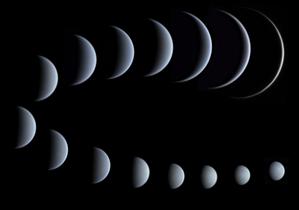
A Matter of Perspective
Pie de foto: Second place winner in the 2023 IAU OAE Astrophotography Contest, category of Still images of phases of Venus.
This exquisite series of images, captured from Santo Domingo, Dominican Republic, between 17 December 2019 and 25 May 2020, shows the phases of Venus as seen from Earth. As Venus and Earth orbit the Sun, we observe different portions of Venus’s sunlit half, similar to the Moon’s phases. The sequence clearly shows Venus as distant, small, bright and gibbous in the lower frames, and ends with Venus reaching the biggest apparent size of all planets (upper frames), very close to the Sun with a small elongation, and appearing as a thin crescent. In the last frame, only 2.8% of the planet’s surface is illuminated.
Crédito: Christofer Baez/IAU OAE (CC BY 4.0)
License: CC-BY-4.0 Creative Commons Reconocimiento 4.0 Internacional (CC BY 4.0) íconos
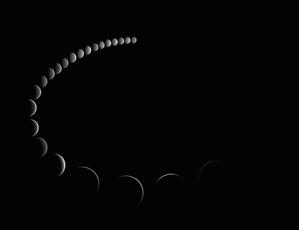
Phases of Venus
Pie de foto: First place winner in the 2023 IAU OAE Astrophotography Contest, category of Still images of phases of Venus.
This is a mesmerising series of images of Venus captured from Surgères, Charente-Maritime, France, over a period of six months in 2015. The phases appear similar to the phases we see of our own Moon and occur for similar reasons. Only half of Venus is illuminated by the Sun and, from Earth, we can sometimes only see part of that illuminated half, depending on the relative positions of the Sun, Earth and Venus. Both Mercury and Venus exhibit phases because their orbit is between the Sun and the orbit of Earth. Depending on the position of Venus relative to the Sun and Earth, Venus goes through its phases over a period of time. This sequence of images beautifully showcases the transition from the ‘gibbous’ to the slender crescents. The use of infrared filters helped to capture Venus's dense perpetual cloud cover during daylight in sharp detail, providing a glimpse into the mysterious nature of the planet’s atmosphere.
Crédito: Stephane Gonzales/IAU OAE (CC BY 4.0)
License: CC-BY-4.0 Creative Commons Reconocimiento 4.0 Internacional (CC BY 4.0) íconos
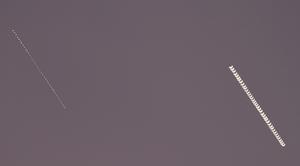
Venus and Mercury Trails
Pie de foto: Honorable mention in the 2023 IAU OAE Astrophotography Contest, category of Still images of phases of Venus.
In this composite image, both Mercury (left) and Venus (right) can be seen heading into the sunset. The phases of each are beautifully captured as they descend. Not all planets or moons in the Solar System show phases as viewed from Earth. This phenomenon occurs because the orbits of Venus and Mercury are positioned between Earth’s orbit and the Sun, sometimes allowing us to see only part of the illuminated portion of each planet. These phases are similar to the phases we see of our own Moon.
Crédito: Marcella Giulia Pace (CC BY 4.0)
License: CC-BY-4.0 Creative Commons Reconocimiento 4.0 Internacional (CC BY 4.0) íconos