Glossary term: 위상
Description: 천문학에서 ‘위상(phase)’은 달이나 행성처럼 스스로 빛을 내지 않는 천체가 관측자에게 어떻게 비춰지는가, 즉 보이는 밝은 부분의 형태를 말합니다. 멀리 떨어진 광원(예: 태양)은 구형 천체 표면의 절반만 밝게 비춥니다. 그리고 관찰자가 보는 시야에서도 천체의 절반만 볼 수 있습니다. 따라서 위상은 관찰자의 위치에서 볼 때, 천체 표면의 어느 부분이 빛을 받고 있는가를 나타냅니다. 이 위상은 천체, 관찰자, 광원의 상대적인 위치에 따라 달라집니다.
가장 잘 알려진 예는 달의 위상 변화입니다. 달은 약 한 달 동안 지구 주위를 공전하면서 광원인 태양과 관찰자인 지구 사이의 위치 관계가 계속 바뀝니다. 그 결과, 지구에서는 달의 밝은 부분이 매일 다르게 보이게 됩니다. 달의 보이는 면 전체가 밝게 비출 때를 보름달, 밝은 부분이 보이지 않을 때를 신월(또는 삭)이라고 합니다. 달의 절반이 비출 때를 반달(상현달, 하현달)이라고 하고, 초승달과 그믐달은 밝은 부분이 절반보다 적을 때를 말합니다.
이런 위상 변화는 달뿐만 아니라 태양계의 다른 행성들, 특히 수성과 금성에서도 관찰됩니다. 심지어 외계 행성계의 행성에서도 비슷한 현상이 일어날 수 있습니다. 또한 달의 어두운 부분은 완전히 검게 보이지 않을 때가 있습니다. 이는 ‘지구반사광(Earthshine)’ 때문으로, 지구에서 반사된 빛이 달의 어두운 쪽을 은은하게 비추기 때문입니다. 이 현상은 레오나르도 다 빈치가 처음으로 기록했습니다.
Related Terms:
See this term in other languages
Term and definition status: The original definition of this term in English have been approved by a research astronomer and a teacher The translation of this term and its definition is still awaiting approval
The OAE Multilingual Glossary is a project of the IAU Office of Astronomy for Education (OAE) in collaboration with the IAU Office of Astronomy Outreach (OAO). The terms and definitions were chosen, written and reviewed by a collective effort from the OAE, the OAE Centers and Nodes, the OAE National Astronomy Education Coordinators (NAECs) and other volunteers. You can find a full list of credits here. All glossary terms and their definitions are released under a Creative Commons CC BY-4.0 license and should be credited to "IAU OAE".
If you notice a factual or translation error in this glossary term or definition then please get in touch.
Related Media
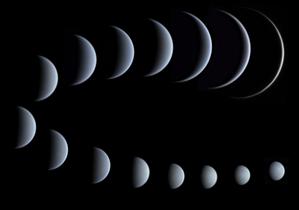
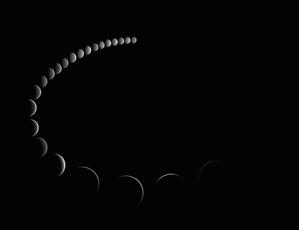
A Matter of Perspective
Caption: Second place winner in the 2023 IAU OAE Astrophotography Contest, category of Still images of phases of Venus.
This exquisite series of images, captured from Santo Domingo, Dominican Republic, between 17 December 2019 and 25 May 2020, shows the phases of Venus as seen from Earth. As Venus and Earth orbit the Sun, we observe different portions of Venus’s sunlit half, similar to the Moon’s phases. The sequence clearly shows Venus as distant, small, bright and gibbous in the lower frames, and ends with Venus reaching the biggest apparent size of all planets (upper frames), very close to the Sun with a small elongation, and appearing as a thin crescent. In the last frame, only 2.8% of the planet’s surface is illuminated.
Credit: Christofer Baez/IAU OAE (CC BY 4.0)
License: CC-BY-4.0 Creative Commons 저작자표시 4.0 국제 (CC BY 4.0) icons
Phases of Venus
Caption: First place winner in the 2023 IAU OAE Astrophotography Contest, category of Still images of phases of Venus.
This is a mesmerising series of images of Venus captured from Surgères, Charente-Maritime, France, over a period of six months in 2015. The phases appear similar to the phases we see of our own Moon and occur for similar reasons. Only half of Venus is illuminated by the Sun and, from Earth, we can sometimes only see part of that illuminated half, depending on the relative positions of the Sun, Earth and Venus. Both Mercury and Venus exhibit phases because their orbit is between the Sun and the orbit of Earth. Depending on the position of Venus relative to the Sun and Earth, Venus goes through its phases over a period of time. This sequence of images beautifully showcases the transition from the ‘gibbous’ to the slender crescents. The use of infrared filters helped to capture Venus's dense perpetual cloud cover during daylight in sharp detail, providing a glimpse into the mysterious nature of the planet’s atmosphere.
Credit: Stephane Gonzales/IAU OAE (CC BY 4.0)
License: CC-BY-4.0 Creative Commons 저작자표시 4.0 국제 (CC BY 4.0) icons
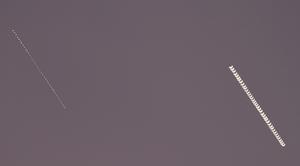
Venus and Mercury Trails
Caption: Honorable mention in the 2023 IAU OAE Astrophotography Contest, category of Still images of phases of Venus.
In this composite image, both Mercury (left) and Venus (right) can be seen heading into the sunset. The phases of each are beautifully captured as they descend. Not all planets or moons in the Solar System show phases as viewed from Earth. This phenomenon occurs because the orbits of Venus and Mercury are positioned between Earth’s orbit and the Sun, sometimes allowing us to see only part of the illuminated portion of each planet. These phases are similar to the phases we see of our own Moon.
Credit: Marcella Giulia Pace (CC BY 4.0)
License: CC-BY-4.0 Creative Commons 저작자표시 4.0 국제 (CC BY 4.0) icons