Termo do glossário: Fase
Descrição: Na astronomia, a fase refere-se ao estado de iluminação parcial de uma lua ou planeta em relação a um observador específico. Uma fonte de luz distante normalmente ilumina apenas metade da superfície de um corpo esférico; o restante permanece escuro. Da mesma forma, apenas cerca de metade da superfície de um corpo esférico está dentro do campo de visão de um observador distante. A fase indica qual fração da superfície visível ao observador está iluminada. Ela muda à medida que se alteram as posições relativas do objeto, do observador e da fonte de luz.
Os exemplos mais conhecidos são as fases da Lua. As posições relativas da Lua, da Terra (como local do observador) e do Sol (como fonte de luz) mudam à medida que a Lua orbita a Terra ao longo de cerca de um mês. Portanto, durante esse período, um observador na Terra verá diferentes fases da Lua. A fase em que toda a porção visível da Lua está iluminada é chamada de Lua Cheia. Quando nenhuma região iluminada pode ser vista, temos a Lua Nova. As duas fases em que metade do disco lunar visível aparece iluminada são denominadas Quarto Crescente e Quarto Minguante, respectivamente. Quando menos da metade da superfície visível está iluminada, a Lua encontra-se na fase de Lua Crescente ou Lua Minguante, dependendo de a área iluminada estar aumentando ou diminuindo.
As fases também são observadas nos planetas do Sistema Solar (particularmente evidentes em Mercúrio e Vênus) e foram inferidas para sistemas de exoplanetas. No caso da Lua, mesmo as regiões não iluminadas diretamente pelo Sol não ficam completamente escuras, pois refletem a luz proveniente da Terra. Esse fenômeno é conhecido como “luz cinéria”, documentado pela primeira vez por Leonardo da Vinci.
Termos relacionados:
Ver este termo em outros idiomas
Status do termo e da definição: A definição original deste termo em inglês foi aprovada por um astrônomo(a) pesquisador(a) e um(a) professor(a) A tradução deste termo e de sua definição ainda aguarda aprovação
O Glossário Multilíngue da OAE é um projeto do Escritório da IAU de Astronomia para a Educação (OAE) em colaboração com o Escritório da IAU para Divulgação da Astronomia (OAO). Os termos e definições foram selecionados, escritos e revisados por meio de um esforço coletivo da OAE, dos Centros e Nós da OAE, dos Coordenadores Nacionais de Educação em Astronomia (NAECs) da OAE e de outros voluntários. Você pode encontrar uma lista completa dos créditos aqui. Todos os termos do glossário e suas definições são disponibilizados sob uma licença Creative Commons CC BY-4.0 e devem ser creditados à "IAU OAE".
Se você notar algum erro factual ou de tradução neste termo do glossário ou em sua definição, por favor entre em contato.
Mídia relacionada
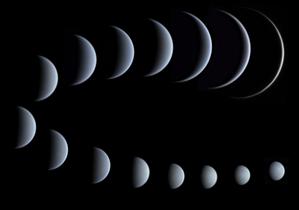
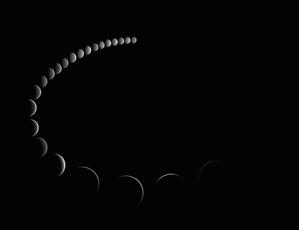
A Matter of Perspective
Legenda: Second place winner in the 2023 IAU OAE Astrophotography Contest, category of Still images of phases of Venus.
This exquisite series of images, captured from Santo Domingo, Dominican Republic, between 17 December 2019 and 25 May 2020, shows the phases of Venus as seen from Earth. As Venus and Earth orbit the Sun, we observe different portions of Venus’s sunlit half, similar to the Moon’s phases. The sequence clearly shows Venus as distant, small, bright and gibbous in the lower frames, and ends with Venus reaching the biggest apparent size of all planets (upper frames), very close to the Sun with a small elongation, and appearing as a thin crescent. In the last frame, only 2.8% of the planet’s surface is illuminated.
Crédito: Christofer Baez/IAU OAE (CC BY 4.0)
License: CC-BY-4.0 Creative Commons Attribution 4.0 International (CC BY 4.0) ícones
Phases of Venus
Legenda: First place winner in the 2023 IAU OAE Astrophotography Contest, category of Still images of phases of Venus.
This is a mesmerising series of images of Venus captured from Surgères, Charente-Maritime, France, over a period of six months in 2015. The phases appear similar to the phases we see of our own Moon and occur for similar reasons. Only half of Venus is illuminated by the Sun and, from Earth, we can sometimes only see part of that illuminated half, depending on the relative positions of the Sun, Earth and Venus. Both Mercury and Venus exhibit phases because their orbit is between the Sun and the orbit of Earth. Depending on the position of Venus relative to the Sun and Earth, Venus goes through its phases over a period of time. This sequence of images beautifully showcases the transition from the ‘gibbous’ to the slender crescents. The use of infrared filters helped to capture Venus's dense perpetual cloud cover during daylight in sharp detail, providing a glimpse into the mysterious nature of the planet’s atmosphere.
Crédito: Stephane Gonzales/IAU OAE (CC BY 4.0)
License: CC-BY-4.0 Creative Commons Attribution 4.0 International (CC BY 4.0) ícones
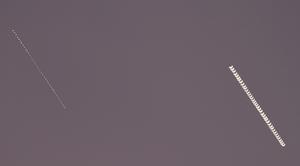
Venus and Mercury Trails
Legenda: Honorable mention in the 2023 IAU OAE Astrophotography Contest, category of Still images of phases of Venus.
In this composite image, both Mercury (left) and Venus (right) can be seen heading into the sunset. The phases of each are beautifully captured as they descend. Not all planets or moons in the Solar System show phases as viewed from Earth. This phenomenon occurs because the orbits of Venus and Mercury are positioned between Earth’s orbit and the Sun, sometimes allowing us to see only part of the illuminated portion of each planet. These phases are similar to the phases we see of our own Moon.
Crédito: Marcella Giulia Pace (CC BY 4.0)
License: CC-BY-4.0 Creative Commons Attribution 4.0 International (CC BY 4.0) ícones