Término del glosario: Eclipse lunar
Descripción: Un eclipse lunar se produce cuando la Luna entra en la sombra de la Tierra. Esto solo puede ocurrir cuando el Sol, la Tierra y la Luna están muy alineados, con la Tierra situada directamente entre el Sol y la Luna. Por lo tanto, un eclipse lunar solo puede producirse en la noche de luna llena. Un eclipse lunar total se produce cuando la Luna se encuentra completamente dentro de la sombra de la Tierra. Un eclipse lunar parcial se produce cuando la Luna solo está parcialmente cubierta por la sombra de la Tierra. El tipo y la duración de un eclipse lunar dependen de la ubicación exacta de la Luna en su órbita alrededor de la Tierra en el momento del eclipse.
Términos relacionados:
Ver este término en otros idiomas
Estado del término y la definición: La definición original de este término en inglés ha sido aprobada por unastrónomo o astrónoma investigadora y un docente La traducción de este término y su definición aún están pendientes de aprobación
El Glosario multilingüe de la OAE es un proyecto de la Oficina de Astronomía para la Educación de la UAI (OAE) en colaboración con la Oficina de Divulgación de Astronomía de la UAI (OAO). Los términos y definiciones fueron seleccionados, redactados y revisados gracias al esfuerzo colectivo de la OAE, los Centros y Nodos de la OAE, los Coordinadores Nacionales de Educación Astronómica (NAECs) y otros voluntarios. Puedes encontrar una lista completa de créditos aquí. Todos los términos del glosario y sus definiciones se publican bajo la licencia Creative Commons CC BY-4.0 y deben atribuirse a la "IAU OAE".
Si detectas algún error de contenido o de traducción en este término del glosario o en ladefinición, ponte en contacto con nosotros.
En otros idiomas
- Árabe: خسوف القمر
- Alemán: Mondfinsternis
- Inglés: Lunar Eclipse
- Francés: Eclipse de lune
- Italiano: Eclissi lunare
- Japonés: 月食 (enlace externo)
- Coreano: 월식
- Portugués de Brasil: Eclipse lunar
- Chino simplificado: 月食
- Chino tradicional: 月食
Contenidos relacionados
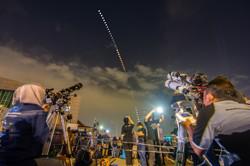
The Eclipse Between Us, by Muhammad Rayhan, Indonesia
Pie de foto: Second place in the 2021 IAU OAE Astrophotography Contest, category Total lunar eclipse.
Total lunar eclipses belong to the rather spectacular celestial events and can be observed easily with and without a telescope. Here we see the stages of the total lunar eclipse of 31.1.2018 photographed in Indonesia: starting with the entry of the full moon disk into Earth's round umbra, the totality as Blood Moon, and the beginning of the Moon's exit from Earth's umbra until moonset.
Crédito: Muhammad Rayhan/IAU OAE
License: CC-BY-4.0 Creative Commons Reconocimiento 4.0 Internacional (CC BY 4.0) íconos
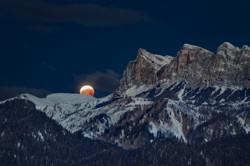
The eclipsed Moon sets near the Rochetta di Prendera, Dolomiti Unesco, by Alessandra Masi, Italy
Pie de foto: First place in the 2021 IAU OAE Astrophotography Contest, category Total lunar eclipse.
A lunar eclipse occurs when the full moon moves into the Earth`s shadow. This is the case when the Sun, Earth and Moon are exactly or very closely aligned. The reddish light reflected from the lunar surface is caused by sunlight that has been refracted on its way through Earth´s atmosphere in the direction of the Moon. It appears reddish because of the Rayleigh scattering of bluer light. The round shape of the Earth's shadow visible on the lunar surface was a proof for Aristotle that the Earth must be a sphere. This photo shows the eclipsed Moon that sets near the Rochetta di Prendera, Dolomiti Unesco, Italy, on 21 January 2019.
Crédito: Alessandra Masi/IAU OAE
License: CC-BY-4.0 Creative Commons Reconocimiento 4.0 Internacional (CC BY 4.0) íconos