Término del glosario: Cinturón de Kuiper
Descripción: El cinturón de Kuiper es una franja de pequeños objetos helados situada en el Sistema Solar exterior, en su mayor parte más allá de la órbita de Neptuno. La mayoría de los objetos se encuentran a distancias de entre 40 y 48 unidades astronómicas del Sol.
Los objetos del cinturón de Kuiper son en su mayoría pequeños, aunque allí también se pueden encontrar varios planetas enanos, entre ellos Plutón. A diferencia de los cuerpos pequeños y los planetas enanos del cinturón de asteroides, los objetos del cinturón de Kuiper están compuestos principalmente por agua congelada, metano y amoníaco.
Términos relacionados:
Ver este término en otros idiomas
Estado del término y la definición: La definición original de este término en inglés ha sido aprobada por unastrónomo o astrónoma investigadora y un docente La traducción de este término y su definición aún están pendientes de aprobación
El Glosario multilingüe de la OAE es un proyecto de la Oficina de Astronomía para la Educación de la UAI (OAE) en colaboración con la Oficina de Divulgación de Astronomía de la UAI (OAO). Los términos y definiciones fueron seleccionados, redactados y revisados gracias al esfuerzo colectivo de la OAE, los Centros y Nodos de la OAE, los Coordinadores Nacionales de Educación Astronómica (NAECs) y otros voluntarios. Puedes encontrar una lista completa de créditos aquí. Todos los términos del glosario y sus definiciones se publican bajo la licencia Creative Commons CC BY-4.0 y deben atribuirse a la "IAU OAE".
Si detectas algún error de contenido o de traducción en este término del glosario o en ladefinición, ponte en contacto con nosotros.
En otros idiomas
- Árabe: حزام كايبر
- Alemán: Kuipergürtel
- Inglés: Kuiper Belt
- Francés: Ceinture de Kuiper
- Hindi: कुइपर बेल्ट
- Italiano: Fascia di Kuiper
- Japonés: カイパーベルト (enlace externo)
- Maratí: क्विपर बेल्ट
- Portugués de Brasil: Cinturão de Kuiper
- Chino simplificado: 柯伊伯带
- Chino tradicional: 柯伊伯帶
Contenidos relacionados
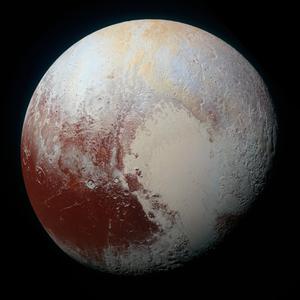
Pluto
Pie de foto: NASA's New Horizons spacecraft captured this high-resolution enhanced colour view of the dwarf planet Pluto on in July 2015. The image combines blue, red and infrared images taken by the Ralph/Multispectral Visual Imaging Camera (MVIC). Pluto’s surface appears enhanced in this view to a rainbow of pale blues, yellows, oranges, and deep reds. The image resolves details and colours on scales as small as 1.3 kilometers.
Crédito: NASA/Johns Hopkins University Applied Physics Laboratory/Southwest Research Institute
enlace de crédito
License: PD Dominio público íconos