Termo do glossário: Cinturão de Kuiper
Descrição: O Cinturão de Kuiper é uma faixa de pequenos objetos gelados no Sistema Solar exterior, localizados principalmente além da órbita de Netuno. A maioria desses objetos encontra-se a distâncias de 40 a 48 unidades astronômicas do Sol.
Os objetos no Cinturão de Kuiper são em sua maioria pequenos, embora vários planetas anões possam ser encontrados lá, incluindo Plutão. Ao contrário dos pequenos corpos e planetas anões no cinturão de asteroides, os objetos do Cinturão de Kuiper são compostos principalmente por água congelada, metano e amônia.
Termos relacionados:
Ver este termo em outros idiomas
Status do termo e da definição: A definição original deste termo em inglês foi aprovada por um astrônomo(a) pesquisador(a) e um(a) professor(a) A tradução deste termo e de sua definição ainda aguarda aprovação
O Glossário Multilíngue da OAE é um projeto do Escritório da IAU de Astronomia para a Educação (OAE) em colaboração com o Escritório da IAU para Divulgação da Astronomia (OAO). Os termos e definições foram selecionados, escritos e revisados por meio de um esforço coletivo da OAE, dos Centros e Nós da OAE, dos Coordenadores Nacionais de Educação em Astronomia (NAECs) da OAE e de outros voluntários. Você pode encontrar uma lista completa dos créditos aqui. Todos os termos do glossário e suas definições são disponibilizados sob uma licença Creative Commons CC BY-4.0 e devem ser creditados à "IAU OAE".
Se você notar algum erro factual ou de tradução neste termo do glossário ou em sua definição, por favor entre em contato.
Em outros idiomas
- Árabe: حزام كايبر
- Alemão: Kuipergürtel
- Inglês: Kuiper Belt
- Espanhol: Cinturón de Kuiper
- Francês: Ceinture de Kuiper
- Hindi: कुइपर बेल्ट
- Italiano: Fascia di Kuiper
- Japonês: カイパーベルト (link externo)
- Marathi: क्विपर बेल्ट
- Chinês Simplificado: 柯伊伯带
- Chinês Tradicional: 柯伊伯帶
Mídia relacionada
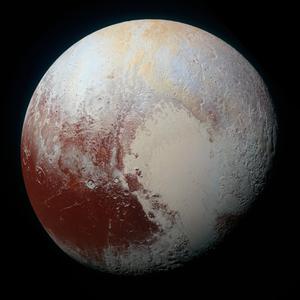
Plutão
Legenda: A espaçonave New Horizons da NASA capturou essa imagem em cores aprimoradas e alta resolução do planeta anão Plutão em julho de 2015. A imagem combina imagens em azul, vermelho e infravermelho obtidas pela câmera Ralph/Multispectral Visual Imaging Camera (MVIC). A superfície de Plutão aparece realçada nessa imagem em uma paleta de cores que vai de azuis claros, amarelos, laranjas e vermelhos intensos. A imagem revela detalhes e cores em escalas tão pequenas quanto 1,3 quilômetro.
Crédito: NASA/Johns Hopkins University Applied Physics Laboratory/Southwest Research Institute
link do crédito
License: PD Domínio Público ícones