بلغات أخرى
- الألمانيّة: Strichspuraufnahme
- الإنجليزيّة: Star Trail
- الإسبانيّة: Estela estelar
- الفرنسيّة: La piste des étoiles
- الإيطاليّة: Scia stellare
- البرتغاليّة البرازيليّة: Trilha das estrelas
- الصينيّة المبسطة: 星轨
- الصينيّة التقليدية: 星軌
وسائط ذات صلة
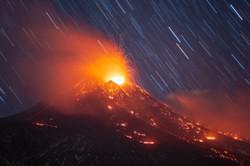
Star Trails And Lava Plume on Mount Etna February 2021, by Dario Giannobile, Italy
الشرح: Third place in the IAU OAE Astrophotography Contest, category Star trails.
This spectacular image captures some of the most dramatic expressions of Nature, the eruption of a volcano and the night sky. The volcano in the foreground is Mount Etna, located in Sicily/Italy, during an eruption in February 2021. In the background, we can see the star trails resulting from the Earth's motion around its imaginary axis. As Mount Etna is located about 37° N, we can notice that the arcs are quite open, as this is far from the North Pole, from where the view from the sky would provide traces drawing circles. As we move to the Equator, either from the Southern or Northern Hemisphere, the star traces become more and more parallel, instead of circular, as the viewer moves away from the zenith pointing to one of the Earth's rotational axes. Therefore, the sky presents us with valuable information about location and time and was an important practice for ancient civilizations to follow the movement of the celestial bodies. The image also captures the varying colours of stars which result from differece in the temperature of stars: higher temperature stars are bluer, compared to the lower temperature white and red stars.
المصدر: Dario Giannobile/IAU OAE
License: CC-BY-4.0 المشاع الإبداعي نَسب المُصنَّف 4.0 دولي (CC BY 4.0) أيقونات
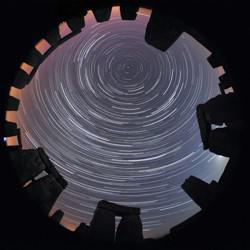
Stone Star Circles, Startrails above Stonehenge, by Till Credner, Germany
الشرح: Second place in the IAU OAE Astrophotography Contest, category Star trails.
Astronomy is one of the oldest (if not the oldest) of the sciences, and as such has connection to various cultures over millennia. This image in a way conveys this relationship by being contextualised in Stonehenge. There is much research into what astronomers call archeoastronomy sites, and how they connect to the sky (for example, seasons, phases of the moon and much more). Civilizations across time and from all over the world have their own views and interpretations of what they see in the sky, and this has been tied not only to culture but also to the people’s day-to-day and seasonal activities. The “concentric circles” which are often referred to as “star trails”, are the result of the apparent motion of the sky, which is in reality due to the rotation of the Earth on its axis. The small dot appearing towards the top center of the image is Polaris – The North or Pole Star. Polaris is only visible to observers in the Northern latitudes. The height of the Pole Star can be used to infer the observer’s actual latitude. Stonehenge is located at around 51° North. This image is taken from one of the most notable ancient sites in the world, brings us back in time, and makes us wonder about the stories told by the people that lived in that place many millennia ago.
المصدر: Till Credner/IAU OAE
License: CC-BY-4.0 المشاع الإبداعي نَسب المُصنَّف 4.0 دولي (CC BY 4.0) أيقونات
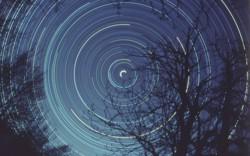
التعرض لنصف يوم لنجم الشمال، بقلم فابريزيو ميلاندري، إيطاليا