Término del glosario: Estela estelar
Descripción: En astrofotografía, las estelas estelares son imágenes impresionantes del cielo nocturno obtenidas mediante exposiciones muy largas. Este efecto se debe a que la cámara gira junto con la Tierra y al movimiento resultante de las estrellas a través del cielo nocturno, lo que provoca estelas en las imágenes. Las estelas estelares muestran el movimiento diurno de la Tierra y, si la cámara apunta hacia el Polo Norte o Sur celeste, las estelas forman semicírculos centrados en la ubicación del polo en el cielo. Además, el patrón de las estelas de estrellas puede utilizarse para determinar la latitud del observador. Las imágenes de estelas de estrellas también pueden crearse tomando una serie de exposiciones cortas durante un periodo de tiempo y luego superponiéndolas unas sobre otras en un programa de edición de fotos.
Términos relacionados:
Ver este término en otros idiomas
Estado del término y la definición: La definición original de este término en inglés ha sido aprobada por unastrónomo o astrónoma investigadora y un docente La traducción de este término y su definición aún están pendientes de aprobación
El Glosario multilingüe de la OAE es un proyecto de la Oficina de Astronomía para la Educación de la UAI (OAE) en colaboración con la Oficina de Divulgación de Astronomía de la UAI (OAO). Los términos y definiciones fueron seleccionados, redactados y revisados gracias al esfuerzo colectivo de la OAE, los Centros y Nodos de la OAE, los Coordinadores Nacionales de Educación Astronómica (NAECs) y otros voluntarios. Puedes encontrar una lista completa de créditos aquí. Todos los términos del glosario y sus definiciones se publican bajo la licencia Creative Commons CC BY-4.0 y deben atribuirse a la "IAU OAE".
Si detectas algún error de contenido o de traducción en este término del glosario o en ladefinición, ponte en contacto con nosotros.
En otros idiomas
- Árabe: مسارات النجوم
- Alemán: Strichspuraufnahme
- Inglés: Star Trail
- Francés: La piste des étoiles
- Italiano: Scia stellare
- Portugués de Brasil: Trilha das estrelas
- Chino simplificado: 星轨
- Chino tradicional: 星軌
Contenidos relacionados
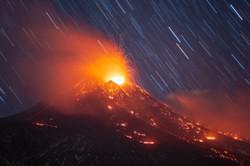
Star Trails And Lava Plume on Mount Etna February 2021, by Dario Giannobile, Italy
Pie de foto: Third place in the IAU OAE Astrophotography Contest, category Star trails.
This spectacular image captures some of the most dramatic expressions of Nature, the eruption of a volcano and the night sky. The volcano in the foreground is Mount Etna, located in Sicily/Italy, during an eruption in February 2021. In the background, we can see the star trails resulting from the Earth's motion around its imaginary axis. As Mount Etna is located about 37° N, we can notice that the arcs are quite open, as this is far from the North Pole, from where the view from the sky would provide traces drawing circles. As we move to the Equator, either from the Southern or Northern Hemisphere, the star traces become more and more parallel, instead of circular, as the viewer moves away from the zenith pointing to one of the Earth's rotational axes. Therefore, the sky presents us with valuable information about location and time and was an important practice for ancient civilizations to follow the movement of the celestial bodies. The image also captures the varying colours of stars which result from differece in the temperature of stars: higher temperature stars are bluer, compared to the lower temperature white and red stars.
Crédito: Dario Giannobile/IAU OAE
License: CC-BY-4.0 Creative Commons Reconocimiento 4.0 Internacional (CC BY 4.0) íconos
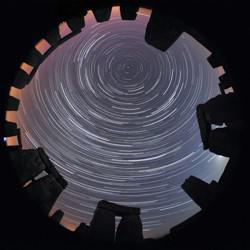
Stone Star Circles, Startrails above Stonehenge, by Till Credner, Germany
Pie de foto: Second place in the IAU OAE Astrophotography Contest, category Star trails.
Astronomy is one of the oldest (if not the oldest) of the sciences, and as such has connection to various cultures over millennia. This image in a way conveys this relationship by being contextualised in Stonehenge. There is much research into what astronomers call archeoastronomy sites, and how they connect to the sky (for example, seasons, phases of the moon and much more). Civilizations across time and from all over the world have their own views and interpretations of what they see in the sky, and this has been tied not only to culture but also to the people’s day-to-day and seasonal activities. The “concentric circles” which are often referred to as “star trails”, are the result of the apparent motion of the sky, which is in reality due to the rotation of the Earth on its axis. The small dot appearing towards the top center of the image is Polaris – The North or Pole Star. Polaris is only visible to observers in the Northern latitudes. The height of the Pole Star can be used to infer the observer’s actual latitude. Stonehenge is located at around 51° North. This image is taken from one of the most notable ancient sites in the world, brings us back in time, and makes us wonder about the stories told by the people that lived in that place many millennia ago.
Crédito: Till Credner/IAU OAE
License: CC-BY-4.0 Creative Commons Reconocimiento 4.0 Internacional (CC BY 4.0) íconos
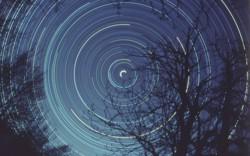
Half day exposure to the north star, by Fabrizio Melandri, Italy
Pie de foto: First place in the IAU OAE Astrophotography Contest, category Star trails.
This star trail image shows the apparent movement of the stars in the night sky, which results from the Earth’s rotation around its polar axis. The trees in the foreground serve as an anchor as we turn with the Earth. The bright white semi-circle in the center of the image is the North (Pole) star – Polaris, which is located very close to the North Celestial Pole. One way to imagine that the Earth is at center of hollow crystal sphere, and the stars are embedded on this sphere, as the Earth spins on its axis, an observer on Earth sees the stars rising and setting, following an arc, because the horizon prevents the observer from the full arc for stars that are further away from the Celestial Pole. The North Celestial Pole (and its opposite the South Celestial Pole) is essentially formed by extending the line of the Earth’s axis. Capturing this image requires the photographer to take a long exposure with the camera on a tripod and pointing towards the Pole Star (North Hemisphere). In the Southern Hemisphere there is no star as close as Polaris is to the Celestial Pole, so the position of the South Celestial Pole is found using the South Cross and Pointer Stars (Alpha and Beta Centauri). Although overall the image has a slight blue tint, it does capture the varying colours of stars, it is easy to distinguish between the higher temperature blue stars and the lower temperature of the whitish stars, and even lower temperature reddish stars. The reason for this variation in colour is because higher temperature stars emit more in shorter wavelengths (bluer), compared to lower temperature stars which emit in longer wavelengths (redder).
Crédito: Fabrizio Melandri/IAU OAE
License: CC-BY-4.0 Creative Commons Reconocimiento 4.0 Internacional (CC BY 4.0) íconos