Glossary term: 日食
Description: 若地球、月球和太陽排成一條直線,且月球位於地球和太陽之間,則會發生日食。從地球表面觀測時,月球圓面覆蓋了天空中的太陽圓面;在太空中觀測時,我們可以看到月球的影子在地球的晝半球上移動。
日食有不同的類型。日全食是指月球圓面完全覆蓋太陽;日偏食是指即使在食甚時,太陽圓面也只有一部分被覆蓋;日環食是指月球與地球的距離比平均值遠,因此看起來比平時小,即使在食甚時也能看到太陽圓面的一圈圓環。
日全食期間,地球上月影最暗處稱為“本影”,月影邊緣稱為“半影”。位於本影內的觀測者看到的是日全食,而位於半影內的觀測者看到的是日偏食。
Related Terms:
See this term in other languages
Term and definition status: The original definition of this term in English have been approved by a research astronomer and a teacher The translation of this term and its definition is still awaiting approval
This is an automated transliteration of the simplified Chinese translation of this term
The OAE Multilingual Glossary is a project of the IAU Office of Astronomy for Education (OAE) in collaboration with the IAU Office of Astronomy Outreach (OAO). The terms and definitions were chosen, written and reviewed by a collective effort from the OAE, the OAE Centers and Nodes, the OAE National Astronomy Education Coordinators (NAECs) and other volunteers. You can find a full list of credits here. All glossary terms and their definitions are released under a Creative Commons CC BY-4.0 license and should be credited to "IAU OAE".
If you notice a factual or translation error in this glossary term or definition then please get in touch.
In Other Languages
- 阿拉伯語: الكسوف الشمسي
- 德語: Sonnenfinsternis
- 英語: Solar Eclipse
- 西班牙語: Eclipse solar
- 法語: Eclipse solaire
- 義大利語: Eclissi solare
- 日語: 日食 (external link)
- 巴西葡萄牙語: Eclipse Solar
- 簡體中文: 日食
Related Media
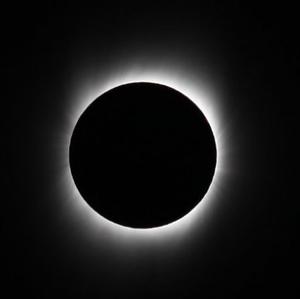
日全食
Caption: 這張照片記錄了在孟加拉國庫里格拉姆觀測到的日全食。日食發生時,從地球上看,月球經過太陽前方時。儘管月球的體積遠小於太陽,但由於月球距離地球更近,兩者的角直徑幾乎相同(約為半根手指的寬度)。因此,當月球恰好位於太陽和地球之間時,能夠完全遮住太陽的盤面。環繞黑色圓盤的光環被稱為日冕。
Credit: 盧特法爾-拉赫曼-尼爾哈爾
credit link
License: CC-BY-3.0 Creative Commons Attribution 3.0 Unported icons

Transit of Phobos from Mars
Caption: This video shows the Sun viewed from Mars as Mars’ moon Phobos transits across the solar disk. This video is composed of images taken from the Martian surface on the 30th of September 2024 by the Mastcam-Z camera of NASA’s Perseverance Mars rover. While our Moon is perfectly sized to eclipse the Sun when seen from the Earth’s surface, Phobos’s size and orbit mean that it cannot cover the solar disk completely. This means that this event is a transit and not an eclipse.
This video is in real time, with the entire transit lasting just 32 seconds. This compares with the several hours a solar eclipse on Earth takes from the Moon first obscuring part of the Sun to the Sun being completely visible again. This is due to Phobos’ much shorter orbital period of just over seven and a half hours compared to the Moon’s orbital period of 27 days as well as the solar disk appearing slightly smaller from Mars than it does from Earth. Note the non-spherical shape of Phobos as it crosses the solar disk.
Credit: NASA/JPL-Caltech/ASU/MSSS
credit link
License: PD Public Domain icons

A total solar eclipse over the La Silla Observatory, Chile
Caption: A real-time video showing the total solar eclipse on the 2nd of July 2019 over the La Silla Observatory in Chile. This video covers the moments before totality, the just under two minutes of totality, and the moments after totality. Note that at the start of the video the Sun was already almost completely obscured by the Moon, it is just hard to see due to the brightness of the Sun and the exposure of the camera. Indeed the Moon started partially eclipsing the Sun roughly an hour before the start of this recording and would continue to partially obscure the Sun for roughly the same time afterwards.
At the point of totality one can see the faint glow of the Sun’s diffuse outer regions and on the horizon one can also see the glow from the parts of the surrounding areas on Earth that are not experiencing totality.
Credit: ESO/A. Santerne
credit link
License: CC-BY-4.0 Creative Commons 姓名標示 4.0 國際 (CC BY 4.0) icons

2024 Total Solar Eclipse from Space
Caption: The NASA Deep Space Climate Observatory (DSCOVR) captured the total solar eclipse over North America on the 8th of April, 2024 from space using its Earth Polychromatic Imaging Camera (EPIC). This video shows images of Earth taken over the course of four and a half hours. The Moon’s shadow on the Earth can be seen as it moves from south-west to north east. While the shadow looks like it covers a huge part of the continent, only a strip up to 185 km wide in the middle of the eclipse's path saw a total eclipse at some point on this day and at any one time only the central part of the shadow would have experienced a total solar eclipse. Most of the area covered by this shadow only saw a partial eclipse.
DSCOVR sits at L1, a stable gravitational point between the Sun and Earth and observes the day side of the Earth.
Credit: NASA/DSCOVR EPIC team/Michala Garrison and Wanmei Liang
credit link
License: PD Public Domain icons

Total Solar Eclipse from Casper, Wyoming, USA
Caption: This video shows the total solar eclipse of the 21st of August 2017 observed from Casper, Wyoming, USA by a team of astronomers from the European Space Agency (ESA). This video has been sped up considerably, in reality the moment of totality lasted just under two and a half minutes while the time from the Moon first appearing to obscure the Sun until the Sun was completely unobscured was two hours and 48 minutes.
Before the eclipse we can see several sunspots on the Sun. The Moon moves across the Sun, covering the whole solar disk visible from the point on the Earth this video was taken from. At totality we can see the diffuse solar corona which is normally outshone by the bright solar disk.
Note that while edges of the Sun appear brighter just before and just after totality, this is due to exposure time of the camera being adjusted to make the features visible at totality more obvious. Towards the end of the video some thin cloud begins to affect the observations.
Credit: Video credit: ESA/CESAR ; Music copyright: Flight Of The Angel 3 by Chris Blackwell, audionetwork.com
credit link
License: CC-BY-SA-3.0-IGO Creative Commons Attribution-ShareAlike 3.0 IGO icons
Related Diagrams

Total Solar Eclipse
Caption: This not to scale diagram shows what happens during a total solar eclipse. The Moon orbits the Earth, but its orbit is slightly tilted with respect to the Earth’s orbit around the Sun. During the new moon lunar phase, the Moon lies between the Earth and the Sun, but due to the Moon’s tilted orbit around the Earth, the Moon normally lies above or below the Sun at this point. However twice a year the Moon’s orbit lines up in such a way that the Moon can lie in a direct line between the Earth and Sun. During each of these periods (each of which last roughly a month) solar (and lunar) eclipses can occur. The Moon is about 400 times smaller than the Sun, but is 400 times closer to the Earth than the Sun. Hence the Sun and Moon have approximately the same angular size when viewed from the Earth. This means that it is possible for the Moon to completely cover the Sun when viewed from Earth. This is known as a total solar eclipse.
Here we see a schematic of such and eclipse. The Moon casts a shadow on the Earth known as the umbra. This is a roughly circular shadow a few hundred kilometres across although its shape can be severely distorted when the eclipse is at the edge of the illuminated part of the Earth. Any region within the umbra will see the Moon completely cover the Sun and thus will experience a total solar eclipse. Outside of the umbra there are regions where the Moon will cover part of the Sun. This partial shadow is known as the penumbra. Regions in the penumbra will experience a partial solar eclipse.
An eclipse is a dynamic event with the Moon moving in its orbit and the Earth rotating. Hence the umbra and penumbra move across the Earth’s surface together. The path the umbra takes across the Earth is known as the path of totality. Let’s consider one particular region that lies in the path of totality: except in rare cases where an eclipse begins at sunrise, a region that experiences totality will first see the Moon cover part of the Sun and gradually move across Sun until it is totally covered. From outside the Earth this would appear as the penumbra moving over this particular region followed by the umbra moving over this region. Once the Moon moves so that it no longer completely covers the Sun, totality ends and the umbra moves away from this particular region. The Moon will continue to uncover the Sun until (unless the Sun sets before the end of the eclipse) the Sun is completely uncovered. From outside the Earth this would appear as the umbra moving away from our particular region and the edge of the penumbra approaching and eventually passing over the region.
Outside of the path or totality there is a much broader region that will lie in the penumbra but will be missed by the umbra. Such regions will not experience a total solar eclipse during this event, only a partial solar eclipse.
Credit: Aneta Margraf/IAU OAE
License: CC-BY-4.0 Creative Commons 姓名標示 4.0 國際 (CC BY 4.0) icons