词条 彗尾
描述: 当彗星靠近太阳时,太阳辐射会加热彗星表面。表面的冰变成气体("升华"),同时带走岩石和尘埃物质。由此产生的混合物在彗核周围形成一团云,这就是彗发。一般来说,彗星会有两条尾巴:喷射出的尘埃粒子形成彗尾,彗尾呈典型的弯曲状。它由从表面释放出来的尘埃粒子组成,这些尘埃粒子沿着彗星的轨道绕太阳运行。尘埃尾的长度可达数百万公里或更长。它们反射太阳光,如果条件合适,肉眼能观测到的彗星大部分都是由它们的白色漫射形状组成的。
相当一部分气体被太阳风--太阳发出的带电粒子--吹走并电离。这些离子形成了彗星的离子尾,通常呈蓝色。离子尾总是直指太阳。如果彗星本身正在远离太阳,离子尾就会在彗星之前。
相关词条
用其他语言查看该词条
词条和定义状态: 该术语的英文原始定义已通过天文研究人员和教师的审核 该术语及其定义的译文仍待审核
OAE多语言词汇表是由国际天文学联合会(IAU) 天文教育办公室(OAE) 和 国际天文学联合会(IAU) 天文推广办公室(OAO)合作的项目。. 术语和定义由 OAE中心, OAE 国家天文教育协调员(NAECs) 以及其他志愿者共同选择、撰写和审阅。您可以在 找到完整的致谢列表。所有词汇表术语及其定义均根据 Creative Commons CC BY-4.0许可证发布 且版权归属于 “IAU OAE”。
如果您发现此词汇术语或定义中的事实或翻译错误, 请向 发邮件 联系.
其他语言版本
- 阿拉伯语: ذيل المذنب
- 德语: Kometenschweif
- 英语: Cometary Tail
- 西班牙语: Cola de un cometa
- 法语: Queue cométaire
- 意大利语: Coda cometaria
- 日语: 尾(彗星の) (外部链接)
- 巴西葡萄牙语: Cauda de cometa
- 繁体中文: 彗尾
相关媒体
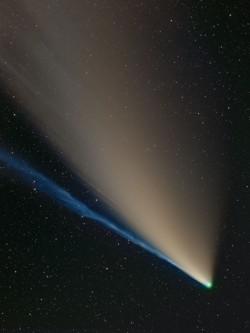
彗星 C/2020F3 (Neowise),有分开的尘埃尾和离子气体尾,以及发出绿色光芒的彗发,作者 Dietmar Gutermuth,德国
图注: 2021 年国际天文学联合会 OAE 天体摄影比赛彗星类第二名。
彗星的结构非常有趣,主要由四个部分组成:由岩石、尘埃和冰冻气体组成的彗核,大小通常为几公里,但也观测到过更大的彗星;彗核周围的一小团气体(只有在彗星最接近太阳时才会出现),称为彗发;以及两条独特的彗尾(有时还有第三条尾)。彗发的绿色是由于其中的碳和氮与太阳的紫外辐射发生反应。我们通常观测到的尾迹是尘埃尾,由微米级的尘埃粒子组成;第二条尾迹由带电粒子组成--即离子尾或气体尾。只有当彗星在一定距离内接近太阳,来自恒星的热量和辐射强到足以使冰冻气体气化时,彗尾才会出现。尘埃尾是弯曲的,而气体尾则是笔直的,并且始终指向远离太阳的方向,因为这是由太阳风携带的--太阳发出的带电粒子流。由于彗星是由残留物质形成的,它们携带着太阳系形成早期的重要信息。这幅美丽的图片显示的是 2020 年 7 月从德国看到的彗星 C/2020 F3(Neowise),四个结构中的三个:彗尾、气体尾和尘埃尾清晰可见。
来源: Dietmar Gutermuth/IAU OAE

你好,彗星,我们跳舞好吗?作者罗伯特·巴尔萨,斯洛伐克
图注: 2021年国际天文学联合会教育办公室天文摄影大赛彗星类别季军作品。
这张优美而富有诗意的照片拍摄于2020年7月来自斯洛伐克,记录了彗星C/2020 F3(NEOWISE)的身影。彗星尾巴的方向为太阳的位置提供了线索。在过去,对于不了解这些天体本质的人来说,天空中彗星的出现常常会让他们感到忧虑甚至恐惧。然而,通过细致的观测以及物理学、化学和地质学知识,我们如今了解到,彗星是太阳系形成早期残留的天体。彗星最显著的特征是蓝色的离子(气体)尾和白色的尘埃尾,这些尾巴可以延伸数千万公里。这些独特的特征,即便肉眼也能轻松观测到,再加上科学的理解,不再会引起恐惧,而是帮助我们探索太阳系的历史,带来敬畏、喜悦和思索,正如这幅影像中所呈现的那样。
来源: 罗伯特·巴尔萨/国际天文学联合会教育办公室
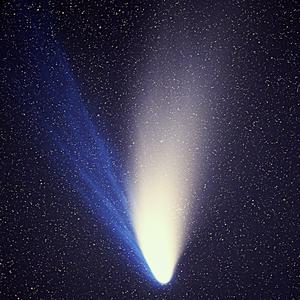
海尔-波普彗星
图注: 彗星 C/1995 O1(海尔-波谱)的图像,拍摄于 1997 年 4 月 4 日,曝光时间为 10 分钟。显示的视场约为 6.5°x6.5°。明亮的彗尾上延伸出两条尾巴:一条白黄色的尘埃尾巴和一条始终指向远离太阳的方向蓝色的气体尾巴。
来源: E.Kolmhofer, H. Raab; Johannes Kepler Observatory, Linz, Austria
来源链接
License: CC-BY-SA-3.0 知识共享许可协议 Attribution-ShareAlike 3.0 Unported 图标

Halley's Comet
图注: Halley’s Comet, is a well-known periodic comet, named after the English astronomer Edmond Halley. It has an orbital period of approximately 75 years and is visible from Earth with the naked eye when it passes through the inner solar system.
The image shows Halley’s Comet, officially designated 1P/Halley, with a tail of gas and dust streaming away from the Sun. It was taken from the La-Silla-Observatory in Chile in 1986 during Halley's Comet's last visit to the inner solar system. The stars in this image appear elongated or as lines of three different colored dots as image was created from three separate observations in different colors of light and the telescope was tracking the comet, which was moving very slightly compared to the background stars. Note that the comets tail does not point in exactly the same direction as the elongation of the stars. This shows us that the comet tail is not always behind the comet, but instead pointing away from the Sun.
The comet passes its perihelion (closest distance to the Sun) at a distance of around 0.59 astronomical units, right between the orbits of Mercury and Venus. Beyond Neptune, it reaches its aphelion (furthest distance from the Sun) at a distance of approximately 35 astronomical units. Halley's Comet reached aphelion in December 2023 and is now moving inwards again. It is expected to be seen with the naked eye from Earth again in mid-2061.
来源: ESO
来源链接