词条 吸积盘
描述: 当一个天体吸积物质时,除非下坠的物质已经径直向吸引的天体运动,否则它不可能直接落到吸引的天体上。事实上,当下坠的物体靠近吸的引物体时,由于角动量守恒,其垂直于它与吸引物体之间连线的速度分量会增加。
在许多情况下,下坠的物会聚集成所谓的吸积盘:一个围绕吸引天体气体和尘埃的漩涡盘。物质会从吸积盘的内缘落到中心天体上。对于一个致密的中心天体来说,落到吸积盘上的物质在下落过程中会获得巨大的能量。当这些能量聚集在吸积盘中时,吸积盘的温度会升高到数十万甚至数百万开尔文。一些星系中心超大质量黑洞周围的吸积盘为活动星系核(AGN)提供了能量。这些极其明亮的天体可能比其宿主星系中所有恒星亮度的总和还要亮。
吸积盘存在于各种天体物理环境中,例如超大质量黑洞、恒星残骸、伽马射线暴或原恒星周围。
相关词条
用其他语言查看该词条
词条和定义状态: 该术语的英文原始定义已通过天文研究人员和教师的审核 该术语及其定义的译文仍待审核
OAE 多语言词汇表是由国际天文学联合会(IAU) 天文教育办公室(OAE) 和 国际天文学联合会(IAU) 天文推广办公室(OAO)合作的项目。. 术语和定义由 OAE中心, OAE 国家天文教育协调员(NAECs) 以及其他志愿者共同选择、撰写和审阅。您可以在 找到完整的致谢列表。所有词汇表术语及其定义均根据 Creative Commons CC BY-4.0许可证发布 且版权归属于 "IAU OAE"。
如果您发现此词汇术语或定义中的事实或翻译错误, 请向 发邮件 联系.
其他语言版本
- 阿拉伯语: قرص التراكم
- 孟加拉语: বিবৃদ্ধি চাকতি
- 德语: Akkretionsscheibe
- 英语: Accretion Disk
- 西班牙语: Disco de acreción
- 法语: Disque d'accrétion
- 印尼语: Piringan Akresi
- 意大利语: disco di accrescimento
- 日语: 降着円盤 (外部链接)
- 巴西葡萄牙语: Disco de acreção
- 繁体中文: 吸積盤
相关媒体

Jet Ejected from the Active Galaxy M87
图注: A 3000-light-year-long jet streaming from the core of galaxy M87, as captured by the Hubble Space Telescope. The center of this image shows the core of the elliptical galaxy M87 (in the constellation Virgo) which hosts an active galactic nucleus (AGN).
An AGN is a very luminous region around a supermassive black hole. It is powered by matter falling towards the black hole and forming a hot accretion disk. Many galaxies host a supermassive black hole, but not all of them are accreting enough matter to appear as an AGN.
The strong gravity of the supermassive black hole in the heart of M87 has caused a huge jet of charges particles to be flung out from the accretion disk. This extends far out into the galaxy itself, beyond the core region. Here we see the jet as a whitish-blue line which gets wider the further it goes from the core. The light emission we see here is caused by the energetic electrons in the jet interacting with magnetic fields.
来源: NASA, ESA, A. Lessing (Stanford University), E. Baltz (Stanford University), M. Shara (AMNH), J. DePasquale (STScI)
来源链接
相关活动
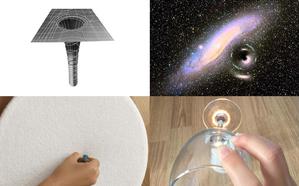
Hunting for black holes
astroEDU educational activity (links to astroEDU website) Description: How do astronomers detect invisible black holes?
License: CC-BY-4.0 知识共享许可协议 署名 4.0 国际 (CC BY 4.0) 图标
标签:
Model
, Experiment
年龄段:
12-14
受教育等级:
非正式
, 初中
学习领域:
建模
, 以观察为主
, 问题解决
, 结构化探究式学习
费用:
低成本
时间跨度:
45 分钟
组别大小:
小组
技能:
构建解释
, 开发和使用模型