بلغات أخرى
- البنغاليّة: বিবৃদ্ধি চাকতি
- الألمانيّة: Akkretionsscheibe
- الإنجليزيّة: Accretion Disk
- الإسبانيّة: Disco de acreción
- الفرنسيّة: Disque d'accrétion
- الإندونيسيّة: Piringan Akresi
- الإيطاليّة: disco di accrescimento
- اليابانيّة: 降着円盤 (رابط خارجي)
- البرتغاليّة البرازيليّة: Disco de acreção
- الصينيّة المبسطة: 吸积盘
- الصينيّة التقليدية: 吸積盤
وسائط ذات صلة

Jet Ejected from the Active Galaxy M87
الشرح: A 3000-light-year-long jet streaming from the core of galaxy M87, as captured by the Hubble Space Telescope. The center of this image shows the core of the elliptical galaxy M87 (in the constellation Virgo) which hosts an active galactic nucleus (AGN).
An AGN is a very luminous region around a supermassive black hole. It is powered by matter falling towards the black hole and forming a hot accretion disk. Many galaxies host a supermassive black hole, but not all of them are accreting enough matter to appear as an AGN.
The strong gravity of the supermassive black hole in the heart of M87 has caused a huge jet of charges particles to be flung out from the accretion disk. This extends far out into the galaxy itself, beyond the core region. Here we see the jet as a whitish-blue line which gets wider the further it goes from the core. The light emission we see here is caused by the energetic electrons in the jet interacting with magnetic fields.
المصدر: NASA, ESA, A. Lessing (Stanford University), E. Baltz (Stanford University), M. Shara (AMNH), J. DePasquale (STScI)
رابط المصدر
License: CC-BY-4.0 المشاع الإبداعي نَسب المُصنَّف 4.0 دولي (CC BY 4.0) أيقونات
الأنشطة المرتبطة
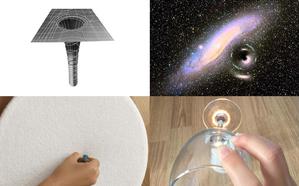
Hunting for black holes
astroEDU educational activity (links to astroEDU website) Description: How do astronomers detect invisible black holes?
License: CC-BY-4.0 المشاع الإبداعي نَسب المُصنَّف 4.0 دولي (CC BY 4.0) أيقونات
وسوم:
Model
, Experiment
الفئات العمرية:
12-14
المرحلة التعليمية:
غير رسمي
, المرحلة المتوسطة
مجالات التعلم:
النمذجة
, قائم على الملاحظة
, حل المشكلات
, تعلم منظم قائم على الاستقصاء
التكاليف:
تكلفة منخفضة
المدة:
45 دقيقة
حجم المجموعة:
جماعي
المهارات:
صياغة التفسيرات
, تطوير النماذج واستخدامها