Glossary term: Impact Craters
Description: An impact crater is a depression on the surface of a planet, moon, or other solid minor body of the Solar System. Impact craters are formed by a high velocity impact of a smaller body (meteorite). The Moon is full of impact craters due to its lack of atmosphere. The thick atmosphere on Earth stops many meteors from ever reaching the ground. An example of an impact crater on Earth Is Meteor Crater in Arizona, USA.
Related Terms:
See this term in other languages
Term and definition status: This term and its definition have been approved by a research astronomer and a teacher
The OAE Multilingual Glossary is a project of the IAU Office of Astronomy for Education (OAE) in collaboration with the IAU Office of Astronomy Outreach (OAO). The terms and definitions were chosen, written and reviewed by a collective effort from the OAE, the OAE Centers and Nodes, the OAE National Astronomy Education Coordinators (NAECs) and other volunteers. You can find a full list of credits here. All glossary terms and their definitions are released under a Creative Commons CC BY-4.0 license and should be credited to "IAU OAE".
If you notice a factual error in this glossary definition then please get in touch.
In Other Languages
- Arabic: الفوهات الصدمية
- German: Einschlagskrater
- Spanish: Cráteres de impacto
- French: Cratères d'impact
- Italian: Crateri da impatto
- Korean: 충돌 구덩이
- Brazilian Portuguese: Crateras de impacto
- Simplified Chinese: 撞击坑
- Traditional Chinese: 撞擊坑
Related Media
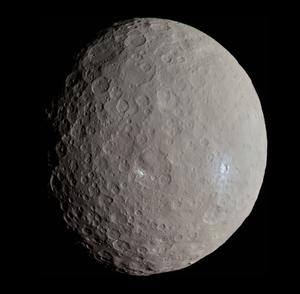
Ceres
Caption: True-colour image of the asteroid Ceres acquired by the spaceprobe Dawn in May 2015, at a distance of 13641 km. The prominent, bright crater at right is Haulani. The smaller bright spot to its left is exposed on the floor of Oxo. Ejecta from these impacts appears to have exposed bright material, probably water ice.
Credit: NASA / JPL-Caltech / UCLA / MPS / DLR / IDA / Justin Cowart
License: CC-BY-2.0 Creative Commons Attribution 2.0 Generic icons