Glossary term: 충돌 구덩이
Description: 충돌 구덩이는 태양계의 행성이나 위성 또는 암석 소행성 표면에서 관측되는 함몰 지형입니다. 충돌 구덩이는 큰 천체의 표면에 작은 천체(운석)가 고속으로 충돌하여 형성됩니다. 달에는 대기가 없기 때문에 충돌 구덩이들이 많습니다. 지구에서는 두꺼운 대기 때문에 많은 유성들이 대부분 지표면까지 도달하지 못합니다. 지구상 충돌구덩이의 예로는 미국의 애리조나주에 있는 미티어 크레이터가 있습니다.
Related Terms:
See this term in other languages
Term and definition status: The original definition of this term in English have been approved by a research astronomer and a teacher The translation of this term and its definition is still awaiting approval
The OAE Multilingual Glossary is a project of the IAU Office of Astronomy for Education (OAE) in collaboration with the IAU Office of Astronomy Outreach (OAO). The terms and definitions were chosen, written and reviewed by a collective effort from the OAE, the OAE Centers and Nodes, the OAE National Astronomy Education Coordinators (NAECs) and other volunteers. You can find a full list of credits here. All glossary terms and their definitions are released under a Creative Commons CC BY-4.0 license and should be credited to "IAU OAE".
If you notice a factual or translation error in this glossary term or definition then please get in touch.
In Other Languages
- 아랍어: الفوهات الصدمية
- 독일어: Einschlagskrater
- 영어: Impact Craters
- 스페인어: Cráteres de impacto
- 프랑스어: Cratères d'impact
- 이탈리아어: Crateri da impatto
- 브라질 포르투갈어: Crateras de impacto
- 중국어 간체: 撞击坑
- 중국어 번체: 撞擊坑
Related Media
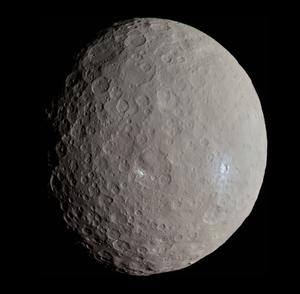
Ceres
Caption: True-colour image of the asteroid Ceres acquired by the spaceprobe Dawn in May 2015, at a distance of 13641 km. The prominent, bright crater at right is Haulani. The smaller bright spot to its left is exposed on the floor of Oxo. Ejecta from these impacts appears to have exposed bright material, probably water ice.
Credit: NASA / JPL-Caltech / UCLA / MPS / DLR / IDA / Justin Cowart