Término del glosario: Cráteres de impacto
Descripción: Un cráter de impacto es una depresión en la superficie de un planeta, una luna u otro cuerpo menor sólido del Sistema Solar. Los cráteres de impacto se forman por el choque a gran velocidad de un cuerpo más pequeño (un meteorito). La Luna está llena de cráteres de impacto debido a su falta de atmósfera. La densa atmósfera de la Tierra impide que muchos meteoros lleguen a alcanzar el suelo. Un ejemplo de cráter de impacto en la Tierra es el Cráter Barringer, en Arizona (EE. UU.).
Términos relacionados:
Ver este término en otros idiomas
Estado del término y la definición: La definición original de este término en inglés ha sido aprobada por unastrónomo o astrónoma investigadora y un docente La traducción de este término y su definición aún están pendientes de aprobación
El Glosario multilingüe de la OAE es un proyecto de la Oficina de Astronomía para la Educación de la UAI (OAE) en colaboración con la Oficina de Divulgación de Astronomía de la UAI (OAO). Los términos y definiciones fueron seleccionados, redactados y revisados gracias al esfuerzo colectivo de la OAE, los Centros y Nodos de la OAE, los Coordinadores Nacionales de Educación Astronómica (NAECs) y otros voluntarios. Puedes encontrar una lista completa de créditos aquí. Todos los términos del glosario y sus definiciones se publican bajo la licencia Creative Commons CC BY-4.0 y deben atribuirse a la "IAU OAE".
Si detectas algún error de contenido o de traducción en este término del glosario o en ladefinición, ponte en contacto con nosotros.
En otros idiomas
- Árabe: الفوهات الصدمية
- Alemán: Einschlagskrater
- Inglés: Impact Craters
- Francés: Cratères d'impact
- Italiano: Crateri da impatto
- Coreano: 충돌 구덩이
- Portugués de Brasil: Crateras de impacto
- Chino simplificado: 撞击坑
- Chino tradicional: 撞擊坑
Contenidos relacionados
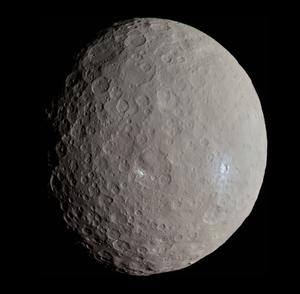
Ceres
Pie de foto: True-colour image of the asteroid Ceres acquired by the spaceprobe Dawn in May 2015, at a distance of 13641 km. The prominent, bright crater at right is Haulani. The smaller bright spot to its left is exposed on the floor of Oxo. Ejecta from these impacts appears to have exposed bright material, probably water ice.
Crédito: NASA / JPL-Caltech / UCLA / MPS / DLR / IDA / Justin Cowart
License: CC-BY-2.0 Creative Commons Atribución 2.0 Genérica íconos