Termo do glossário: Galáxia de Andrômeda
Descrição: A galáxia de Andrômeda é uma galáxia espiral como a nossa, embora duas vezes maior. É a única galáxia desse tipo visível a olho nu no hemisfério norte, embora somente em locais escuros, longe das luzes das cidades. Ela também é conhecida como M31, em homenagem ao astrônomo francês Charles Messier, que criou um catálogo de 110 objetos com Andrômeda na posição 31.
Termos relacionados:
Ver este termo em outros idiomas
Status do termo e da definição: A definição original deste termo em inglês foi aprovada por um astrônomo(a) pesquisador(a) e um(a) professor(a) A tradução deste termo e de sua definição ainda aguarda aprovação
O Glossário Multilíngue da OAE é um projeto do Escritório da IAU de Astronomia para a Educação (OAE) em colaboração com o Escritório da IAU para Divulgação da Astronomia (OAO). Os termos e definições foram selecionados, escritos e revisados por meio de um esforço coletivo da OAE, dos Centros e Nós da OAE, dos Coordenadores Nacionais de Educação em Astronomia (NAECs) da OAE e de outros voluntários. Você pode encontrar uma lista completa dos créditos aqui. Todos os termos do glossário e suas definições são disponibilizados sob uma licença Creative Commons CC BY-4.0 e devem ser creditados à "IAU OAE".
Se você notar algum erro factual ou de tradução neste termo do glossário ou em sua definição, por favor entre em contato.
Em outros idiomas
- Árabe: مجرة المرأة المسلسلة
- Bengali: অ্যান্ড্রোমিডা ছায়াপথ
- Alemão: Andromedagalaxie
- Inglês: Andromeda Galaxy
- Espanhol: Galaxia de Andrómeda
- Francês: Galaxie d'Andromède
- Hindi: एंड्रोमेडा आकाशगंगा
- Italiano: Galassia di Andromeda
- Japonês: アンドロメダ銀河 (link externo)
- Coreano: 안드로메다은하
- Marathi: अॅन्ड्रोमेडा
- Chinês Simplificado: 仙女座星系
- Chinês Tradicional: 仙女座星系
Mídia relacionada
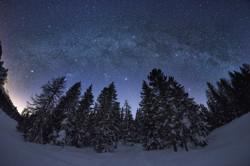
Winter Milky Way
Legenda: Winner in the 2022 IAU OAE Astrophotography Contest, category Still images of celestial patterns.
Taken near Lake Misurina in the Veneto region of Italy in February 2019, this image shows a clear and starry sky over a winter landscape.
We can see part of the Milky Way arc. From the left side, towards the south-east, we see Sirius, "The Burner" in Greek, the brightest star in the night sky. It is part of the constellation Canis Major, The Great Dog, one of the dogs of Orion, the great hunter, in Greek mythology. Orion’s other dog, Canis Minor, the Small Dog, is represented by the bright star Procyon and its fainter neighbours. The Greek star name means “The One [rising] before The Dog” and the star is seen at the top left side of the image just above the arc of the Galaxy. Orion lies to the right of Canis Major. We can spot its characteristic “belt”, an asterism composed of three bright stars aligned in a straight line.
Above the treetops to the right of Orion, the open star clusters of the Hyades and the Pleiades in the constellation Taurus, the Bull, are visible. According to ancient lore, these two clusters form a Celestial Gate directly next to the intersection of the great circles of the ecliptic and the Milky Way. In Greco-Roman mythology, Taurus is associated with the god Zeus who is said to have used a bull to seduce the Phoenician princess Europa.
Above the constellation Taurus, we can see a bright star just above the arc of the Galaxy. This is Capella, the brightest star of the constellation Auriga, The Charioteer. This is one of the 88 modern constellations and is associated with the Greek hero Erichthonius of Athens. Hindu astronomy considers Capella as the heart of Brahma, one of the three major gods. The indigenous people of Bororo in Brazil have a constellation representing a cayman, comprising some of the stars of Auriga and some stars from neighbouring constellations.
To the right of Taurus, we find the modern constellation Perseus with the bright double star cluster h+chi Perseii, which represents the metal of Perseus’s sabre in Greek mythology. Perseus is the hero who was sent out to prove himself, and happened to rescue Andromeda from the sea monster Cetus as the Roman poet Ovid wrote. We can also see the constellation Cassiopeia, associated with the queen and mother of Andromeda in Greek mythology. It is composed of five bright stars in the shape of a W, which was considered the asterism of The Key by the Greeks according to the poet Aratus. The recognisable shape is also associated with other mythologies: for instance, it represents the princess Sharmishtha in Hindu astronomy, a bat in Thailand, and a camel in native Arabic astronomy.
In the gap between the trees, the Andromeda Galaxy is visible.
Crédito: Giorgia Hofer/IAU OAE
License: CC-BY-4.0 Creative Commons Attribution 4.0 International (CC BY 4.0) ícones

Uma imagem da Galáxia de Andrômeda em luz visível
Legenda: A Galáxia de Andrômeda vista em luz visível. Como a nossa Via Láctea, Andrômeda é uma galáxia espiral barrada. Aqui podemos ver seu núcleo brilhante e seu disco espiral. O brilho das estrelas no disco é interrompido por faixas de poeira que fazem parte de sua estrutura espiral.
Andrômeda é a maior galáxia do Grupo Local de galáxias que inclui a Via Láctea.
À esquerda do núcleo e logo acima do disco, vemos a galáxia anã M32 e, à direita e abaixo do disco, vemos a galáxia anã M110. Ambas são galáxias satélites da Galáxia de Andrômeda.
Crédito: Torben Hansen
link do crédito
License: CC-BY-2.0 Creative Commons Attribution 2.0 Generic ícones
Diagramas relacionados

Mapa da Constelação de Andrômeda
Legenda: A constelação de Andrômeda mostrando as estrelas brilhantes e as constelações vizinhas. Andrômeda é cercada por (no sentido horário a partir do topo) Cassiopeia, Lacerta, Pegasus, Peixes, Áries, Triângulo e Perseu. A estrela mais brilhante de Andrômeda (Alpheratz) está na parte inferior da constelação. Juntamente com três estrelas em Pegasus, ela forma o asterismo conhecido como o "Grande Quadrado de Pegasus". As próximas duas estrelas brilhantes da constelação (Mirach e Almach) formam uma linha que se estende a nordeste de Alpheratz.
Andrômeda é uma constelação do norte e é mais visível nas noites de outono do Hemisfério Norte. É visível de todo o hemisfério norte e da maioria das regiões temperadas do hemisfério sul, mas não é visível das regiões antárticas e subantárticas.
O objeto mais famoso de Andrômeda, a Galáxia de Andrômeda, está marcado aqui com uma elipse vermelha e seu número de catálogo Messier M31.
O círculo amarelo à esquerda marca a posição do aglomerado aberto NGC 752 e o círculo verde à direita marca a NGC 7662 (a nebulosa bola de neve azul), uma nebulosa planetária.
O eixo y desse diagrama está em graus de declinação, com o norte para cima, e o eixo x está em horas de ascensão reta, com o leste à esquerda. Os tamanhos das estrelas marcadas aqui estão relacionados à magnitude aparente da estrela, uma medida de seu brilho aparente. Os pontos maiores representam estrelas mais brilhantes. As letras gregas marcam as estrelas mais brilhantes da constelação. Elas são classificadas por brilho, com a estrela mais brilhante sendo rotulada como alfa, a segunda mais brilhante como beta etc., embora essa ordem nem sempre seja seguida exatamente.
Crédito: Adaptado pelo Escritório de Astronomia para Educação da IAU a partir do original da IAU/Sky & Telescope
License: CC-BY-4.0 Creative Commons Attribution 4.0 International (CC BY 4.0) ícones
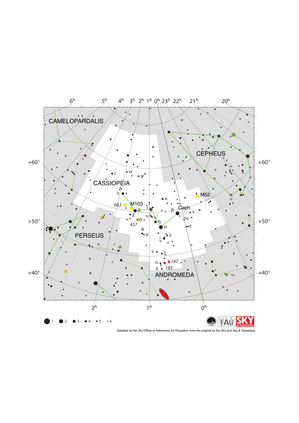
Cassiopeia Constellation Map
Legenda: The constellation Cassiopeia along with its bright stars and its surrounding constellations. Cassiopeia is surrounded by (going clockwise from the top):Cepheus, Andromeda, Perseus and Camelopardalis.
Cassiopeia is a northern constellation that is visible from all of the northern hemisphere and equatorial regions of the southern hemisphere. It is most visible in the evenings in the northern hemisphere late autumn and southern hemisphere late spring.
The open star clusters M52, M103, NGC 457 and NGC 663 all lie in this constellation. These are marked with yellow circles. Two dwarf elliptical galaxies NGC 147 and NGC 185 lie in the southern part of the constellation. These are marked with red ellipses and are gravitationally bound to the larger Andromeda galaxy which lies to the south in the constellation of Andromeda.
The y-axis of this diagram is in degrees of declination with north as up and the x-axis is in hours of right ascension with east to the left. The sizes of the stars marked here relate to the star's apparent magnitude, a measure of its apparent brightness. The larger dots represent brighter stars. The Greek letters mark the brightest stars in the constellation. These are ranked by brightness with the brightest star being labeled alpha, the second brightest beta, etc., although this ordering is not always followed exactly. The dotted boundary lines mark the IAU's boundaries of the constellations and the solid green lines mark one of the common forms used to represent the figures of the constellations. Neither the constellation boundaries, nor the lines joining the stars appear on the sky.
Crédito: Adapted by the IAU Office of Astronomy for Education from the original by IAU/Sky & Telescope
License: CC-BY-4.0 Creative Commons Attribution 4.0 International (CC BY 4.0) ícones

Mapa da Constelação do Triângulo
Legenda: A constelação do Triângulo com suas estrelas brilhantes e constelações vizinhas.O Triângulo é cercado por (no sentido horário a partir do topo): Andrômeda, Peixes, Áries e Perseu. O Triângulo é uma constelação típica do norte e, portanto, toda a constelação é visível em algum momento do ano em todo o hemisfério norte. A constelação inteira também é visível das regiões equatoriais e mais temperadas do hemisfério sul. O Triângulo é melhor visto à noite no inverno do hemisfério norte e no verão do hemisfério sul. A Galáxia do Triângulo M33 está localizada nessa constelação. Essa galáxia espiral é o terceiro maior membro do grupo local de galáxias, depois da galáxia de Andrômeda e da Via Láctea. Ela está marcada aqui com uma elipse vermelha. O eixo y desse diagrama está em graus de declinação, com o norte para cima, e o eixo x está em horas de ascensão reta, com o leste à esquerda. Os tamanhos das estrelas marcadas aqui estão relacionados à magnitude aparente da estrela, uma medida de seu brilho aparente. Os pontos maiores representam estrelas mais brilhantes. As letras gregas marcam as estrelas mais brilhantes da constelação. Elas são classificadas por brilho, com a estrela mais brilhante sendo rotulada como alfa, a segunda mais brilhante como beta, etc., embora essa ordem nem sempre seja seguida exatamente. As linhas de divisão pontilhadas marcam os limites das constelações da IAU e as linhas verdes sólidas marcam uma das formas comuns usadas para representar as figuras das constelações. A linha azul na parte inferior esquerda do diagrama marca a eclíptica. Nem os limites das constelações, nem as linhas que unem as estrelas, nem a eclíptica aparecem no céu.
Crédito: Adaptado pelo Escritório de Astronomia para Educação da IAU a partir do original da IAU e da Sky & Telescope
License: CC-BY-4.0 Creative Commons Attribution 4.0 International (CC BY 4.0) ícones
Atividades relacionadas

3D Universe: the Milky Way and friends
astroEDU educational activity (links to astroEDU website) Description: Use tactile models printed in 3D to explore our galactic neighborhood.
License: CC-BY-4.0 Creative Commons Attribution 4.0 International (CC BY 4.0) ícones
Faixas etárias:
10-12
, 12-14
, 14-16
, 16-19
, 19+
Nível de ensino:
Ensino fundamental
, Médio
, Universidade
Áreas de aprendizagem:
Aprendizagem por descoberta guiada
, Aula interativa
, Modelagem
Custos:
Custo médio
Duração:
1 hour
Tamanho do grupo:
Grupo
Habilidades:
Analisar e interpretar dados
, Desenvolver e usar modelos







.jpg)