词条 仙女座星系
描述: 仙女座星系是一个螺旋星系,与我们的银河系类似,但大小是银河系的两倍。它是在北半球唯一肉眼可见的河外星系,尽管只能在远离城市灯光的黑暗处看到。它也被称为M31,源自法国天文学家夏尔·梅西耶(Charles Messier),他创建了一个包含110个天体的星表,其中仙女座星系位于第31位。
相关词条
用其他语言查看该词条
词条和定义状态: 该术语的英文原始定义已通过天文研究人员和教师的审核 该术语及其定义的译文仍待审核
OAE多语言词汇表是由国际天文学联合会(IAU) 天文教育办公室(OAE) 和 国际天文学联合会(IAU) 天文推广办公室(OAO)合作的项目。. 术语和定义由 OAE中心, OAE 国家天文教育协调员(NAECs) 以及其他志愿者共同选择、撰写和审阅。您可以在 找到完整的致谢列表。所有词汇表术语及其定义均根据 Creative Commons CC BY-4.0许可证发布 且版权归属于 “IAU OAE”。
如果您发现此词汇术语或定义中的事实或翻译错误, 请向 发邮件 联系.
其他语言版本
- 阿拉伯语: مجرة المرأة المسلسلة
- 孟加拉语: অ্যান্ড্রোমিডা ছায়াপথ
- 德语: Andromedagalaxie
- 英语: Andromeda Galaxy
- 西班牙语: Galaxia de Andrómeda
- 法语: Galaxie d'Andromède
- 北印度语: एंड्रोमेडा आकाशगंगा
- 意大利语: Galassia di Andromeda
- 日语: アンドロメダ銀河 (外部链接)
- 韩语: 안드로메다은하
- 马拉地语: अॅन्ड्रोमेडा
- 巴西葡萄牙语: Galáxia de Andrômeda
- 繁体中文: 仙女座星系
相关媒体
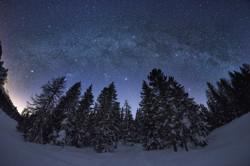
冬季银河
图注: 2022 年国际天文学联合会 OAE 天体摄影比赛静态天体图案类获奖作品。
本影像摄于2019年2月意大利威尼托大区的密苏里纳湖(Lago di Misurina),呈现冬夜星空与雪原交辉的奇景。
银河弧光下,夜空中最亮的天狼星(Sirius/大犬座α)闪耀于东南方。在希腊神话中,这颗"燃烧者"隶属猎户座忠犬——大犬座(Canis Major)。其左侧的小犬座(Canis Minor)以"先犬星"(Procyon/南河三)为主导,该星名暗示其先于天狼星升起的特性。猎户座位于大犬座右侧,其标志性"腰带三星"清晰可辨。
猎户座右上方树冠处,金牛座的毕宿星团(Hyades)与昴星团(Pleiades)构成传说中的"天界之门",此处恰为黄道与银河两大天球基准圈的交汇点。希腊神话中,金牛化身喻指宙斯诱拐腓尼基公主欧罗巴的传说。
金牛座上方银河弧缘,御夫座主星五车二(Capella)粲然生辉。这颗恒星在印度教中被视为创世神梵天之心,而巴西博罗罗原住民则将御夫座部分星群与邻座恒星共组"凯门鳄星座"。
金牛座右侧可见英仙座(Perseus),其内的英仙座h+χ双星团被古希腊人视为英雄珀尔修斯神剑的寒光。这位斩杀海怪、解救安德洛墨达的传奇人物,其故事经奥维德史诗流传至今。影像中同样可见呈W形的仙后座(Cassiopeia)——希腊诗人阿拉托斯笔下象征"天国之钥"的星群,在印度天文传统中对应莎米什塔公主,在泰国喻指蝙蝠,于阿拉伯古星象中则化身骆驼。
林木间隙处,肉眼可辨的仙女座星系(Andromeda Galaxy)静静悬浮。
来源: Giorgia Hofer/IAU OAE

A visible light image of the Andromeda Galaxy
图注: The Andromeda Galaxy viewed in visible light. Like our Milky Way, Andromeda is a barred spiral galaxy. Here we can see its bright core and spiral disk. The glow from the stars in the disk is interrupted by lanes of dust that form part of its spiral structure.
Andromeda is the largest galaxy in the Local Group of galaxies that includes the Milky Way.
To the left of the core and just above the disk we see the dwarf galaxy M32 and to the right and below the disk we see the dwarf galaxy M110. These are both satellite galaxies of the Andromeda Galaxy.
来源: Torben Hansen
来源链接
相关图表

仙女座星图
图注: 仙女座及其明亮恒星与周边星座示意图。从顶部开始沿顺时针方向,仙女座周边的星座依次为:仙后座、蝎虎座、 飞马座、双鱼座、白羊座、三角座和英仙座。仙女座最亮的恒星壁宿一位于该星座的下部区域。它与飞马座中的三颗恒星共同构成了著名的飞马座四边形这一星群。从壁宿一向东北方向延伸,接下来两颗明亮的恒星奎宿九和天大将军一连成一条明显的星链。
仙女座是北天星座,在北半球秋季的夜空中最为显着。整个北半球和南半球大部分温带地区均可观测到该星座,但在南极及亚南极地区则完全不可见。
仙女座最著名的天体——仙女座星系在图中以红色椭圆标注,它的梅西耶星表编号是M31。左边的黄色圆圈标出了疏散星团NGC 752的位置,右边的绿色圆圈标出了行星状星云NGC 7662(蓝色雪球星云)。
该图的纵轴为赤纬,横轴为赤经,方向为上北下南左东右西。图中标注的恒星大小对应其视星等——衡量天体视亮度的标准,较大的圆点代表着较亮的恒星。图中的希腊字母标注着星座中最亮的恒星。这些恒星按亮度排序,最亮的一般被标记为α星,第二亮的一般为β星,等等,不过这种字母排序并不总是和实际亮度排序完全一致。图中虚线标注的是国际天文学联合会划定的星座边界,绿色实线则是一种常见的星座形象连线。需要注意的是,在实际观测时,这些边界与连线都不会出现在天空中。
来源: 国际天文学联合会天文教育办公室(IAU OAE)根据国际天文学联合会和《天空与望远镜》的原文改编
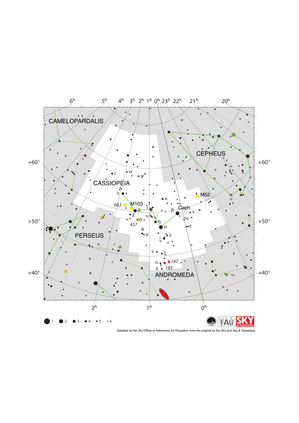
Cassiopeia Constellation Map
图注: The constellation Cassiopeia along with its bright stars and its surrounding constellations. Cassiopeia is surrounded by (going clockwise from the top):Cepheus, Andromeda, Perseus and Camelopardalis.
Cassiopeia is a northern constellation that is visible from all of the northern hemisphere and equatorial regions of the southern hemisphere. It is most visible in the evenings in the northern hemisphere late autumn and southern hemisphere late spring.
The open star clusters M52, M103, NGC 457 and NGC 663 all lie in this constellation. These are marked with yellow circles. Two dwarf elliptical galaxies NGC 147 and NGC 185 lie in the southern part of the constellation. These are marked with red ellipses and are gravitationally bound to the larger Andromeda galaxy which lies to the south in the constellation of Andromeda.
The y-axis of this diagram is in degrees of declination with north as up and the x-axis is in hours of right ascension with east to the left. The sizes of the stars marked here relate to the star's apparent magnitude, a measure of its apparent brightness. The larger dots represent brighter stars. The Greek letters mark the brightest stars in the constellation. These are ranked by brightness with the brightest star being labeled alpha, the second brightest beta, etc., although this ordering is not always followed exactly. The dotted boundary lines mark the IAU's boundaries of the constellations and the solid green lines mark one of the common forms used to represent the figures of the constellations. Neither the constellation boundaries, nor the lines joining the stars appear on the sky.
来源: Adapted by the IAU Office of Astronomy for Education from the original by IAU/Sky & Telescope
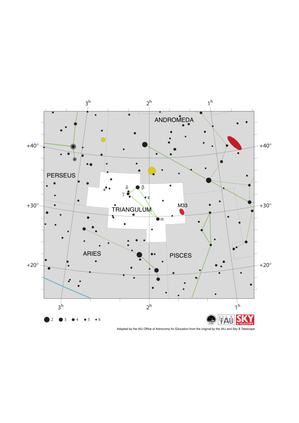
Triangulum Constellation Map
图注: The constellation Triangulum with its bright stars and surrounding constellations. Triangulum is surrounded by (going clockwise from the top): Andromeda, Pisces, Aries and Perseus.
Triangulum is a northern constellation and thus the whole constellation is visible at some point in the year throughout the northern hemisphere. The whole constellation is also visible from equatorial and most temperate regions of the southern hemisphere. Triangulum is best viewed in the evening in the northern hemisphere winter and southern hemisphere summer.
The Triangulum Galaxy M33 lies in the constellation. This spiral galaxy is the third largest member of the local group of galaxies after the Andromeda Galaxy and Milky Way. It is marked here with a red ellipse.
The y-axis of this diagram is in degrees of declination with north as up and the x-axis is in hours of right ascension with east to the left. The sizes of the stars marked here relate to the star's apparent magnitude, a measure of its apparent brightness. The larger dots represent brighter stars. The Greek letters mark the brightest stars in the constellation. These are ranked by brightness with the brightest star being labeled alpha, the second brightest beta, etc., although this ordering is not always followed exactly. The dotted boundary lines mark the IAU's boundaries of the constellations and the solid green lines mark one of the common forms used to represent the figures of the constellations. The blue line at the bottom left of the diagram marks the ecliptic. Neither the constellation boundaries, nor the lines joining the stars, nor the ecliptic, appear on the sky.
来源: Adapted by the IAU Office of Astronomy for Education from the original by the IAU and Sky & Telescope
相关活动

3D Universe: the Milky Way and friends
astroEDU educational activity (links to astroEDU website) Description: Use tactile models printed in 3D to explore our galactic neighborhood.
License: CC-BY-4.0 知识共享许可协议 署名 4.0 国际 (CC BY 4.0) 图标
年龄段:
10-12
, 12-14
, 14-16
, 16-19
, 19+
受教育等级:
初中
, 中学
, 大学
学习领域:
引导式发现学习
, 互动讲座
, 建模
费用:
中等成本
时间跨度:
1 小时
组别大小:
小组
技能:
分析和解读数据
, 开发和使用模型








.jpg)