Termo do glossário: Ionização
Descrição: A ionização é o processo de subtração ou adição de elétrons a átomos previamente neutros, mudando assim um gás de átomos (ou moléculas) neutros para um composto de íons carregados, ou seja, um plasma.
Termos relacionados:
Ver este termo em outros idiomas
Status do termo e da definição: A definição original deste termo em inglês foi aprovada por um astrônomo(a) pesquisador(a) e um(a) professor(a) A tradução deste termo e de sua definição ainda aguarda aprovação
O Glossário Multilíngue da OAE é um projeto do Escritório da IAU de Astronomia para a Educação (OAE) em colaboração com o Escritório da IAU para Divulgação da Astronomia (OAO). Os termos e definições foram selecionados, escritos e revisados por meio de um esforço coletivo da OAE, dos Centros e Nós da OAE, dos Coordenadores Nacionais de Educação em Astronomia (NAECs) da OAE e de outros voluntários. Você pode encontrar uma lista completa dos créditos aqui. Todos os termos do glossário e suas definições são disponibilizados sob uma licença Creative Commons CC BY-4.0 e devem ser creditados à "IAU OAE".
Se você notar algum erro factual ou de tradução neste termo do glossário ou em sua definição, por favor entre em contato.
Em outros idiomas
- Árabe: التأيُّن
- Alemão: Ionisierung
- Inglês: Ionization
- Espanhol: Ionización
- Francês: Ionisation
- Italiano: Ionizzazione
- Coreano: 이온화
- Chinês Simplificado: 电离
- Chinês Tradicional: 電離
Mídia relacionada
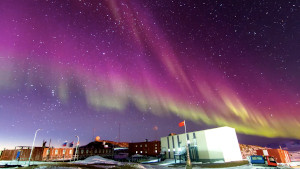
Até o fim do mundo, por Hang Li, China
Legenda: Primeiro lugar no Concurso de Astrofotografia da IAU OAE 2021, categoria Aurorae (time-lapses).
As auroras são frequentemente chamadas de “luzes do norte” na Europa ou na América do Norte, mas aqui vemos que elas também existem no extremo sul do nosso planeta. Filmado na Estação Zhongshan, na Antártida, este vídeo em time-lapse (câmera-rápida) mostra como algumas faixas da aurora podem permanecer estáveis por longos períodos, enquanto outras características parecem “dançar”. Veja quantos padrões diferentes de redemoinhos e ondas você consegue identificar no vídeo.
Crédito: Hang Li/IAU OAE
License: CC-BY-4.0 Creative Commons Attribution 4.0 International (CC BY 4.0) ícones
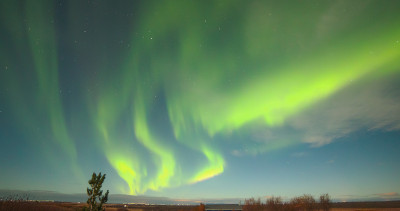
Icelandic Rivers of Light, by Sergio Díaz Ruiz, Spain
Legenda: Second place in the 2021 IAU OAE Astrophotography Contest, category Aurorae (time-lapses)
This video shows how aurorae evolve slowly over timescales of a few minutes. Note the clouds being illuminated from behind in the last two shots. Aurorae are caused by interactions between the charged particles blown out in huge explosions from the Sun and the Earth's magnetic field. The changes over time are caused by huge waves of particles pushing the Earth's magnetic field into strange shapes before it snaps back into place.
Crédito: Sergio Díaz Ruiz/IAU OAE
License: CC-BY-4.0 Creative Commons Attribution 4.0 International (CC BY 4.0) ícones
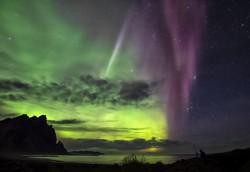
Multicolored aurora in Iceland, by Marco Migliardi on behalf of Associazione Astronomica Cortina, Italy
Legenda: First place in the 2021 IAU OAE Astrophotography Contest, category Aurorae (still images)
Aurorae are the result of ionisation and excitation processes in Earth's upper atmosphere, caused by charged particles from the solar wind or from coronal mass ejections. The different colours in an aurora display indicate the species of atmospheric atoms and molecules involved. The most common colour is a bright green, which, together with deep red, originates from atomic oxygen. Blue, purple and pink hues are much rarer and originate from molecular nitrogen. The reflection of the aurora in the water indicates the brightness of intense aurorae at higher latitudes.
Crédito: Marco Migliardi on behalf of Associazione Astronomica Cortina/IAU OAE.
License: CC-BY-4.0 Creative Commons Attribution 4.0 International (CC BY 4.0) ícones
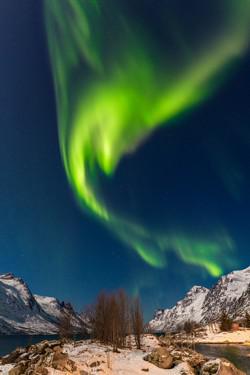
Northern light dragon over Ersfjordbotn/Norway
Legenda: Second place in the 2021 IAU OAE Astrophotography Contest, category Aurorae (still images)
Aurorae often display waving curtain-like patterns where arcs or bands form moving curls, folds, or even spirals. These irregular shapes mirror the small-scale structure of Earth's magnetic field interacting with charged particle flows. Although the full Moon illuminates both the landscape and the night sky, the auroa is easily visible, which demonstrates that it can be a very bright and colourful phenomenon.
Crédito: Rainer Sparenberg/IAU OAE
License: CC-BY-4.0 Creative Commons Attribution 4.0 International (CC BY 4.0) ícones