Termo do glossário: Tempestade geomagnética
Descrição: Além da radiação eletromagnética emitida pelo Sol, há um fluxo constante de partículas carregadas que deixam o Sol, conhecido como vento solar. Certos tipos de atividade solar – como as erupções solares e as mais dramáticas ejeções de massa coronal – podem aumentar repentina e drasticamente a quantidade de partículas carregadas que saem do Sol, criando uma frente de choque dentro do vento solar, que se propaga para fora. Se partes dessa frente de choque atingirem nosso planeta, elas interagem com o campo magnético da Terra, criando uma tempestade geomagnética (às vezes também chamada de tempestade solar). As consequências variam de inofensivas – aumento e maior beleza das luzes polares (auroras) – a interações prejudiciais que podem danificar satélites, perturbar transmissões e, em casos extremos, interromper redes de energia elétrica.
Termos relacionados:
Ver este termo em outros idiomas
Status do termo e da definição: A definição original deste termo em inglês foi aprovada por um astrônomo(a) pesquisador(a) e um(a) professor(a) A tradução deste termo e de sua definição ainda aguarda aprovação
O Glossário Multilíngue da OAE é um projeto do Escritório da IAU de Astronomia para a Educação (OAE) em colaboração com o Escritório da IAU para Divulgação da Astronomia (OAO). Os termos e definições foram selecionados, escritos e revisados por meio de um esforço coletivo da OAE, dos Centros e Nós da OAE, dos Coordenadores Nacionais de Educação em Astronomia (NAECs) da OAE e de outros voluntários. Você pode encontrar uma lista completa dos créditos aqui. Todos os termos do glossário e suas definições são disponibilizados sob uma licença Creative Commons CC BY-4.0 e devem ser creditados à "IAU OAE".
Se você notar algum erro factual ou de tradução neste termo do glossário ou em sua definição, por favor entre em contato.
Em outros idiomas
- Árabe: العاصفة الجيومغناطيسية
- Alemão: Geomagnetischer Sturm
- Inglês: Geomagnetic Storm
- Espanhol: Tormenta geomagnética
- Francês: Tempête géomagnétique
- Italiano: Tempesta Geomagnetica
- Japonês: 磁気嵐 (link externo)
- Chinês Simplificado: 地磁暴
- Chinês Tradicional: 地磁暴
Mídia relacionada
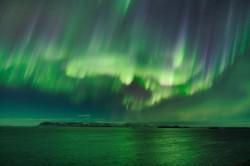
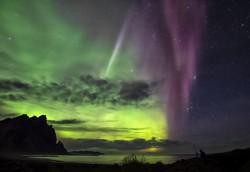
Iceland aurora, by Emanuele Balboni, Italy
Legenda: Third place in the 2021 IAU OAE Astrophotography Contest, category Aurorae (still images)
The blurred motions of the aurora caught during the exposure time of this photograph beautifully illustrate its dynamic nature. While certain forms of aurorae, like homogeneous arcs and bands or diffuse glows, can remain static for hours, others, like rayed arcs or bands (also called "curtains"), can change within seconds in shape and brightness.
Crédito: Emanuele Balboni/IAU OAE
License: CC-BY-4.0 Creative Commons Attribution 4.0 International (CC BY 4.0) ícones
Multicolored aurora in Iceland, by Marco Migliardi on behalf of Associazione Astronomica Cortina, Italy
Legenda: First place in the 2021 IAU OAE Astrophotography Contest, category Aurorae (still images)
Aurorae are the result of ionisation and excitation processes in Earth's upper atmosphere, caused by charged particles from the solar wind or from coronal mass ejections. The different colours in an aurora display indicate the species of atmospheric atoms and molecules involved. The most common colour is a bright green, which, together with deep red, originates from atomic oxygen. Blue, purple and pink hues are much rarer and originate from molecular nitrogen. The reflection of the aurora in the water indicates the brightness of intense aurorae at higher latitudes.
Crédito: Marco Migliardi on behalf of Associazione Astronomica Cortina/IAU OAE.
License: CC-BY-4.0 Creative Commons Attribution 4.0 International (CC BY 4.0) ícones
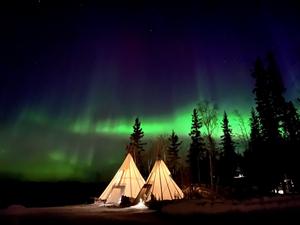
Northern Lights - Teepees
Legenda: Honorable mention in the 2023 IAU OAE Astrophotography Contest, category of Still images taken exclusively with smartphones/mobile devices.
Taken with a smartphone at Cassidy Point, Yellowknife, Canada, on 24 March 2023, this stunning display captured the ethereal Northern Lights painting the night sky. The biting cold of -20°F (-29°C) set the stage for the vibrant hues of the Aurora Borealis, a celestial ballet created by collisions between charged solar particles and the Earth's atmosphere. The Earth’s magnetic field directs the charged particles towards the polar regions, where they interact with the various atoms and molecules in the atmosphere. This natural phenomenon transforms the sky into a canvas of radiant greens, pinks, and purples, casting a mesmerising glow above. The different colours of an aurora are determined by the gases in Earth’s atmosphere, the altitude where the aurora occurs, the density of the atmosphere, and the energy of the charged particles. In general, green is attributed to atomic oxygen, red is associated with high-altitude atomic oxygen and molecular nitrogen, while purple and blue are associated with molecular nitrogen only. Pink auroras are typically associated with a mix of nitrogen blue and red. Against this cosmic backdrop, the teepees of Aurora Village below provide a tranquil contrast to the celestial spectacle unfolding overhead. Preserving the pristine darkness of this location ensures the continued splendour of such awe-inspiring natural light shows.
Crédito: Oanh Vuong/IAU OAE (CC BY 4.0)
License: CC-BY-4.0 Creative Commons Attribution 4.0 International (CC BY 4.0) ícones
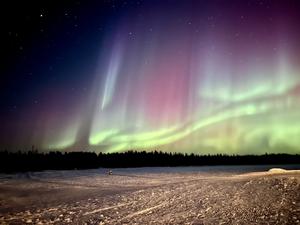
Northern Lights Color
Legenda: Winner in the 2023 IAU OAE Astrophotography Contest, category of Still images taken exclusively with smartphones/mobile devices.
This photograph taken with a smartphone captures the ethereal beauty of the Northern Lights at Cassidy Point, Yellowknife, NT, Canada on 24 March 2023, at temperatures well below freezing (–29°C). The mesmerising dance of the Aurora Borealis (Australis), commonly known as the Northern (Southern) Lights, paints the night sky in striking hues. The aurora is a natural phenomenon caused by charged particles from the Sun interacting with Earth’s atmosphere, and being redirected by Earth’s magnetic field towards the north and south polar regions. The charged particles excite atoms and molecules in the atmosphere, resulting in a light display that varies in colour and form. The different colours of an aurora are determined by the gases (atoms and molecules) in Earth's atmosphere, the altitude of the aurora, the density of the atmosphere, and the energy of the charged particles. In general, green is attributed to atomic oxygen, red is associated with high-altitude atomic oxygen and molecular nitrogen, while purple and blue are associated with molecular nitrogen only. Pink auroras are typically associated with a mix of nitrogen blue and red. On this particular night, the serene environment of Cassidy Point provided an unobstructed view of the lights.
Crédito: Jason Johnson/IAU OAE (CC BY 4.0)
License: CC-BY-4.0 Creative Commons Attribution 4.0 International (CC BY 4.0) ícones
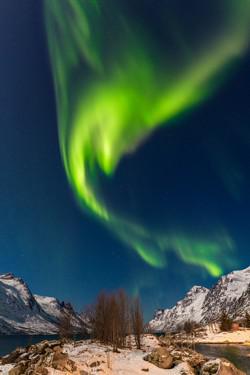
Northern light dragon over Ersfjordbotn/Norway
Legenda: Second place in the 2021 IAU OAE Astrophotography Contest, category Aurorae (still images)
Aurorae often display waving curtain-like patterns where arcs or bands form moving curls, folds, or even spirals. These irregular shapes mirror the small-scale structure of Earth's magnetic field interacting with charged particle flows. Although the full Moon illuminates both the landscape and the night sky, the auroa is easily visible, which demonstrates that it can be a very bright and colourful phenomenon.
Crédito: Rainer Sparenberg/IAU OAE
License: CC-BY-4.0 Creative Commons Attribution 4.0 International (CC BY 4.0) ícones