Glossary term: महाग्रह
Description: विशाल ग्रह एक ठूलो पिण्ड हो जुन मुख्यतया हाइड्रोजन, हेलियम, वा पानी, मिथेन, वा अमोनिया जस्ता अधिक जटिल अणुहरूबाट बनेको हुन्छ। जबकि स्थलीय ग्रह मुख्यतया धेरै उच्च उम्लने बिन्दु भएका पदार्थहरू जस्तै फलाम वा चट्टानबाट बनेको हुन्छ, विशाल ग्रहहरूमा अन्य पदार्थले घेरिएको ठोस कोर रहेको मानिन्छ। विशाल ग्रहको द्रव्यमान पृथ्वीको भन्दा धेरै बढी हुन्छ, जसले गर्दा यसको गुरुत्वाकर्षण हाइड्रोजन र हेलियम जस्ता हल्का तत्वहरूबाट बनेको विस्तारित ग्यासीय वायुमण्डललाई कायम राख्न पर्याप्त बलियो हुन्छ।
विशाल ग्रहहरू दुई श्रेणीमा पर्छन्: ग्यास विशाल ग्रहहरू जुन मुख्यतया हाइड्रोजन र हेलियमबाट बनेका हुन्छन्, र बरफ विशाल ग्रहहरू जुन मुख्यतया पानी, मिथेन, र अमोनियाबाट बनेका हुन्छन् र हाइड्रोजन र हेलियमको वायुमण्डलले घेरिएका हुन्छन्। दुवै अवस्थामा नामहरू भ्रामक हुन सक्छन् किनभने ग्यास विशाल ग्रहहरूमा अधिकांश पदार्थ ग्यासीय अवस्थामा हुँदैन र बरफ विशाल ग्रहहरूमा ठोस बरफ हुँदैन, बरु यो त्यो पदार्थ हो जुन ग्रहमा जम्मा हुनु अघि चिसो बाह्य सौर्यमण्डलमा जमेको थियो।
सौर्यमण्डलका चार सबैभन्दा ठूला ग्रहहरू (बृहस्पति, शनि, वरुण, र अरुण) सबै विशाल ग्रहहरू हुन्।
Related Terms:
See this term in other languages
Term and definition status: The original definition of this term in English have been approved by a research astronomer and a teacher The translation of this term and its definition is still awaiting approval
The OAE Multilingual Glossary is a project of the IAU Office of Astronomy for Education (OAE) in collaboration with the IAU Office of Astronomy Outreach (OAO). The terms and definitions were chosen, written and reviewed by a collective effort from the OAE, the OAE Centers and Nodes, the OAE National Astronomy Education Coordinators (NAECs) and other volunteers. You can find a full list of credits here. All glossary terms and their definitions are released under a Creative Commons CC BY-4.0 license and should be credited to "IAU OAE".
If you notice a factual or translation error in this glossary term or definition then please get in touch.
In Other Languages
- अरबिक: الكوكب العملاق
- जर्मन: Riesenplanet
- अंग्रेजी: Giant Planet
- स्पेनिस: Planeta gigante
- फ्रान्सेली: Planète géante
- ईटालियन: Pianeta gigante
- ब्राजिली पुर्तगाली: Planeta gigante
- सरल चिनि: 巨行星
- प्राचिन चिनि: 巨行星
Related Media
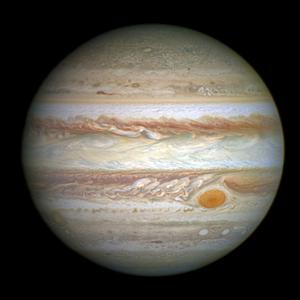
Jupiter
Caption: This full disk view of Jupiter was obtained on 21 April 2014 with Hubble's Wide Field Camera 3 (WFC3). It shows the prominent great red spot, a gigantic cyclone. Cloud ribbons cover the surface, whose colours stem from gases like ammonia and other chemical compounds.
Credit: NASA, ESA, and A. Simon (Goddard Space Flight Center)
credit link
License: CC-BY-4.0 Creative Commons Attribution 4.0 International (CC BY 4.0) icons
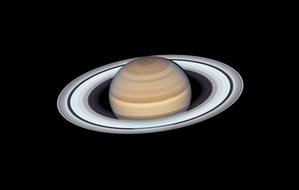
Saturn
Caption: The NASA/ESA Hubble Space Telescope’s Wide Field Camera 3 observed Saturn on 20 June 2019 as the planet made its closest approach to Earth this year, at approximately 1.36 billion kilometres away. The image shows coloured bands of gas on the planet's surface as well as its prominent rings made of ice and rocky material.
Credit: NASA, ESA, A. Simon (Goddard Space Flight Center), and M.H. Wong (University of California, Berkeley)
credit link
License: CC-BY-4.0 Creative Commons Attribution 4.0 International (CC BY 4.0) icons
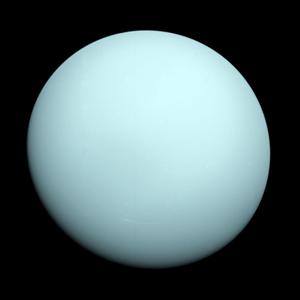
Uranus in natural colours
Caption: This is an image of the planet Uranus taken by the spacecraft Voyager 2 in 1986. Its appearance is close to what the naked eye would see. The greenish-blue colour indicates an atmosphere containing methane.
Credit: NASA/JPL-Caltech
credit link
License: PD Public Domain icons
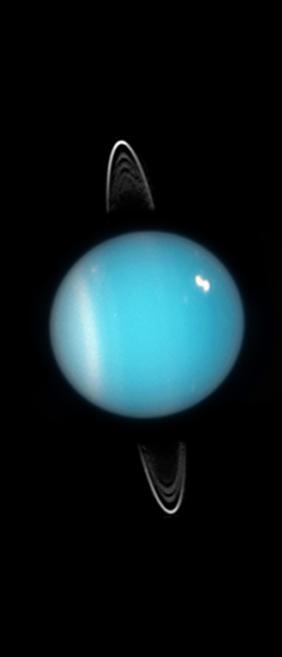
Uranus with rings
Caption: The NASA/ESA Hubble Space Telescope’s ACS/HRC camera observed Uranus in August 2005. The surface depicts white clouds and a bright polar region. The rings around Uranus are narrow and contain rocky material from tiny dust particles up to metre-sized boulders.
Credit: NASA, ESA, and M. Showalter (SETI Institute)
credit link
License: PD Public Domain icons
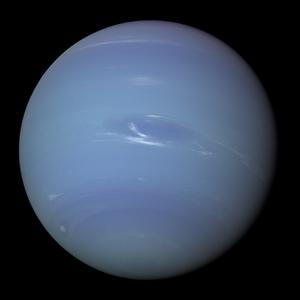
Neptune
Caption: Voyager 2 Narrow Angle Camera image of Neptune taken in August 1989. The Great Dark Spot, flanked by cirrus clouds, is at center. A smaller dark storm, Dark Spot Jr., is rotating into view at bottom left. Additionally, a patch of white cirrus clouds to its north, named "Scooter" for its rapid motion relative to other features, is visible.
Credit: NASA / JPL / Voyager-ISS / Justin Cowart
credit link
License: PD Public Domain icons