Glossary term: Optics
Description: Optics is the science of light and its interactions with matter, and the art of constructing instruments that make use of the general principles of light–matter interactions. In astronomy, the "optics" of a telescope or instrument are those parts that guide light towards a detector, notably mirrors, lenses, masks, slits, or waveguides where visible light is concerned, as well as dispersive elements such as prisms and gratings that produce spectra. Active optics is the term for a mirror kept in the correct shape by active mechanical elements ("actuators"), while adaptive optics is a system whereby a mirror is quickly deformed in just the right way to counteract atmospheric disturbances (the "twinkling" of stars). The adjective "optical" is also used to refer to astronomy using visible light.
Related Terms:
See this term in other languages
Term and definition status: This term and its definition have been approved by a research astronomer and a teacher
The OAE Multilingual Glossary is a project of the IAU Office of Astronomy for Education (OAE) in collaboration with the IAU Office of Astronomy Outreach (OAO). The terms and definitions were chosen, written and reviewed by a collective effort from the OAE, the OAE Centers and Nodes, the OAE National Astronomy Education Coordinators (NAECs) and other volunteers. You can find a full list of credits here. All glossary terms and their definitions are released under a Creative Commons CC BY-4.0 license and should be credited to "IAU OAE".
If you notice a factual error in this glossary definition then please get in touch.
Related Media
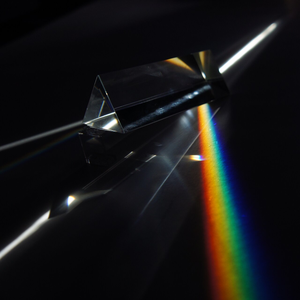
Light Dispersion by a Triangular Prism
Caption: This photograph shows a prism splitting a beam of white light into its component colors — a beautiful demonstration of optics, the branch of physics that studies how light behaves and interacts with materials. When white light enters the prism, different wavelengths (colors) bend by different amounts because of a process called refraction. This separation of colors produces a spectrum — similar to a rainbow — revealing that white light is actually made up of many colors combined going from blue, through green and yellow to red.
Understanding optics helps scientists and engineers design lenses, microscopes, telescopes, cameras, and many other tools that shape and control light for practical use. The way the prism disperses light into a spectrum is the same principle that makes rainbows form in the sky when sunlight passes through raindrops.
Credit: Kelvinsong
credit link
License: CC0 CC0 1.0 Universal (CC0 1.0) Public Domain Dedication icons
Related Activities
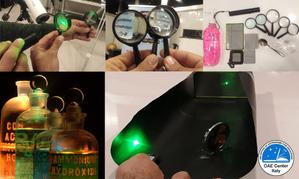
How do telescopes work?
astroEDU educational activity (links to astroEDU website) Description: Let's discover telescopes and experiment simple optics
License: CC-BY-4.0 Creative Commons Attribution 4.0 International (CC BY 4.0) icons
Age Ranges:
10-12
Education Level:
Primary
Areas of Learning:
Guided-discovery learning
, Historical focussed activity
, Observation based
Costs:
Medium Cost
Duration:
1 hour
Group Size:
Group
Skills:
Asking questions






.jpg)
