This page describes an image Evoluzione stellare
Scarica File ( immagine 999.87 kB)
Scarica il file PDF (PDF file 952.32 kB)
Disponibile anche in bianco e nero
Scarica File ( immagine 448.90 kB)
Scarica il file PDF (PDF file 648.71 kB)
Didascalia del diagramma:
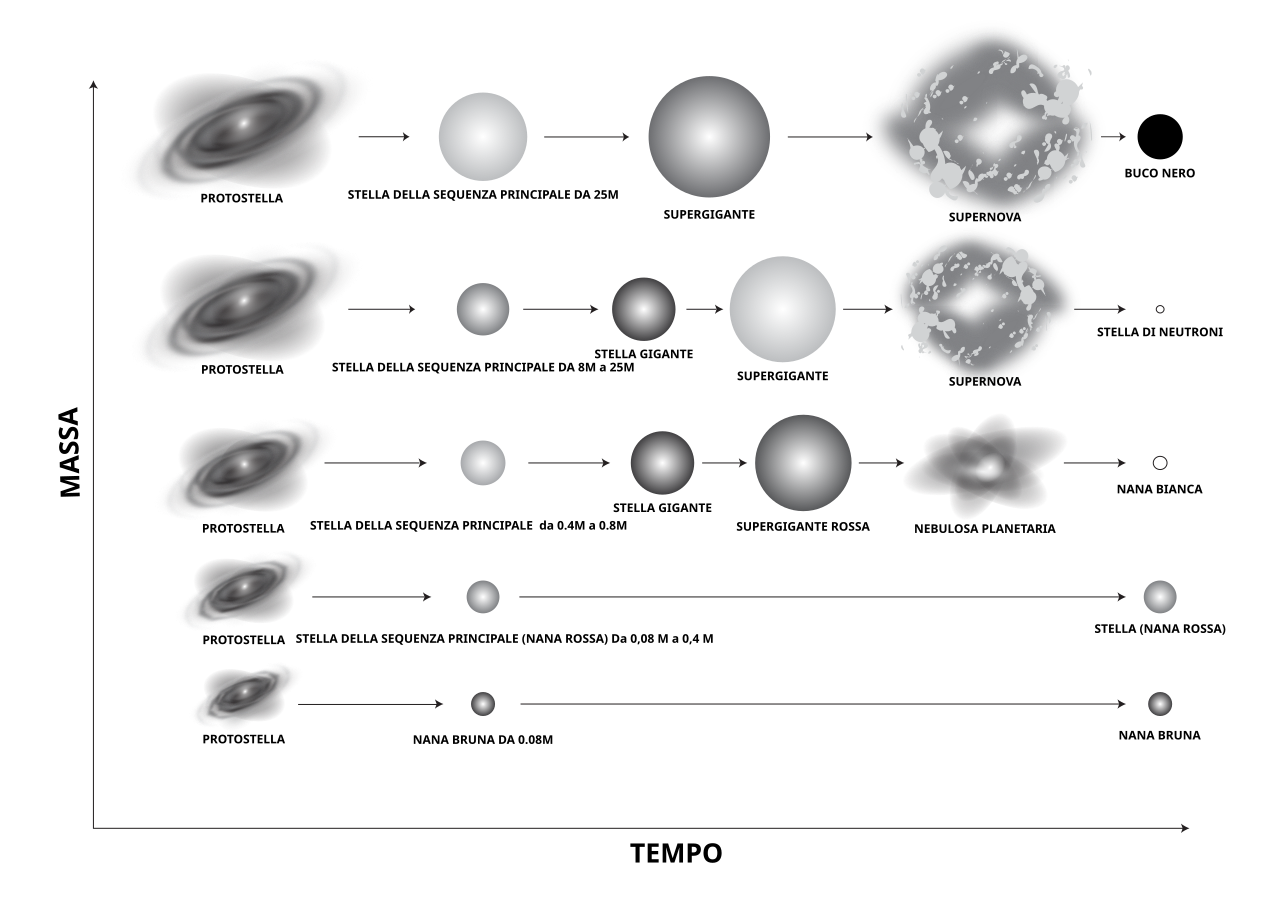
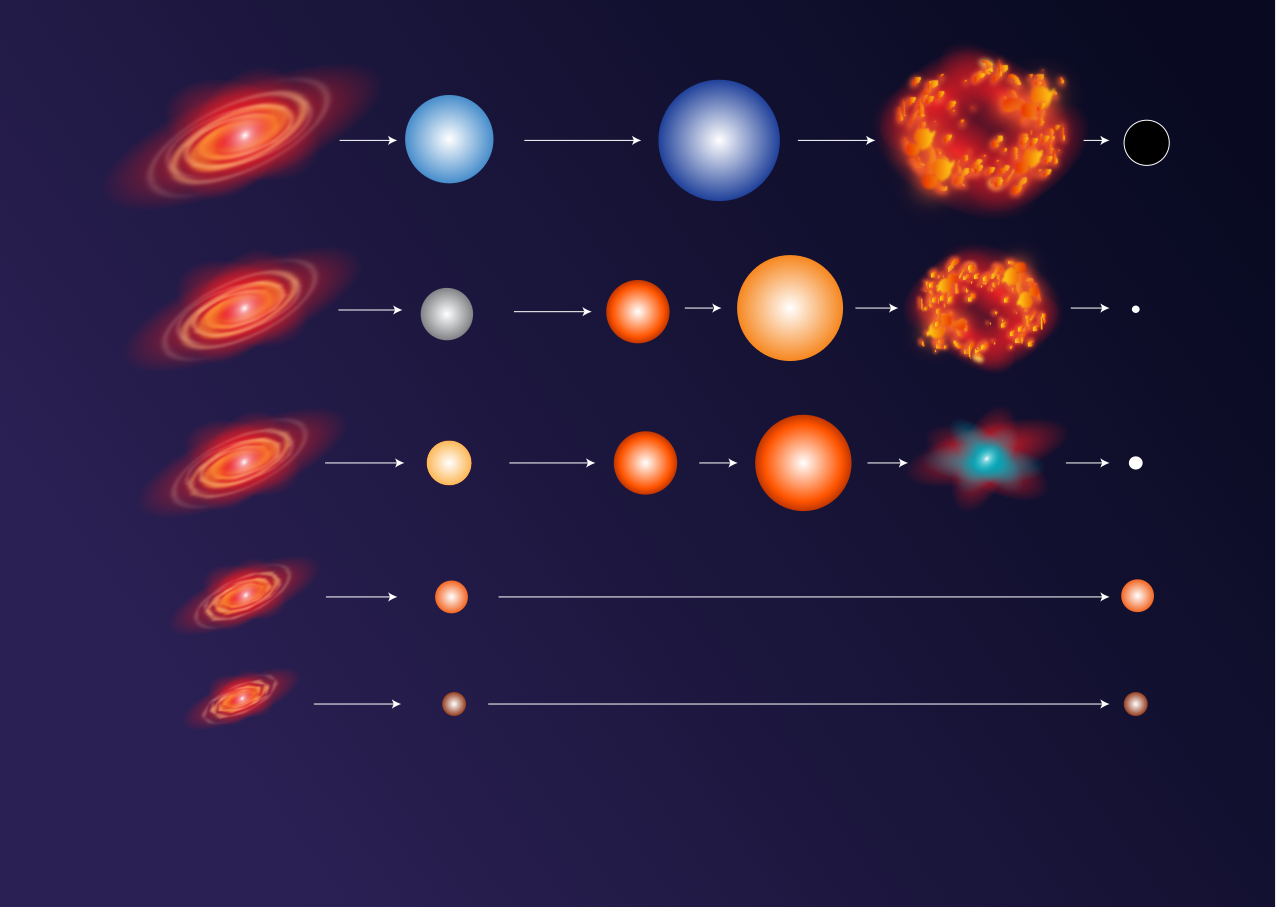
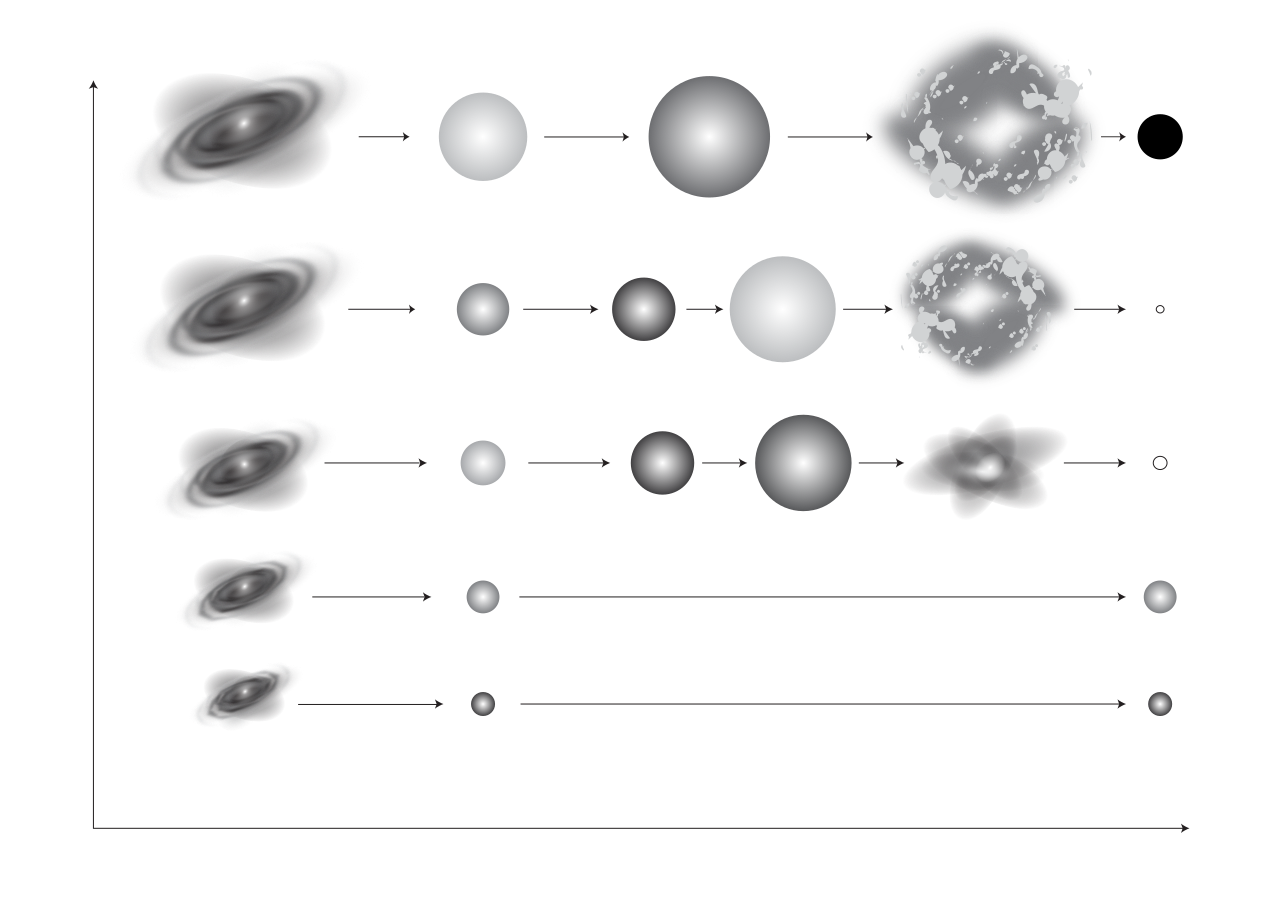
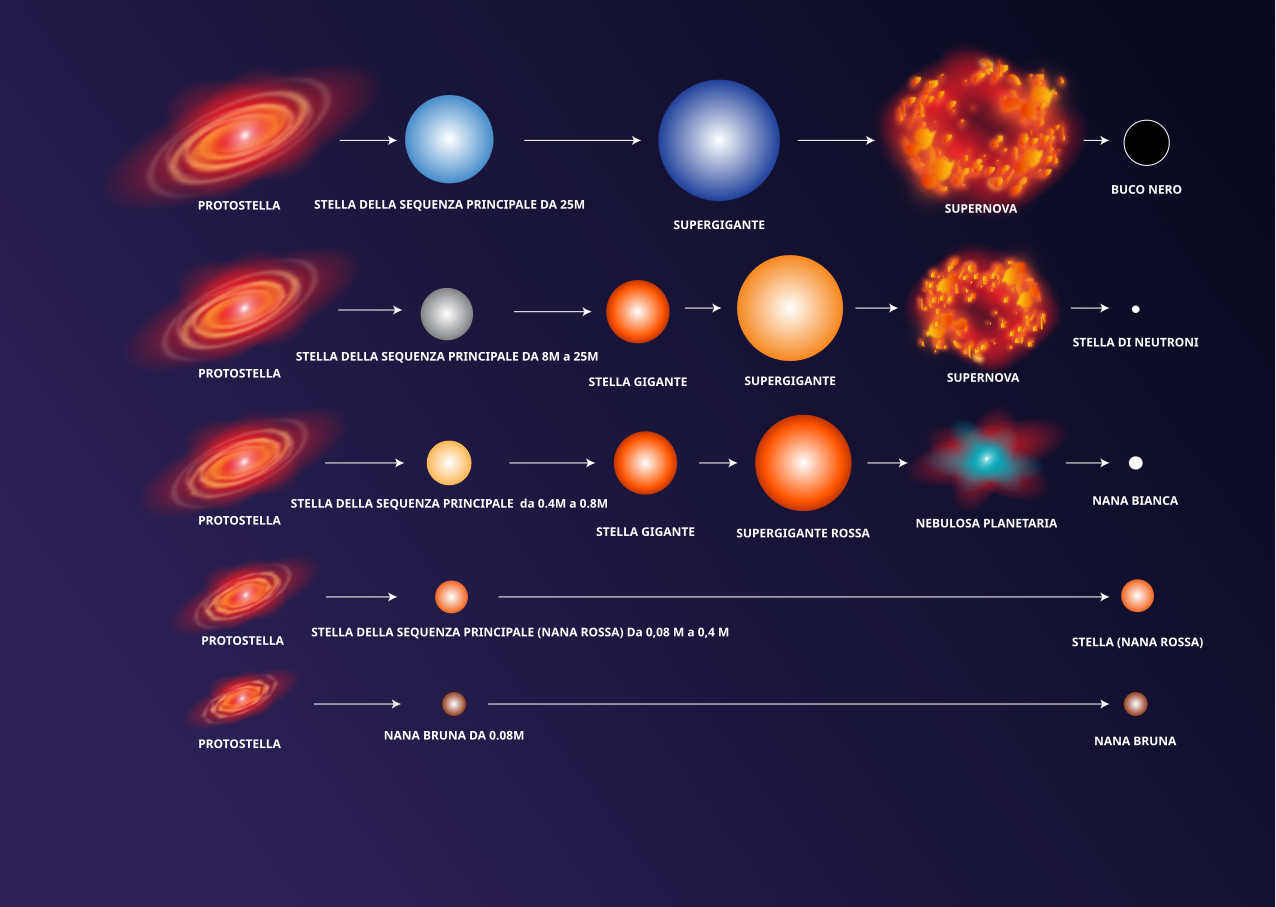
Questo diagramma illustra il ciclo di vita di stelle di massa diversa. La massa dei vari tipi di stelle aumenta dal basso verso l’alto con il passare del tempo, da sinistra a destra.
Il ciclo di vita di una stella dipende dalla sua massa: le stelle con massa inferiore hanno una durata di vita più lunga. Tutte le stelle si formano da nubi di gas che collassano sotto la propria gravità. Man mano che la stella collassa, il suo nucleo diventa più caldo e più denso. Se la stella ha una massa superiore a 0,08 masse solari (0,08 volte la massa del Sole), la pressione esercitata dalla massa della stella sul proprio nucleo crea una temperatura del nucleo sufficientemente elevata da innescare la fusione dell’idrogeno. In questo modo l’idrogeno viene bruciato nel nucleo della stella trasformandosi in elio, fornendo una fonte di calore che alimenta la stella e impedisce al suo nucleo di collassare ulteriormente. Se l’oggetto in collasso ha una massa inferiore a 0,08 masse solari, la fusione dell’idrogeno nel suo nucleo non si innesca. Continua quindi a raffreddarsi e a contrarsi lentamente. Tali oggetti substellari sono noti come nane brune, qui raffigurate nella riga più in basso.
Una volta formatesi, le stelle bruciano l’idrogeno nei loro nuclei e iniziano la cosiddetta fase della sequenza principale. Le stelle più massicce (>25 masse solari, qui raffigurate in alto) hanno temperature del nucleo molto elevate e quindi consumano il loro combustibile a base di idrogeno più rapidamente. Ciò significa che potrebbero trascorrere solo pochi milioni di anni sulla sequenza principale bruciando idrogeno nei loro nuclei. Una volta esaurito l’idrogeno nel nucleo, il nucleo della stella si contrae, diventa più caldo e nel nucleo ha inizio la combustione dell’elio. Mentre il nucleo si contrae, gli strati esterni della stella si espandono ed essa diventa una supergigante. Nel caso delle stelle più massicce, forti venti stellari spogliano la stella degli strati esterni più freddi, portando la stella a diventare molto grande e molto calda: una supergigante blu. Una volta esaurito l’elio nel nucleo, viene bruciato il carbonio e poi elementi più pesanti. Alla fine la stella termina con un nucleo di ferro. La fusione del ferro in elementi più pesanti non genera energia, quindi a questo punto la fusione nel nucleo si arresta. Quando questo nucleo di ferro raggiunge una massa sufficiente, esso e la materia circostante collassano improvvisamente formando un buco nero, mentre gli strati esterni vengono scagliati via in un’esplosione di supernova.
Le stelle di massa leggermente inferiore (tra 8 e 25 masse solari, qui visibili al secondo posto dall’alto) si evolvono in modo simile, sebbene non dispongano di venti sufficientemente intensi da espellere i propri strati esterni e diventare supergiganti blu; si evolvono invece in supergiganti rosse. Anche queste stelle collassano e generano esplosioni di supernova. Il residuo del nucleo della stella non è abbastanza massiccio da collassare in un buco nero. Al contrario, i suoi elettroni e protoni si combinano per formare neutroni ed è sostenuto da un effetto della meccanica quantistica chiamato pressione di degenerazione dei neutroni. Ciò fa sì che il residuo della stella sia una minuscola stella di neutroni, con una massa di diverse masse solari ma un diametro di soli pochi chilometri.
Per le stelle di massa simile a quella del Sole (tra 0,4 e 8 masse solari, visibili qui nella riga centrale), la stella brucia idrogeno nel proprio nucleo fino a esaurirlo. A questo punto, attorno al nucleo si forma un guscio in cui brucia l’idrogeno. Alla fine il nucleo diventerà abbastanza caldo da bruciare l’elio trasformandolo in carbonio e ossigeno. Successivamente, la stella si ritrova con un nucleo di carbonio e ossigeno circondato da gusci in cui bruciano elio e idrogeno. Questi gusci sono instabili e producono pulsazioni termiche che scuotono la stella. Alla fine queste pulsazioni diventano così intense che gli strati esterni della stella vengono espulsi. Ciò lascia il nucleo di carbonio e ossigeno come una nana bianca sostenuta dalla pressione di degenerazione degli elettroni. Gli strati esterni della stella formano quella che è nota come nebulosa planetaria (che in realtà non ha nulla a che vedere con i pianeti, nonostante il nome).
Le stelle di massa più bassa (visibili qui nella seconda riga dal basso) hanno una massa talmente ridotta che i loro tempi evolutivi sono molto più lunghi dell’età dell’universo. Ciò significa che nessuna di esse si è evoluta oltre la sequenza principale. Le stelle di bassa massa sono completamente convettive, il che significa che il materiale nel nucleo viene costantemente mescolato con quello sovrastante. Ciò implica che tutto l’idrogeno presente nella stella finirebbe per essere bruciato nel nucleo, ma questo processo richiederà trilioni di anni.
Crediti per il Diaframma: Danielle Futselaar/IAU OAE.
Stato di traduzione del Diagramma: Non ancora approvato da un revisore
Traduttori del Diagramma: Giuliana Giobbi
Licenza diagramma: Creative Commons Attribuzione 4.0 Internazionale (CC BY 4.0) Creative Commons Attribuzione 4.0 Internazionale (CC BY 4.0) icone
Termini di glossario connessi:
Buco nero
, Evoluzione stellare
, Formazione delle stelle
, Fusione di idrogeno
, Nana Bianca
, Residui stellari
, Stella di neutroni
, Stella supergigante
, Supernova
Want to make your own translation or version of this diagram? Then
download the SVG
version of this diagram in English (801.78 kB). You can edit this using
software like Inkscape (free) or Adobe Illustrator
(proprietary). Just remember to credit the author of the original appropriately.
Disponibile anche in bianco e nero ( immagine 801.78 kB).
You can also make your own version or translation of this diagram by adding adding text to a version of
this diagram with no text. Just download one of the following files:
Download Text-Free File ( immagine 931.25 kB)
Download Text-Free PDF File (PDF file 946.98 kB)
Disponibile anche in bianco e nero:
Download Text-Free File ( immagine 401.54 kB)
Download Text-Free PDF File (PDF file 643.36 kB)
Le didascalie di file multimediali presentate sul sito web OAE sono state scritte,Tradotte e riviste tramit Sun impegno collettivo dell'OAE, dei Centri e Nodi OAE, iCoordinatori Nazionali per la Didattica dell'Astronomia e altri volontari. Trovatel'elenco completo dei crediti per il nostro progetto di traduzione. Tutte le didascaliedei file multimediali sono pubblicate sotto Creative Commons CC BY-4.0 licenza di traduzione, e dovrebbero essereaccreditate all'IAU OAE.I file multimediali stessi possono avere licenze diverse (vedi sopra) eDovrebbero essere accreditate come specificato al paragrafo "crediti"
Se noti un errore in questo diagramma, o nella sua didascalia, per favore contattaci.