Termine del Glossario Fusione di idrogeno
Descrizione Il termine fusione nucleare indica tutte le reazioni in cui nuclei atomici più leggeri si scontrano e si fondono per formare uno o più nuclei atomici più pesanti. In astronomia, la fusione dell'idrogeno è la reazione di fusione nucleare che trasforma i nuclei di idrogeno (ciascuno costituito da un singolo protone) in nuclei di elio-4 (ciascuno costituito da due protoni e due neutroni legati insieme). Il nucleo di elio-4 ha una massa inferiore alla somma delle masse dei protoni e dei neutroni che lo compongono. Secondo la famosa formula di Einstein E=mc2, questa differenza di massa corrisponde a una differenza di energia. Quando i protoni e i neutroni si fondono per formare l'elio-4, viene rilasciata la quantità di energia corrispondente a questa differenza. In questo modo, la fusione dell'idrogeno serve come fonte di energia per le cosiddette stelle di sequenza principale come il nostro Sole. Almeno per un certo periodo di tempo, tali stelle si trovano in uno stato di equilibrio: La quantità di energia rilasciata dalla fusione dell'idrogeno nei loro nuclei corrisponde all'energia che queste stelle luminose emettono sotto forma di luce e altri tipi di radiazioni elettromagnetiche e di particelle.
La fusione dell'idrogeno avviene attraverso diversi passaggi intermedi. Per le stelle con una massa pari o inferiore a quella del nostro Sole, procede attraverso la cosiddetta catena protone-protone (catena pp). Nella versione più semplice di questa catena di reazioni, due nuclei di idrogeno (protoni) si fondono per produrre nuclei di deuterio (un protone, un neutrone ciascuno), che poi si fondono con un altro nucleo di idrogeno per produrre elio-3 (due protoni, un neutrone). Due di questi nuclei di elio-3 si fondono per dare elio-4 e due nuclei di idrogeno rimanenti. Nelle stelle con una massa superiore a 1,3 volte quella del nostro Sole, un processo alternativo, definito ciclo CNO, diventa il modo dominante per fondere l'idrogeno in elio. Gli scienziati sulla Terra hanno costruito macchine per creare reazioni di fusione con la speranza che in futuro possa diventare un modo praticabile per generare energia. La fusione dell'idrogeno non avviene solo nelle stelle, ma anche durante la fase iniziale del Big Bang del nostro universo.
Termini correlati
Vedi questo termine in altre lingue
status del termine e della definizione La definizione originale di questo termine in inglese é stata approvata da un ricercatore astronomo e da un docente La traduzione di questo termine e della sua definizione sono ancora in attesa di approvazione
Il Glossario Multilingue OAE é un progetto dell'Ufficio IAU per la didatticadell'astronomia (OAE) in collaborazione con l'ufficio IAU per la DivulgazioneAstronomica (OAO). I termini e le definizioni sono stater scelte, scritte eriviste da un impegno collettivo da parte di OAE, i Centri e i Nodi OAE e i Coordinatori Nazionali per la Didattica dell'Astronomia e da altri volontari.Potete trovare una lista completa dei crediti, Tutti i termini del glossarioE le definizioni sono pubblicate su Creative Commons CC BY-4.0 licenza e dovrebbero essere accreditate ad IAU OAE.Se noti un errore di fatto o di traduzione in questo termine del glossario, per favore contattaci.
In Altre Lingue
- Arabo: اندماج الهيدروجين
- Tedesco: Wasserstoffbrennen
- Inglese: Hydrogen Fusion
- Spagnolo: Fusión de hidrógeno
- Francese: Fusion de l'hydrogène
- Brasiliano Portoghese: Fusão de hidrogênio
- Cinese semplificato: 氢聚变
- Cinese tradizionale: 氫聚變
Diagrami correlati
Stellar Structure
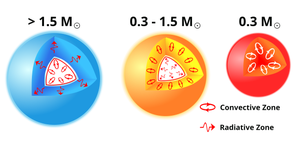
Didascalia: Stars are balls of plasma. For most of a star’s life it burns hydrogen into helium in its core. This phase of a star’s life is known as the main sequence. Burning hydrogen into helium produces heat, that heat travels out of the star’s core eventually reaching the star’s photosphere (often referred to as the “surface” of the star). From here the heat can radiate into space as various forms of electromagnetic radiation. However, how heat travels from the core to the photosphere depends on the star’s mass.
Imagine a parcel of gas rising inside a star. As it rises, it moves into an area of lower pressure, so it cools down and expands. If the parcel is still hotter, and therefore less dense than its surroundings, it keeps moving upward due to buoyancy. Eventually, it will rise far enough to cool and sink back down. This rising and sinking cycle is called convection. Whether convection occurs depends on how quickly temperature changes as you move away from the star’s core. If the temperature in a star drops rapidly, rising parcels of gas are more likely to stay hotter than their surroundings, so convection dominates as the mode of energy transfer in this part of the star. Conversely if the temperature drops more slowly (i.e. if the temperature gradient is small) then heat will mostly be transferred by radiation (photons).
In the most massive main sequence stars (more massive than about 1.5 times the mass of the Sun, seen here on the left), hydrogen is burned into helium using the CNO cycle. This is highly temperature dependent and thus energy production is concentrated near the center of the star. This leads to a larger temperature gradient and thus a convective core. Further out the temperature gradient becomes smaller and heat transport is dominated by radiation. This is called the radiative zone.
For lower mass stars like the Sun (between 0.3 and 1.5 solar masses, seen here in the middle) hydrogen is burned to helium using a different process (the pp chain). This depends less on the internal temperature than the CNO cycle and so energy production is more distributed in the star’s core. This leads to a smaller temperature gradient and thus a radiative core where convection occurs surrounded by a radiative zone. Going further out the gas becomes cool enough for some elements to hang to on some of their electrons, i.e. not being completely ionised. This partially ionised gas is more opaque to photons, trapping heat. This leads to a large temperature gradient and thus convection.
The lowest mass stars (below 0.3 solar masses, seen here on the right) have no radiative zone and are fully convective.
The arrows in the radiative zone are shown as wavy lines heading out of the star. However, a photon’s journey out of a star is much more complex with each individual photon travelling only a short distance before being deflected by some of the charged particles that make up the plasma of the star’s interior. This leads to a long and winding road that takes millennia instead of the few seconds it would take if the photon did not interact with particles in the plasma.
Crediti: Based on a vector diagram by Wikimedia user Д.Ильин which itself is based on a diagram from sun.org
License: CC-BY-4.0 Creative Commons Attribuzione 4.0 Internazionale (CC BY 4.0) icone
Evoluzione stellare
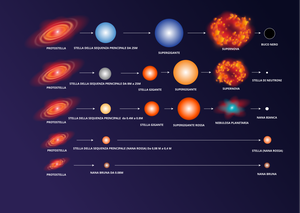
Didascalia: Questo diagramma illustra il ciclo di vita di stelle di massa diversa. La massa dei vari tipi di stelle aumenta dal basso verso l’alto con il passare del tempo, da sinistra a destra.
Il ciclo di vita di una stella dipende dalla sua massa: le stelle con massa inferiore hanno una durata di vita più lunga. Tutte le stelle si formano da nubi di gas che collassano sotto la propria gravità. Man mano che la stella collassa, il suo nucleo diventa più caldo e più denso. Se la stella ha una massa superiore a 0,08 masse solari (0,08 volte la massa del Sole), la pressione esercitata dalla massa della stella sul proprio nucleo crea una temperatura del nucleo sufficientemente elevata da innescare la fusione dell’idrogeno. In questo modo l’idrogeno viene bruciato nel nucleo della stella trasformandosi in elio, fornendo una fonte di calore che alimenta la stella e impedisce al suo nucleo di collassare ulteriormente. Se l’oggetto in collasso ha una massa inferiore a 0,08 masse solari, la fusione dell’idrogeno nel suo nucleo non si innesca. Continua quindi a raffreddarsi e a contrarsi lentamente. Tali oggetti substellari sono noti come nane brune, qui raffigurate nella riga più in basso.
Una volta formatesi, le stelle bruciano l’idrogeno nei loro nuclei e iniziano la cosiddetta fase della sequenza principale. Le stelle più massicce (>25 masse solari, qui raffigurate in alto) hanno temperature del nucleo molto elevate e quindi consumano il loro combustibile a base di idrogeno più rapidamente. Ciò significa che potrebbero trascorrere solo pochi milioni di anni sulla sequenza principale bruciando idrogeno nei loro nuclei. Una volta esaurito l’idrogeno nel nucleo, il nucleo della stella si contrae, diventa più caldo e nel nucleo ha inizio la combustione dell’elio. Mentre il nucleo si contrae, gli strati esterni della stella si espandono ed essa diventa una supergigante. Nel caso delle stelle più massicce, forti venti stellari spogliano la stella degli strati esterni più freddi, portando la stella a diventare molto grande e molto calda: una supergigante blu. Una volta esaurito l’elio nel nucleo, viene bruciato il carbonio e poi elementi più pesanti. Alla fine la stella termina con un nucleo di ferro. La fusione del ferro in elementi più pesanti non genera energia, quindi a questo punto la fusione nel nucleo si arresta. Quando questo nucleo di ferro raggiunge una massa sufficiente, esso e la materia circostante collassano improvvisamente formando un buco nero, mentre gli strati esterni vengono scagliati via in un’esplosione di supernova.
Le stelle di massa leggermente inferiore (tra 8 e 25 masse solari, qui visibili al secondo posto dall’alto) si evolvono in modo simile, sebbene non dispongano di venti sufficientemente intensi da espellere i propri strati esterni e diventare supergiganti blu; si evolvono invece in supergiganti rosse. Anche queste stelle collassano e generano esplosioni di supernova. Il residuo del nucleo della stella non è abbastanza massiccio da collassare in un buco nero. Al contrario, i suoi elettroni e protoni si combinano per formare neutroni ed è sostenuto da un effetto della meccanica quantistica chiamato pressione di degenerazione dei neutroni. Ciò fa sì che il residuo della stella sia una minuscola stella di neutroni, con una massa di diverse masse solari ma un diametro di soli pochi chilometri.
Per le stelle di massa simile a quella del Sole (tra 0,4 e 8 masse solari, visibili qui nella riga centrale), la stella brucia idrogeno nel proprio nucleo fino a esaurirlo. A questo punto, attorno al nucleo si forma un guscio in cui brucia l’idrogeno. Alla fine il nucleo diventerà abbastanza caldo da bruciare l’elio trasformandolo in carbonio e ossigeno. Successivamente, la stella si ritrova con un nucleo di carbonio e ossigeno circondato da gusci in cui bruciano elio e idrogeno. Questi gusci sono instabili e producono pulsazioni termiche che scuotono la stella. Alla fine queste pulsazioni diventano così intense che gli strati esterni della stella vengono espulsi. Ciò lascia il nucleo di carbonio e ossigeno come una nana bianca sostenuta dalla pressione di degenerazione degli elettroni. Gli strati esterni della stella formano quella che è nota come nebulosa planetaria (che in realtà non ha nulla a che vedere con i pianeti, nonostante il nome).
Le stelle di massa più bassa (visibili qui nella seconda riga dal basso) hanno una massa talmente ridotta che i loro tempi evolutivi sono molto più lunghi dell’età dell’universo. Ciò significa che nessuna di esse si è evoluta oltre la sequenza principale. Le stelle di bassa massa sono completamente convettive, il che significa che il materiale nel nucleo viene costantemente mescolato con quello sovrastante. Ciò implica che tutto l’idrogeno presente nella stella finirebbe per essere bruciato nel nucleo, ma questo processo richiederà trilioni di anni.
Crediti: Danielle Futselaar/IAU OAE
License: CC-BY-4.0 Creative Commons Attribuzione 4.0 Internazionale (CC BY 4.0) icone