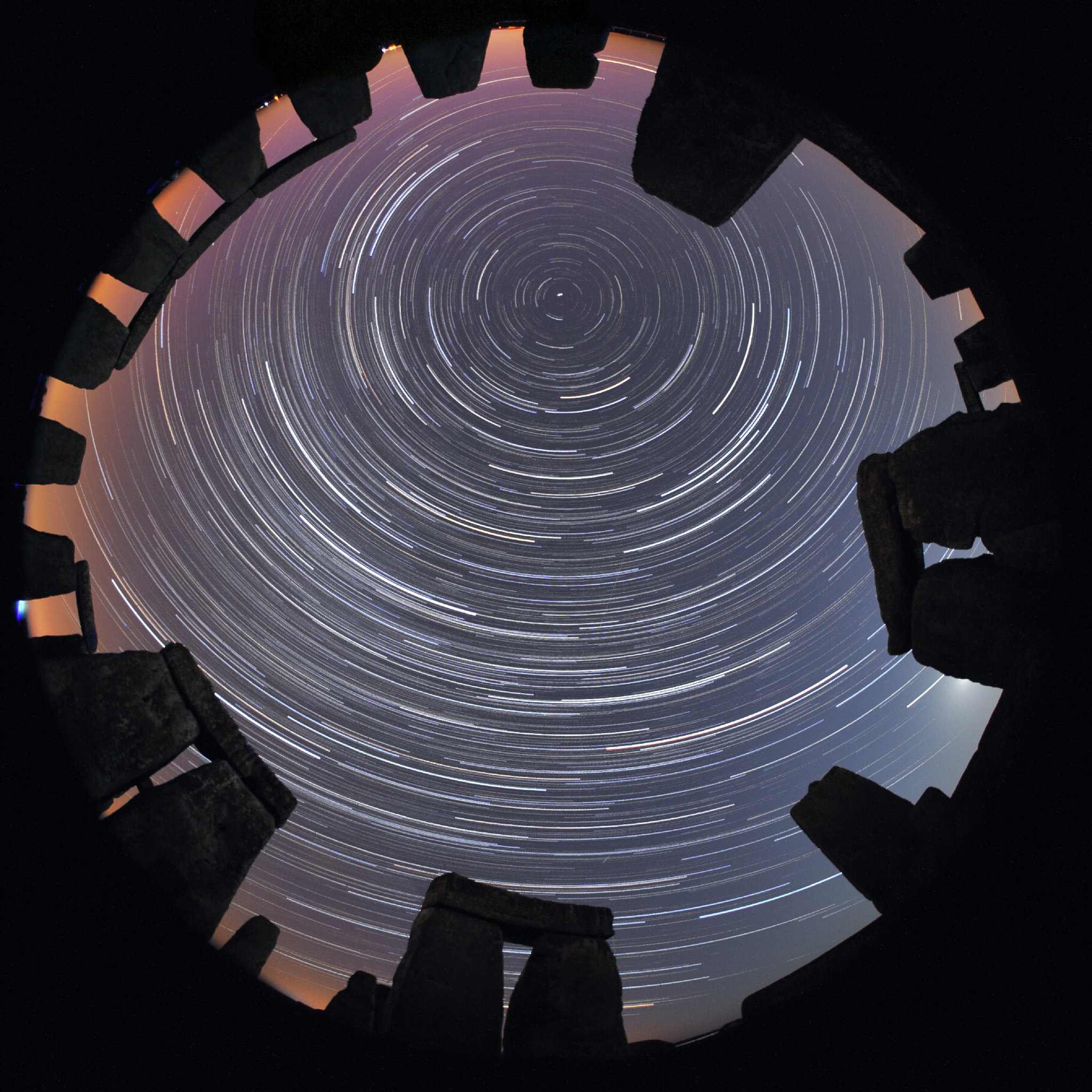
This page describes an image Stone Star Circles, Startrails above Stonehenge, by Till Credner, Germany
Télécharger ce fichier à partir de Zenodo ( image 1.26 MB)
Enregistrement de ce fichier sur Zenodo
Légende d'image :
Second place in the IAU OAE Astrophotography Contest, category Star trails.
Astronomy is one of the oldest (if not the oldest) of the sciences, and as such has connection to various cultures over millennia. This image in a way conveys this relationship by being contextualised in Stonehenge. There is much research into what astronomers call archeoastronomy sites, and how they connect to the sky (for example, seasons, phases of the moon and much more). Civilizations across time and from all over the world have their own views and interpretations of what they see in the sky, and this has been tied not only to culture but also to the people’s day-to-day and seasonal activities. The “concentric circles” which are often referred to as “star trails”, are the result of the apparent motion of the sky, which is in reality due to the rotation of the Earth on its axis. The small dot appearing towards the top center of the image is Polaris – The North or Pole Star. Polaris is only visible to observers in the Northern latitudes. The height of the Pole Star can be used to infer the observer’s actual latitude. Stonehenge is located at around 51° North. This image is taken from one of the most notable ancient sites in the world, brings us back in time, and makes us wonder about the stories told by the people that lived in that place many millennia ago.
Faire défiler pour afficher les légendes dans d'autres langues
Crédits pour l'image : Till Credner/IAU OAE
DOI : 10.5281/zenodo.5371591
Termes du glossaire en rapport :
La piste des étoiles
, Étoiles circumpolaires
Catégories :
Astronomie à l'œil nu
Licence de l'image : Creative Commons (CC) Attribution 4.0 International (CC BY 4.0) Creative Commons (CC) Attribution 4.0 International (CC BY 4.0) Icônes
Les légendes des fichiers média présents sur le site de l'OAE ont été écrites, traduites et relues grâce à un effort collectif de l'OAE, les Centres et les Noeuds de l'OAE, les Coordinateurs Nationaux de l'Astronomie pour l'Education de l'OAE(NAECs) et d'autres volontaires. La liste complète des crédits pour ce projet est disponible ici . Toutes les légendes des fichiers média sont déposés sous licence Creative Commons CC BY-4.0 et doivent être créditées au nom de "IAU OAE". Les fichiers média eux-mêmes peuvent avoir des licences différentes (voir plus haut) et et doivent être crédités comme indiqué ci-dessus sous le terme "credit".
Si vous constatez une erreur dans cette légende ou dans un de ses traductions, veuillez nous contacter veuillez nous contacter.
Légendes proposées dans différentes langues :
Légende d'image : আইএইউ ওএই অ্যাস্ট্রোফটোগ্রাফি প্রতিযোগিতায় দ্বিতীয় স্থান, বিভাগ স্টার ট্রেইল।
জ্যোতির্বিদ্যা হল বিজ্ঞানের প্রাচীনতম (যদি প্রাচীনতম না হয়) এক, এবং সহস্রাব্দ ধরে বিভিন্ন সংস্কৃতির সাথে এর সংযোগ রয়েছে। এই চিত্রটি স্টোনহেঞ্জে প্রাসঙ্গিকতার মাধ্যমে এই সম্পর্কটিকে একভাবে বোঝায়। জ্যোতির্বিজ্ঞানীরা আর্কিওঅস্ট্রোনমি সাইটগুলিকে কী বলে এবং তারা কীভাবে আকাশের সাথে সংযোগ স্থাপন করে (উদাহরণস্বরূপ, ঋতু, চাঁদের পর্যায় এবং আরও অনেক কিছু) সে সম্পর্কে অনেক গবেষণা রয়েছে। সময় জুড়ে এবং সারা বিশ্ব থেকে সভ্যতাগুলির নিজস্ব দৃষ্টিভঙ্গি এবং তারা আকাশে যা দেখে তার ব্যাখ্যা রয়েছে এবং এটি কেবল সংস্কৃতির সাথেই নয়, মানুষের দৈনন্দিন এবং ঋতুগত কার্যকলাপের সাথেও জড়িত। "এককেন্দ্রিক বৃত্ত" যা প্রায়শই "তারকা পথ" হিসাবে উল্লেখ করা হয়, আকাশের আপাত গতির ফলাফল, যা বাস্তবে তার অক্ষের উপর পৃথিবীর ঘূর্ণনের কারণে। ছবির উপরের কেন্দ্রের দিকে প্রদর্শিত ছোট বিন্দুটি পোলারিস - উত্তর বা মেরু তারকা। পোলারিস শুধুমাত্র উত্তর অক্ষাংশে পর্যবেক্ষকদের কাছে দৃশ্যমান। মেরু তারার উচ্চতা পর্যবেক্ষকের প্রকৃত অক্ষাংশ অনুমান করতে ব্যবহার করা যেতে পারে। স্টোনহেঞ্জ প্রায় 51° উত্তরে অবস্থিত। এই ছবিটি বিশ্বের সবচেয়ে উল্লেখযোগ্য প্রাচীন স্থানগুলির মধ্যে একটি থেকে নেওয়া হয়েছে, এটি আমাদেরকে সময়ের সাথে ফিরিয়ে আনে এবং বহু সহস্রাব্দ আগে সেই জায়গায় বসবাসকারী লোকদের দ্বারা বলা গল্পগুলি সম্পর্কে আমাদের বিস্মিত করে৷
Crédits pour l'image : টিল ক্রেডনার/আইএইউ ওএই
Termes du glossaire en rapport : Circumpolar Stars , Star Trail Statuts de la traduction de la légende: Pas encore approuvé par un·e relecteur(rice)
Traducteurs de la légende: Raktim Mukherjee
Légende d'image : Zweiter Platz im IAU OAE Astrofotografie-Wettbewerb, Kategorie Sternenspuren.
Die Astronomie ist eine der ältesten (wenn nicht die älteste) Wissenschaften und als solche seit Jahrtausenden mit verschiedenen Kulturen verbunden. Dieses Bild vermittelt diese Beziehung in gewisser Weise, indem es in den Kontext von Stonehenge gestellt wird. Es gibt viele Forschungen über das, was Astronomen als archäoastronomische Stätten bezeichnen, und wie sie mit dem Himmel in Verbindung stehen (z. B. Jahreszeiten, Mondphasen und vieles mehr). Zivilisationen aus allen Zeiten und aus der ganzen Welt haben ihre eigenen Ansichten und Interpretationen dessen, was sie am Himmel sehen, und dies ist nicht nur mit der Kultur, sondern auch mit den täglichen und saisonalen Aktivitäten der Menschen verbunden. Die "konzentrischen Kreise", die oft als "Sternenspuren" bezeichnet werden, sind das Ergebnis der scheinbaren Bewegung des Himmels, die in Wirklichkeit auf die Drehung der Erde um ihre Achse zurückzuführen ist. Der kleine Punkt oben in der Mitte des Bildes ist Polaris - der Nord- oder Polarstern. Polaris ist nur für Beobachter in den nördlichen Breitengraden sichtbar. Aus der Höhe des Polarsterns lässt sich der tatsächliche Breitengrad des Beobachters ableiten. Stonehenge befindet sich auf etwa 51° Nord. Dieses Bild stammt von einer der bedeutendsten antiken Stätten der Welt, versetzt uns in die Vergangenheit und lässt uns über die Geschichten der Menschen nachdenken, die vor vielen Jahrtausenden an diesem Ort lebten.
Crédits pour l'image : Till Credner/IAU OAE
Termes du glossaire en rapport : Strichspuraufnahme , Zirkumpolarsterne Statuts de la traduction de la légende: Pas encore approuvé par un·e relecteur(rice)
Traducteurs de la légende: Emma Krojanski
Légende d'image : Second place in the IAU OAE Astrophotography Contest, category Star trails.
Astronomy is one of the oldest (if not the oldest) of the sciences, and as such has connection to various cultures over millennia. This image in a way conveys this relationship by being contextualised in Stonehenge. There is much research into what astronomers call archeoastronomy sites, and how they connect to the sky (for example, seasons, phases of the moon and much more). Civilizations across time and from all over the world have their own views and interpretations of what they see in the sky, and this has been tied not only to culture but also to the people’s day-to-day and seasonal activities. The “concentric circles” which are often referred to as “star trails”, are the result of the apparent motion of the sky, which is in reality due to the rotation of the Earth on its axis. The small dot appearing towards the top center of the image is Polaris – The North or Pole Star. Polaris is only visible to observers in the Northern latitudes. The height of the Pole Star can be used to infer the observer’s actual latitude. Stonehenge is located at around 51° North. This image is taken from one of the most notable ancient sites in the world, brings us back in time, and makes us wonder about the stories told by the people that lived in that place many millennia ago.
Crédits pour l'image : Till Credner/IAU OAE
Termes du glossaire en rapport : Circumpolar Stars , Star Trail
Légende d'image : Secondo posto al concorso di astrofotografia IAU OAE, categoria Scie stellari.
L'astronomia è una delle scienze più antiche (se non la più antica) e come tale è legata a varie culture da millenni. Questa immagine trasmette in un certo senso questa relazione, essendo stata scattata a Stonehenge. Molte ricerche sono dedicate a quelli che gli astronomi chiamano siti di archeoastronomia e sul loro legame con il cielo (ad esempio, le stagioni, le fasi lunari e molto altro). Le civiltà di tutto il mondo e di tutti i tempi hanno una propria visione e interpretazione di ciò che vedono nel cielo, legata non solo alla cultura ma anche alle attività quotidiane e stagionali delle persone. I "cerchi concentrici", spesso chiamati "scie stellari", sono il risultato del movimento apparente del cielo, che in realtà è dovuto alla rotazione della Terra attorno al suo asse. Il piccolo punto che appare in alto al centro dell'immagine è la Stella Polare. La Stella Polare è visibile solo agli osservatori dell'emisfero boreale. L'altezza della Stella Polare rispetto all'orizzonte può essere utilizzata per dedurre la latitudine effettiva dell'osservatore. Stonehenge si trova a circa 51° Nord. Questa immagine, scattata in uno dei più importanti siti antichi del mondo, ci riporta indietro nel tempo e ci fa pensare alle storie raccontate dalle persone che vivevano in quel luogo molti millenni fa.
Crédits pour l'image : Till Credner/IAU OAE
Termes du glossaire en rapport : Scia stellare , Stelle circumpolari Statuts de la traduction de la légende: Approuvé par un·e relecteur(rice)
Traducteurs de la légende: Giuliana Giobbi, Francesco Salvestrini
Relecteurs de la légende: Rosa Valiante, Rodolfo Canestrari
Légende d'image : 国际天文学联合会 OAE 天文摄影比赛星轨类第二名。
天文学即使不是最古老的科学,也是其中之一,因此千百年来与各种文化都有着千丝万缕的联系。这张图片以巨石阵为背景,在某种程度上传达了这种联系。关于天文学家所说的考古天文学遗址,以及它们与天空的联系(如季节、月相等),有很多研究。古今中外的文明对天空中的景象都有自己的看法和解释,这不仅与文化有关,也与人们的日常活动和季节活动有关。通常被称为 "星轨 "的 "同心圆 "是天空视运动的结果,实际上是地球自转的结果。图像中心上方出现的小点是Polaris--北极星。只有北半球的观测者才能看到北极星。北极星的高度可以用来推断观测者的实际纬度。巨石阵位于北纬 51°左右。这张照片摄于世界上最著名的古代遗址之一,它把我们带回了过去,让我们对千年前生活在那里的人们所讲述的故事产生了好奇。
Crédits pour l'image : Till Credner/IAU OAE
Termes du glossaire en rapport : 拱极星 , 星轨 Statuts de la traduction de la légende: Pas encore approuvé par un·e relecteur(rice)
Traducteurs de la légende: Hu Xueying
Légende d'image : 國際天文學聯合會 OAE 天文攝影比賽星軌類第二名。
天文學即使不是最古老的科學,也是其中之一,因此千百年來與各種文化都有著千絲萬縷的聯繫。這張圖片以巨石陣為背景,在某種程度上傳達了這種聯繫。關於天文學家所說的考古天文學遺址,以及它們與天空的聯繫(如季節、月相等),有很多研究。古今中外的文明對天空中的景象都有自己的看法和解釋,這不僅與文化有關,也與人們的日常活動和季節活動有關。通常被稱為 "星軌 "的 "同心圓 "是天空視運動的結果,實際上是地球自轉的結果。圖像中心上方出現的小點是Polaris--北極星。只有北半球的觀測者才能看到北極星。北極星的高度可以用來推斷觀測者的實際緯度。巨石陣位於北緯 51°左右。這張照片攝於世界上最著名的古代遺址之一,它把我們帶回了過去,讓我們對千年前生活在那裡的人們所講述的故事產生了好奇。
Crédits pour l'image : Till Credner/IAU OAE
Termes du glossaire en rapport : 拱極星 , 星軌 Statuts de la traduction de la légende: Pas encore approuvé par un·e relecteur(rice)
Traducteurs de la légende: Transcription à partir de la traduction en chinois simplifé par - Hu Xueying









- Ressources
- Moteur de recherche des ressources pédagogiques
- Parcourir les ressources pédagogiques par Sujet
- Parcourir les images
- AstroEdu - Activités en classe
- Grandes Idées - Littéracie en astronomie
- Glossaire
- Rapports de l'OAE
- L'astronomie pour l'Education à travers le monde
- Sélection de ressources externes