This page describes an image A Coronal Mass Ejection
Descargar archivo ( imagen 596.22 kB)
Pie de foto:
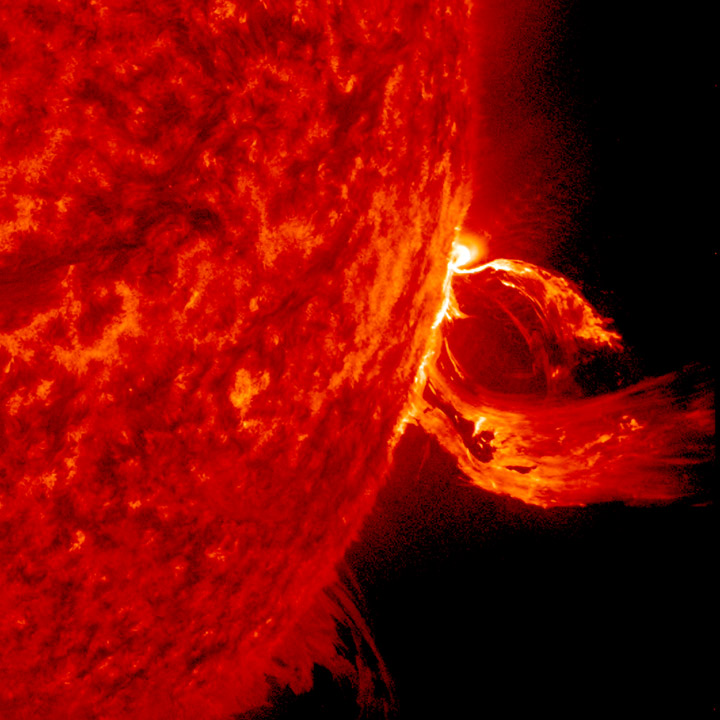
A burst of solar material can be seen erupting from the Sun in this view, illustrating a coronal mass ejection (CME)—a large eruption of plasma and magnetic field from the Sun’s outer atmosphere, or corona. These CMEs are caused by magnetic explosions in the Sun's corona. During a CME, huge amounts of electrically charged particles are launched into space at great speeds, carrying part of the Sun’s magnetic field with them. These events are driven by changes in the Sun’s magnetic structure and release vast clouds of hot gas that travel outward into the solar system. When a CME moves through space, it can interact with a planet’s magnetic field and atmosphere, sometimes creating spectacular auroras or, in strong cases, interfering with artificial satellites and power systems.
CMEs are often associated with a temporary brightening of the region of the Sun where the CME originated. This is known as a solar flare. Stars other than the Sun can also have CMEs and flares.
This image was taken by NASA's Solar Dynamics Observatory (SDO). This is a space mission to monitor the Sun. The image here is taken at a special wavelength which partially ionised helium emits strongly at.
Desplázate hasta los subtítulos en otros idiomas
Crédito de la imagen: NASA/Goddard/SDO Enlace del crédito
Términos relacionados del glosario:
Eyección de masa coronal (CME)
, Sol
Licencia de la imagen: Dominio público Dominio público íconos
Las descripciones de los archivos multimedia que aparecen en la página web de la OAE han sido redactadas, traducidas y revisadas gracias al esfuerzo conjunto de la OAE y los Centros y Nodos de la OAE, los Coordinadores Nacionales de Educación Astronómica (NAECs) y otros voluntarios. Puedes consultar la lista completa de los créditos de nuestro proyecto de traducción aquí. Todos los pies de foto de los archivos multimedia se publican bajo una Creative Commons CC BY-4.0 licencia y deben atribuirse a la "IAU OAE". Los propios archivos multimedia pueden tener diferentes licencias (véase más arriba) y deben citarse tal y como se indica en "credit".
Pies de foto en diferentes idiomas:
Pie de foto: In dieser Ansicht ist ein Ausbruch von solarem Material zu sehen, der von der Sonne ausgestoßen wird. Er veranschaulicht einen koronalen Massenauswurf (CME) – eine gewaltige Eruption von Plasma und Magnetfeldern aus der äußeren Atmosphäre der Sonne, der Korona. Diese CMEs werden durch magnetische Explosionen in der Sonnenkorona ausgelöst. Bei einem CME werden gewaltige Mengen elektrisch geladener Teilchen mit enormer Geschwindigkeit ins All geschleudert, wobei sie einen Teil des solaren Magnetfelds mit sich führen. Diese Ereignisse werden durch Veränderungen in der magnetischen Struktur der Sonne ausgelöst und setzen riesige Wolken aus heißem Gas frei, die sich nach außen in das Sonnensystem ausbreiten. Wenn sich ein CME durch den Weltraum bewegt, kann er mit dem Magnetfeld und der Atmosphäre eines Planeten in Wechselwirkung treten und dabei manchmal spektakuläre Polarlichter erzeugen oder, in starken Fällen, künstliche Satelliten und die Stromversorgung stören.
CMEs gehen oft mit einer vorübergehenden Aufhellung des Sonnenbereichs einher, aus dem der CME stammt. Dies wird als Sonnenflare bezeichnet. Auch andere Sterne als die Sonne können CMEs und Flares aufweisen.
Dieses Bild wurde vom Solar Dynamics Observatory (SDO) der NASA aufgenommen. Dabei handelt es sich um eine Weltraummission zur Beobachtung der Sonne. Das vorliegende Bild wurde bei einer speziellen Wellenlänge aufgenommen, in der teilweise ionisiertes Helium stark strahlt.
Crédito de la imagen: NASA/Goddard/SDO
Términos relacionados del glosario: Koronaler Massenauswurf (CME) , Sonne Estado de la traducción de los subtítulos: Aún no ha sido aprobado por un revisor o revisora
Traductores de las leyendas: Simon Kraus
Pie de foto: A burst of solar material can be seen erupting from the Sun in this view, illustrating a coronal mass ejection (CME)—a large eruption of plasma and magnetic field from the Sun’s outer atmosphere, or corona. These CMEs are caused by magnetic explosions in the Sun's corona. During a CME, huge amounts of electrically charged particles are launched into space at great speeds, carrying part of the Sun’s magnetic field with them. These events are driven by changes in the Sun’s magnetic structure and release vast clouds of hot gas that travel outward into the solar system. When a CME moves through space, it can interact with a planet’s magnetic field and atmosphere, sometimes creating spectacular auroras or, in strong cases, interfering with artificial satellites and power systems.
CMEs are often associated with a temporary brightening of the region of the Sun where the CME originated. This is known as a solar flare. Stars other than the Sun can also have CMEs and flares.
This image was taken by NASA's Solar Dynamics Observatory (SDO). This is a space mission to monitor the Sun. The image here is taken at a special wavelength which partially ionised helium emits strongly at.
Crédito de la imagen: NASA/Goddard/SDO
Términos relacionados del glosario: Coronal Mass Ejection (CME) , Sun
Pie de foto: In questa immagine si vede un getto di materiale solare che erompe dal Sole, a illustrazione di un’espulsione di massa coronale (CME), ovvero una grande eruzione di plasma e campo magnetico proveniente dall’atmosfera esterna del Sole, o corona. Queste CME sono causate da esplosioni magnetiche nella corona solare. Durante una CME, enormi quantità di particelle elettricamente cariche vengono lanciate nello spazio a velocità elevate, trasportando con sé parte del campo magnetico solare. Questi eventi sono determinati da cambiamenti nella struttura magnetica del Sole e rilasciano vaste nubi di gas caldo che si propagano verso l’esterno nel sistema solare. Quando un CME si muove nello spazio, può interagire con il campo magnetico e l’atmosfera di un pianeta, creando talvolta spettacolari aurore o, nei casi più intensi, interferendo con i satelliti artificiali e le reti elettriche.
I CME sono spesso associati a un temporaneo aumento di luminosità della regione del Sole da cui hanno avuto origine. Questo fenomeno è noto come brillamento solare. Anche altre stelle oltre al Sole possono essere soggette a CME e brillamenti.
Questa immagine è stata scattata dal Solar Dynamics Observatory (SDO) della NASA. Si tratta di una missione spaziale volta al monitoraggio del Sole. L’immagine qui riportata è stata acquisita a una lunghezza d’onda specifica, alla quale l’elio parzialmente ionizzato emette con particolare intensità.
Crédito de la imagen: NASA/Goddard/SDO
Términos relacionados del glosario: Espulsione di massa coronale (CME) , Sole Estado de la traducción de los subtítulos: Aún no ha sido aprobado por un revisor o revisora
Traductores de las leyendas: Giuliana Giobbi