Glossar-Begriff: Koronaler Massenauswurf (CME)
Beschreibung: Ein koronaler Massenauswurf (abgekürzt KMA, üblicher: CME, vom englischen "coronal mass ejection) ist ein explosiver Ausstoß von Sonnenplasma und dem dazugehörigen Magnetfeld von der Sonne in die Heliosphäre, bzw. ein Massenauswurf eines Sterns in seine Astrosphäre. Koronale Massenauswürfe sind magnetische Explosionen, die üblicherweise mit Sonneneruptionen einhergehen. Als CME bezeichnet man den tatsächlichen Auswurf von Materie. Die "Eruption" hingegen beschränkt sich auf die sichtbare Strahlung bei diesem Ereignis. Koronale Massenauswürfe können sich voneinander stark unterscheiden, was ihre Struktur, Dichte oder Geschwindigkeit betrifft. Koronale Massenauswürfe, die auf die Erde treffen, können erhebliche geomagnetische Stürme erzeugen.
Ähnliche Begriffe:
Dieser Begriff in anderen Sprachen
Begriffs- und Definitionsstatus Die Originaldefinition dieses Begriffes auf Englisch wurden von einer*einem forschenden Astronom*in und einer Lehrkraft bestätigt Die Übersetzung dieses Begriffs und seiner Definition warten auf Prüfung und Bestätigung
Der mehrsprachige OAE-Glossar ist ein Projekt des IAU Office of Astronomy for Education (OAE) als Bildungsbüro der Internationalen Astronomischen Union in Zusammenarbeit mit dem IAU Office of Astronomy Outreach (OAO). Die Begriffe und Definitionen wurden gewählt, geschrieben und geprüft durch einen kollektiven Aufwand des OAE, des OAE Zentren und Knotenpunkte, des OAE National Astronomy Education Coordinators (NAECs, Nationale Koordinatoren für astronomische Bildungsarbeit) und anderen Freiwilligen. Die volle Liste an Mitarbeitenden ist hier. Alle Glossar-Begriffe und ihre Definitionen sind unter einer Creative Commons CC BY-4.0 Lizenz veröffentlicht und sollten "IAU OAE" zugeschrieben werden.
Wenn dir ein inhaltlicher oder Übersetzungsfehler in diesem Glossarbegriff oder dieser Definition auffallen, bitte kontaktiere uns.
Auf anderen Sprachen
- Arabisch: قذف الكتلة الإكليلي (CME)
- Englisch: Coronal Mass Ejection (CME)
- Spanisch: Eyección de masa coronal (CME)
- Französisch: Éjection de masse coronale (EMC ou CME en anglais)
- Italienisch: Espulsione di massa coronale (CME)
- Japanisch: コロナ質量放出 (externer Link)
- Koreanisch: 코로나질량방출(CME)
- Brasilianisches Portugiesisch: Ejeção de massa coronal (CME)
- Vereinfachtes Chinesisch: 日冕物质抛射(CME)
- Traditionelles Chinesisch: 日冕物質拋射(CME)
Ähnliche Medien
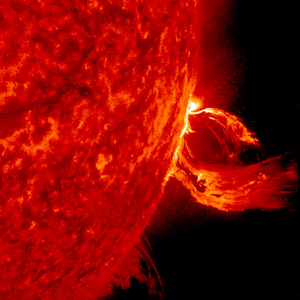
Ein koronaler Massenauswurf
Unterschrift: In dieser Ansicht ist ein Ausbruch von solarem Material zu sehen, der von der Sonne ausgestoßen wird. Er veranschaulicht einen koronalen Massenauswurf (CME) – eine gewaltige Eruption von Plasma und Magnetfeldern aus der äußeren Atmosphäre der Sonne, der Korona. Diese CMEs werden durch magnetische Explosionen in der Sonnenkorona ausgelöst. Bei einem CME werden gewaltige Mengen elektrisch geladener Teilchen mit enormer Geschwindigkeit ins All geschleudert, wobei sie einen Teil des solaren Magnetfelds mit sich führen. Diese Ereignisse werden durch Veränderungen in der magnetischen Struktur der Sonne ausgelöst und setzen riesige Wolken aus heißem Gas frei, die sich nach außen in das Sonnensystem ausbreiten. Wenn sich ein CME durch den Weltraum bewegt, kann er mit dem Magnetfeld und der Atmosphäre eines Planeten in Wechselwirkung treten und dabei manchmal spektakuläre Polarlichter erzeugen oder, in starken Fällen, künstliche Satelliten und die Stromversorgung stören.
CMEs gehen oft mit einer vorübergehenden Aufhellung des Sonnenbereichs einher, aus dem der CME stammt. Dies wird als Sonnenflare bezeichnet. Auch andere Sterne als die Sonne können CMEs und Flares aufweisen.
Dieses Bild wurde vom Solar Dynamics Observatory (SDO) der NASA aufgenommen. Dabei handelt es sich um eine Weltraummission zur Beobachtung der Sonne. Das vorliegende Bild wurde bei einer speziellen Wellenlänge aufgenommen, in der teilweise ionisiertes Helium stark strahlt.
Bild: NASA/Goddard/SDO
Quellenlink
License: PD Gemeinfrei Symbole