词条 日冕物质抛射(CME)
描述: 日冕物质抛射(或CME)是指太阳(以及其他类似恒星)向日球层(或其他恒星的星球层)中爆炸性喷射太阳等离子体及其磁场。CME是一种磁场爆发活动,通常与太阳耀斑有关。CME是物质的物理上的抛射,与仅限于可见辐射的“耀斑”不同。CME在结构、密度和速度方面变化很大,撞击地球的CME可能引发严重的地磁风暴。
相关词条
用其他语言查看该词条
词条和定义状态: 该术语的英文原始定义已通过天文研究人员和教师的审核 该术语及其定义的译文仍待审核
OAE 多语言词汇表是由国际天文学联合会(IAU) 天文教育办公室(OAE) 和 国际天文学联合会(IAU) 天文推广办公室(OAO)合作的项目。. 术语和定义由 OAE中心, OAE 国家天文教育协调员(NAECs) 以及其他志愿者共同选择、撰写和审阅。您可以在 找到完整的致谢列表。所有词汇表术语及其定义均根据 Creative Commons CC BY-4.0许可证发布 且版权归属于 "IAU OAE"。
如果您发现此词汇术语或定义中的事实或翻译错误, 请向 发邮件 联系.
其他语言版本
- 阿拉伯语: قذف الكتلة الإكليلي (CME)
- 德语: Koronaler Massenauswurf (CME)
- 英语: Coronal Mass Ejection (CME)
- 西班牙语: Eyección de masa coronal (CME)
- 法语: Éjection de masse coronale (EMC ou CME en anglais)
- 意大利语: Espulsione di massa coronale (CME)
- 日语: コロナ質量放出 (外部链接)
- 韩语: 코로나질량방출(CME)
- 巴西葡萄牙语: Ejeção de massa coronal (CME)
- 繁体中文: 日冕物質拋射(CME)
相关媒体
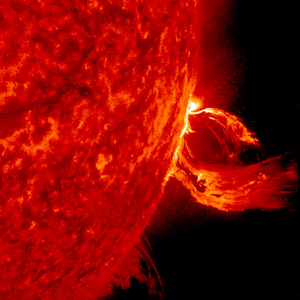
A Coronal Mass Ejection
图注: A burst of solar material can be seen erupting from the Sun in this view, illustrating a coronal mass ejection (CME)—a large eruption of plasma and magnetic field from the Sun’s outer atmosphere, or corona. These CMEs are caused by magnetic explosions in the Sun's corona. During a CME, huge amounts of electrically charged particles are launched into space at great speeds, carrying part of the Sun’s magnetic field with them. These events are driven by changes in the Sun’s magnetic structure and release vast clouds of hot gas that travel outward into the solar system. When a CME moves through space, it can interact with a planet’s magnetic field and atmosphere, sometimes creating spectacular auroras or, in strong cases, interfering with artificial satellites and power systems.
CMEs are often associated with a temporary brightening of the region of the Sun where the CME originated. This is known as a solar flare. Stars other than the Sun can also have CMEs and flares.
This image was taken by NASA's Solar Dynamics Observatory (SDO). This is a space mission to monitor the Sun. The image here is taken at a special wavelength which partially ionised helium emits strongly at.
来源: NASA/Goddard/SDO
来源链接
License: PD 公共领域 图标