Término del glosario: Agujero negro
Descripción: Un agujero negro es una región del espacio en la que la fuerza gravitatoria es tan grande que nada, ni siquiera la luz, puede escapar de él.
Muchas galaxias, incluida la Vía Láctea, tienen un gran agujero negro (conocido como agujero negro supermasivo) en su centro.
Una de las formas en que los astrónomos creen que se forman los agujeros negros más pequeños es cuando una estrella masiva colapsa al final de su vida. Sin embargo, los astrónomos aún no conocen los orígenes de los agujeros negros supermasivos.
El límite exterior de un agujero negro se conoce como horizonte de eventos.
Cerca de los agujeros negros, las condiciones físicas son tan extremas que el tiempo transcurre mucho más lentamente (en comparación con un observador situado lejos del agujero negro) y, alrededor de los agujeros negros más pequeños, los objetos se estiran y se rompen en pedazos. La materia que cae hacia un agujero negro forma un disco de acreción. Esto suele ir acompañado de chorros de materia que se expulsan desde este disco. Los discos de acreción de los agujeros negros son la fuente de energía de los cuásares y otros núcleos galácticos activos (AGN), así como de muchas otras fuentes de rayos X.
Términos relacionados:
Ver este término en otros idiomas
Estado del término y la definición: La definición original de este término en inglés ha sido aprobada por unastrónomo o astrónoma investigadora y un docente La traducción de este término y su definición aún están pendientes de aprobación
El Glosario multilingüe de la OAE es un proyecto de la Oficina de Astronomía para la Educación de la UAI (OAE) en colaboración con la Oficina de Divulgación de Astronomía de la UAI (OAO). Los términos y definiciones fueron seleccionados, redactados y revisados gracias al esfuerzo colectivo de la OAE, los Centros y Nodos de la OAE, los Coordinadores Nacionales de Educación Astronómica (NAECs) y otros voluntarios. Puedes encontrar una lista completa de créditos aquí. Todos los términos del glosario y sus definiciones se publican bajo la licencia Creative Commons CC BY-4.0 y deben atribuirse a la "IAU OAE".
Si detectas algún error de contenido o de traducción en este término del glosario o en ladefinición, ponte en contacto con nosotros.
En otros idiomas
- Árabe: الثقب الأسود
- Bengalí: কৃষ্ণবিবর
- Alemán: Schwarzes Loch
- Inglés: Black Hole
- Francés: Trou noir
- Italiano: Buco nero
- Japonés: ブラックホール (enlace externo)
- Portugués de Brasil: Buraco negro
- Chino simplificado: 黑洞
- Chino tradicional: 黑洞
Diagramas relacionados
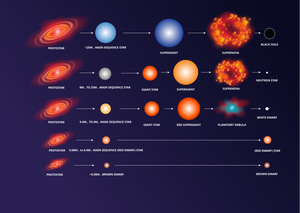
Stellar Evolution
Pie de foto: This diagram shows the life cycle of stars of different masses. The mass of the different types of star increases from bottom to top with time going from left to right.
The life cycle of a star depends on its mass, with lower mass stars have longer lifetimes. All stars form from clouds of gas that collapse under their own gravity. As the star collapses, its core becomes hotter and denser. If the star has a mass greater than 0.08 solar masses (0.08 times the mass of the Sun), the pressure of the star’s mass pushing down on its core creates a high enough core temperature for hydrogen fusion to ignite. This burns hydrogen into helium in the star’s core, providing a heat source to power the star and to stop its core from collapsing further. If the collapsing object has a mass below 0.08 solar masses then it does not ignite hydrogen fusion in its core. It continues to cool and slowly contract. Such substellar objects are known as brown dwarfs, shown here in the lowest row.
After stars have formed, they burn hydrogen in their cores and begin their so-called main sequence phase. The most massive stars (>25 solar masses, shown here at the top) have very high core temperatures and thus burn through their hydrogen fuel more quickly. This means they may only spend a few million years on the main sequence burning hydrogen in their cores. Once the hydrogen in the core is exhausted the star’s core contracts, becomes hotter and helium burning starts in the core. While the core contracts, the outer layers of the star expand and it becomes a supergiant. For the most massive stars strong stellar winds strip off the cooler outer layers, leading to the star being very large and very hot, a blue supergiant. Once helium is exhausted in the core, carbon is burned, and then heavier elements. Eventually the star ends with an iron core. Fusing iron into heavier elements does not generate energy so at this point fusion stops in the core. Once this core of iron is massive enough, it and the surrounding matter suddenly collapses to form a black hole and the outer layers are flung off in a supernova explosion.
Slightly lower mass stars (between 8 and 25 solar masses, seen here second top) evolve in a similar way although they do not have strong enough winds to push their outer layers away and become blue supergiants, instead it evolves into a red supergiant. While such stars also collapse and create supernova explosions. The remnant of the star’s core is not massive enough to collapse into a black hole. Instead, its electrons and protons combine to form neutrons and it is supported by a quantum mechanical effect called neutron degeneracy pressure. This results in the remnant of the star being a tiny neutron star, several solar masses in mass but only a few kilometres across.
For stars similar in mass to the Sun (between 0.4 and 8 solar masses, seen here in the middle row), the star burns hydrogen in its core until the hydrogen in its core is exhausted. At this point a hydrogen burning shell forms around the core. Eventually the core will become hot enough to burn helium into carbon and oxygen. After this the star is left with a carbon and oxygen core surrounded by shells burning helium and hydrogen. These shells are unstable producing thermal pulsations that convulse the star. Eventually these pulsations become so extreme that the star’s outer layers are thrown off. This leaves the carbon and oxygen core as a white dwarf supported by electron degeneracy pressure. The outer layers of the star form what is known as a planetary nebula (which doesn’t actually have anything to do with planets despite the name).
The lowest mass stars (seen here in the second bottom row) are so low in mass that their evolutionary timescales are much longer than the age of the universe. This means that none have evolved beyond the main-sequence. Low mass stars are fully convective meaning material in the core is constantly being mixed with material above. This means that all the hydrogen in the star would eventually be burned in the core, but this will take trillions of years.
Crédito: Danielle Futselaar/IAU OAE
License: CC-BY-4.0 Creative Commons Reconocimiento 4.0 Internacional (CC BY 4.0) íconos
Actividades relacionadas
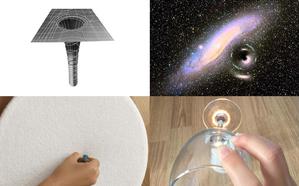
Hunting for black holes
astroEDU educational activity (links to astroEDU website) Description: How do astronomers detect invisible black holes?
License: CC-BY-4.0 Creative Commons Reconocimiento 4.0 Internacional (CC BY 4.0) íconos
Etiquetas:
Model
, Experiment
Rango de edades:
12-14
Nivel educativo:
Educación no forma
, Educación secundaria
Áreas de aprendizaje:
Modelización
, Basado en la observación
, Resolución de problemas
, Aprendizaje basado en la investigación estructurada
Costos:
Bajo coste
Duración:
45 minutos
Tamaño del grupo:
Grupo
Competencias:
Elaborar explicaciones
, Desarrollar y utilizar modelos
What is a black hole?
astroEDU educational activity (links to astroEDU website) Description: What are black holes and what would happen if the Sun was replaced by one of them?
License: CC-BY-4.0 Creative Commons Reconocimiento 4.0 Internacional (CC BY 4.0) íconos
Etiquetas:
Model
, Experiment
, Investigation
Rango de edades:
12-14
Nivel educativo:
Educación no forma
, Educación secundaria
Áreas de aprendizaje:
Grupos de discusión
, Clase interactiva
, Modelización
, Basado en la observación
, Resolución de problemas
, Aprendizaje basado en la investigación estructurada
Costos:
Bajo coste
Duración:
45 minutos
Tamaño del grupo:
Grupo
Competencias:
Elaborar explicaciones
, Desarrollar y utilizar modelos
, Participar en debates basados en pruebas
, Planificar y llevar a cabo investigaciones

Model of a Black Hole
astroEDU educational activity (links to astroEDU website) Description: Understand the mystery of black holes through a hands-on activity.
License: CC-BY-4.0 Creative Commons Reconocimiento 4.0 Internacional (CC BY 4.0) íconos
Etiquetas:
Hands-on
, Model
, Interactive
, Space-time
, Black holes
Rango de edades:
8-10
, 10-12
Nivel educativo:
Primaria
, Secondary
Áreas de aprendizaje:
Modelización
, Aprendizaje basado en la investigación estructurada
Costos:
Coste medio
Duración:
1 hora
Tamaño del grupo:
Grupo
Competencias:
Plantear preguntas
, Desarrollar y utilizar modelos