Término del glosario: Oposición
Descripción: Cuando dos objetos astronómicos parecen estar alineados, o casi alineados, con respecto a un observador, en direcciones opuestas en el cielo, se dice que se encuentran en oposición. No es necesario que ambos objetos sean realmente visibles para el observador. Por ejemplo, durante la luna llena, el Sol, el observador en la Tierra y la Luna están alineados, por lo que la parte visible de la superficie lunar está totalmente iluminada por el Sol, a menos que la alineación sea perfecta, en cuyo caso se produce un eclipse lunar. Cuando se dice que un planeta, un cometa o un asteroide está «en oposición», normalmente se hace referencia al Sol y a los observadores en la Tierra. Cuando un planeta está en oposición, se ve especialmente brillante, parece moverse en una dirección opuesta a la habitual («movimiento retrógrado», ya que la Tierra se mueve más rápido en su órbita interior) y se encuentra especialmente cerca de la Tierra.
Términos relacionados:
Ver este término en otros idiomas
Estado del término y la definición: La definición original de este término en inglés ha sido aprobada por unastrónomo o astrónoma investigadora y un docente La traducción de este término y su definición aún están pendientes de aprobación
El Glosario multilingüe de la OAE es un proyecto de la Oficina de Astronomía para la Educación de la UAI (OAE) en colaboración con la Oficina de Divulgación de Astronomía de la UAI (OAO). Los términos y definiciones fueron seleccionados, redactados y revisados gracias al esfuerzo colectivo de la OAE, los Centros y Nodos de la OAE, los Coordinadores Nacionales de Educación Astronómica (NAECs) y otros voluntarios. Puedes encontrar una lista completa de créditos aquí. Todos los términos del glosario y sus definiciones se publican bajo la licencia Creative Commons CC BY-4.0 y deben atribuirse a la "IAU OAE".
Si detectas algún error de contenido o de traducción en este término del glosario o en ladefinición, ponte en contacto con nosotros.
En otros idiomas
- Árabe: المقابلة الفلكية
- Alemán: Opposition
- Inglés: Opposition
- Francés: Opposition
- Italiano: Opposizione
- Japonés: 衝 (enlace externo)
- Coreano: 충
- Portugués de Brasil: Oposição
- Chino simplificado: 冲
- Chino tradicional: 衝
Contenidos relacionados
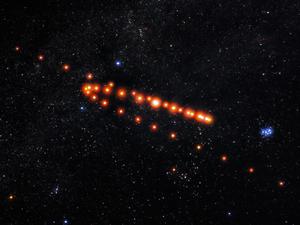
Retrograde Motion of Mars
Pie de foto: Winner in the 2023 IAU OAE Astrophotography Contest, category Still images with smartphones-mobile devices.
This image captures the celestial waltz of Mars as it demonstrates its intriguing retrograde motion against the background of fixed stars. This event, when Mars appears to backtrack in its orbit, arises from the different speeds at which Earth and Mars orbit the Sun. Earth’s faster movement occasionally positions it ahead of Mars, creating the illusion of the Red Planet moving in reverse from our perspective. This retrograde motion occurs when Mars is on the other side of the sky from the Sun, when it is said to be in opposition. Following Mars from 14 August 2022 to 5 April 2023, this smartphone image stands as a testament to perseverance and precision in the tranquil setting of Bataan, Philippines. Enduring unpredictable weather and ever-shifting celestial alignments, the photographer meticulously captured each shot at regular intervals of five to eight days. The process involved aligning 35 distinct images of Mars, taken without any external lens or telescope, alongside a stacked background image composed of 54 frames lasting 15 seconds each, portraying the starry expanse. Fusing these images involved precisely aligning them and cropping Mars in order to centre its position, revealing its retrograde movement against the backdrop of stars. This intricate process, blending the images seamlessly into the background by masking, highlights the planet’s unique motion. In the lower right corner, the Pleiades star cluster is visible.
Crédito: Rob Kerby Guevarra/IAU OAE (CC BY 4.0)
License: CC-BY-4.0 Creative Commons Reconocimiento 4.0 Internacional (CC BY 4.0) íconos
Diagramas relacionados

Opposition and Conjunction
Pie de foto: This diagram shows the Earth's orbit around the Sun and the orbits of two other planets, one orbiting the Sun outside the Earth's orbit and one orbiting the Sun inside the Earth's orbit. At different times in the orbits of both of these planets, their positions appear to line up with the Earth and the Sun. At these points each planet would appear close to the Sun when viewed from Earth. When this happens each planet is said to be in conjunction with the Sun.
For the planet that orbits the Sun within the Earth's orbit it can be in conjunction with the Sun twice in its orbit, once when it is between the Sun and the Earth and once when it is on the other side of the Sun from the Earth. When the planet is in conjunction between the the Sun and Earth it is said to be in inferior conjunction and when it is in conjunction on the far side of the Sun from the Earth it is said to be in superior conjunction.
For the planet orbiting the Sun outside the Earth's orbit, it can sometimes be on the other side of the sky. At this point the Earth lies between the planet and the Sun. The planet in this case is said to be in opposition.
Opposition and conjunction are not just limited to planets and other types of solar system objects such as dwarf planets, comets and asteroids can also be in opposition and conjunction. However only those objects that have an orbit that takes them outside the Earth's orbit can be in opposition.
Conjunction is also used to refer to alignments in the sky between planets in the Solar System. For example when Jupiter and Venus appear very close on the sky when viewed from Earth they are said to be in conjunction with each other.
Crédito: Aneta Margraf/IAU OAE
License: CC-BY-4.0 Creative Commons Reconocimiento 4.0 Internacional (CC BY 4.0) íconos