词条 冲
描述: 当两个天体在观测者看来排成一条直线或接近一条直线,并且在天空中位于相反方向时,谓之为“冲”。观测者并不需要能同时看到这两个物体。例如,在满月时,太阳、地球上的观测者和月亮排成一线,因此月亮可见部分的表面完全被太阳照亮——除非三者完美对齐,在这种情况下会发生月食。当行星、彗星或小行星处于冲时,通常是指与太阳和地球上的观测者的关系。当行星处于冲时,它将显得特别明亮,在移动方向上出现“逆行”(因为地球在其较内侧轨道上移动得更快),并且离地球特别近。
相关词条
用其他语言查看该词条
词条和定义状态: 该术语的英文原始定义已通过天文研究人员和教师的审核 该术语及其定义的译文仍待审核
OAE 多语言词汇表是由国际天文学联合会(IAU) 天文教育办公室(OAE) 和 国际天文学联合会(IAU) 天文推广办公室(OAO)合作的项目。. 术语和定义由 OAE中心, OAE 国家天文教育协调员(NAECs) 以及其他志愿者共同选择、撰写和审阅。您可以在 找到完整的致谢列表。所有词汇表术语及其定义均根据 Creative Commons CC BY-4.0许可证发布 且版权归属于 "IAU OAE"。
如果您发现此词汇术语或定义中的事实或翻译错误, 请向 发邮件 联系.
其他语言版本
- 阿拉伯语: المقابلة الفلكية
- 德语: Opposition
- 英语: Opposition
- 西班牙语: Oposición
- 法语: Opposition
- 意大利语: Opposizione
- 日语: 衝 (外部链接)
- 韩语: 충
- 巴西葡萄牙语: Oposição
- 繁体中文: 衝
相关媒体
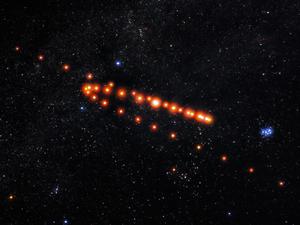
火星逆行
图注: 这幅照片捕捉到了火星的天体华尔兹,它在固定恒星的背景下展示了引人入胜的逆行运动。火星在其轨道上出现逆行现象,是由于地球和火星绕太阳运行的速度不同。地球的运动速度较快,偶尔会领先于火星,从我们的角度看去,就会产生这颗红色星球发生了逆行运动的错觉。当火星和太阳分别位于地球的两侧,即所谓的“火星冲日”时,这种逆行运动就会发生。从2022年8月14日到2023年4月5日,智能手机拍摄的这幅火星图像见证了摄影师在菲律宾巴丹的宁静环境中的坚持不懈和精益求精。摄影师经历着变幻莫测的天气和不断变化的天体排列,每隔五到八天就精心拍摄一次。在整个过程中,摄影师没有使用任何外部镜头或望远镜拍摄到了35幅不同的火星图像,并需要将它们与一幅展现了广袤星空的背景图像进行对齐。这幅背景图像由54帧叠加而成,每帧曝光15秒。融合这些图像需要对它们进行精确对齐,并对火星进行裁剪,以便使其位置居中,从而在星空背景下显示火星的逆行。这一复杂的过程通过遮罩将图像完美无缝地融入背景,突出了火星独特的运动轨迹。在图像的右下角,可以看到昴星团。
来源: Rob Kerby Guevarra/IAU OAE (CC BY 4.0)
相关图表

Opposition and Conjunction
图注: This diagram shows the Earth's orbit around the Sun and the orbits of two other planets, one orbiting the Sun outside the Earth's orbit and one orbiting the Sun inside the Earth's orbit. At different times in the orbits of both of these planets, their positions appear to line up with the Earth and the Sun. At these points each planet would appear close to the Sun when viewed from Earth. When this happens each planet is said to be in conjunction with the Sun.
For the planet that orbits the Sun within the Earth's orbit it can be in conjunction with the Sun twice in its orbit, once when it is between the Sun and the Earth and once when it is on the other side of the Sun from the Earth. When the planet is in conjunction between the the Sun and Earth it is said to be in inferior conjunction and when it is in conjunction on the far side of the Sun from the Earth it is said to be in superior conjunction.
For the planet orbiting the Sun outside the Earth's orbit, it can sometimes be on the other side of the sky. At this point the Earth lies between the planet and the Sun. The planet in this case is said to be in opposition.
Opposition and conjunction are not just limited to planets and other types of solar system objects such as dwarf planets, comets and asteroids can also be in opposition and conjunction. However only those objects that have an orbit that takes them outside the Earth's orbit can be in opposition.
Conjunction is also used to refer to alignments in the sky between planets in the Solar System. For example when Jupiter and Venus appear very close on the sky when viewed from Earth they are said to be in conjunction with each other.
来源: Aneta Margraf/IAU OAE