Termo do glossário: Oposição
Descrição: Quando dois objetos astronômicos parecem estar alinhados ou quase alinhados com um observador, em direções opostas no céu, diz-se que eles estão em oposição. Não é necessário que ambos os objetos sejam realmente visíveis para o observador. Por exemplo, na lua cheia, o Sol, o observador na Terra e a Lua estão alinhados, de modo que a parte visível da superfície da Lua é totalmente iluminada pelo Sol — a menos que o alinhamento seja perfeito, caso em que ocorre um eclipse lunar. Quando se diz que um planeta, cometa ou asteroide está “em oposição”, isso geralmente se refere ao Sol e aos observadores na Terra. Quando um planeta está em oposição, ele parece particularmente brilhante, aparenta se mover em uma direção oposta ao habitual (“movimento retrógrado”, pois a Terra se move mais rápido em sua órbita interna) e encontra-se particularmente próximo da Terra.
Termos relacionados:
Ver este termo em outros idiomas
Status do termo e da definição: A definição original deste termo em inglês foi aprovada por um astrônomo(a) pesquisador(a) e um(a) professor(a) A tradução deste termo e de sua definição ainda aguarda aprovação
O Glossário Multilíngue da OAE é um projeto do Escritório da IAU de Astronomia para a Educação(OAE) em colaboração com o Escritório da IAU para Divulgação da Astronomia (OAO). Os termos e definições foram selecionados, escritos e revisados por meio de um esforço coletivo da OAE, dos Centros e Nós da OAE, dos Coordenadores Nacionais de Educação em Astronomia (NAECs) da OAE e de outros voluntários. Você pode encontrar uma lista completa dos créditos aqui. Todos os termos do glossário e suas definições são disponibilizados sob uma licença Creative Commons CC BY-4.0 e devem ser creditados à "IAU OAE".
Se você notar algum erro factual ou de tradução neste termo do glossário ou em sua definição, por favor entre em contato.
Em outros idiomas
- Árabe: المقابلة الفلكية
- Alemão: Opposition
- Inglês: Opposition
- Espanhol: Oposición
- Francês: Opposition
- Italiano: Opposizione
- Japonês: 衝 (link externo)
- Coreano: 충
- Chinês Simplificado: 冲
- Chinês Tradicional: 衝
Mídia relacionada
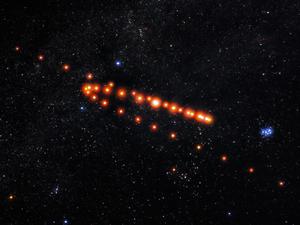
Retrograde Motion of Mars
Legenda: Winner in the 2023 IAU OAE Astrophotography Contest, category Still images with smartphones-mobile devices.
This image captures the celestial waltz of Mars as it demonstrates its intriguing retrograde motion against the background of fixed stars. This event, when Mars appears to backtrack in its orbit, arises from the different speeds at which Earth and Mars orbit the Sun. Earth’s faster movement occasionally positions it ahead of Mars, creating the illusion of the Red Planet moving in reverse from our perspective. This retrograde motion occurs when Mars is on the other side of the sky from the Sun, when it is said to be in opposition. Following Mars from 14 August 2022 to 5 April 2023, this smartphone image stands as a testament to perseverance and precision in the tranquil setting of Bataan, Philippines. Enduring unpredictable weather and ever-shifting celestial alignments, the photographer meticulously captured each shot at regular intervals of five to eight days. The process involved aligning 35 distinct images of Mars, taken without any external lens or telescope, alongside a stacked background image composed of 54 frames lasting 15 seconds each, portraying the starry expanse. Fusing these images involved precisely aligning them and cropping Mars in order to centre its position, revealing its retrograde movement against the backdrop of stars. This intricate process, blending the images seamlessly into the background by masking, highlights the planet’s unique motion. In the lower right corner, the Pleiades star cluster is visible.
Crédito: Rob Kerby Guevarra/IAU OAE (CC BY 4.0)
License: CC-BY-4.0 Creative Commons Attribution 4.0 International (CC BY 4.0) ícones
Diagramas relacionados

Opposition and Conjunction
Legenda: This diagram shows the Earth's orbit around the Sun and the orbits of two other planets, one orbiting the Sun outside the Earth's orbit and one orbiting the Sun inside the Earth's orbit. At different times in the orbits of both of these planets, their positions appear to line up with the Earth and the Sun. At these points each planet would appear close to the Sun when viewed from Earth. When this happens each planet is said to be in conjunction with the Sun.
For the planet that orbits the Sun within the Earth's orbit it can be in conjunction with the Sun twice in its orbit, once when it is between the Sun and the Earth and once when it is on the other side of the Sun from the Earth. When the planet is in conjunction between the the Sun and Earth it is said to be in inferior conjunction and when it is in conjunction on the far side of the Sun from the Earth it is said to be in superior conjunction.
For the planet orbiting the Sun outside the Earth's orbit, it can sometimes be on the other side of the sky. At this point the Earth lies between the planet and the Sun. The planet in this case is said to be in opposition.
Opposition and conjunction are not just limited to planets and other types of solar system objects such as dwarf planets, comets and asteroids can also be in opposition and conjunction. However only those objects that have an orbit that takes them outside the Earth's orbit can be in opposition.
Conjunction is also used to refer to alignments in the sky between planets in the Solar System. For example when Jupiter and Venus appear very close on the sky when viewed from Earth they are said to be in conjunction with each other.
Crédito: Aneta Margraf/IAU OAE
License: CC-BY-4.0 Creative Commons Attribution 4.0 International (CC BY 4.0) ícones