Término del glosario: Satélites galileanos
Descripción: Las lunas galileanas son las cuatro lunas más grandes y brillantes que orbitan alrededor del planeta Júpiter: Io, Europa, Ganímedes y Calisto. La más cercana a Júpiter es Io, que cuenta con cientos de volcanes activos. La principal razón del vulcanismo de Io es que este satélite está siendo «amasado» por los efectos de las mareas provocadas por la gravedad de Júpiter. Toda la superficie de Europa está cubierta de hielo. Se cree que bajo el hielo hay un océano de agua líquida, que es uno de los mejores candidatos para albergar vida fuera de la Tierra en el Sistema Solar. Ganímedes es la luna más grande de nuestro Sistema Solar, y también la que tiene mayor masa, el doble que la de la Luna de la Tierra. Calisto tiene casi exactamente el mismo tamaño que el planeta Mercurio, pero solo posee aproximadamente un tercio de la masa de este.
Las cuatro lunas galileanas fueron descubiertas por Galileo Galilei en 1610, como uno de los varios descubrimientos realizados durante la campaña pionera de Galilei en el uso del telescopio para observaciones astronómicas. Galilei pudo documentar que, con el paso del tiempo, las cuatro lunas orbitan alrededor de Júpiter como un sistema solar en miniatura. Esto supuso una clara demostración de que los objetos astronómicos pueden orbitar alrededor de un centro distinto de la Tierra; esta observación desempeñó un papel importante en el cambio del consenso científico, que pasó de una visión geocéntrica del Sistema Solar a una heliocéntrica.
Términos relacionados:
Ver este término en otros idiomas
Estado del término y la definición: La definición original de este término en inglés ha sido aprobada por unastrónomo o astrónoma investigadora y un docente La traducción de este término y su definición aún están pendientes de aprobación
El Glosario multilingüe de la OAE es un proyecto de la Oficina de Astronomía para la Educación de la UAI (OAE) en colaboración con la Oficina de Divulgación de Astronomía de la UAI (OAO). Los términos y definiciones fueron seleccionados, redactados y revisados gracias al esfuerzo colectivo de la OAE, los Centros y Nodos de la OAE, los Coordinadores Nacionales de Educación Astronómica (NAECs) y otros voluntarios. Puedes encontrar una lista completa de créditos aquí. Todos los términos del glosario y sus definiciones se publican bajo la licencia Creative Commons CC BY-4.0 y deben atribuirse a la "IAU OAE".
Si detectas algún error de contenido o de traducción en este término del glosario o en ladefinición, ponte en contacto con nosotros.
En otros idiomas
- Árabe: أقمار غاليليو
- Alemán: Galileische Satelliten
- Inglés: Galilean Satellites
- Francés: Satellites galiléens
- Italiano: Satelliti galileiani
- Japonés: ガリレオ衛星 (enlace externo)
- Portugués de Brasil: Satélites Galileanos
- Chino simplificado: 伽利略卫星
- Chino tradicional: 伽利略衛星
Contenidos relacionados
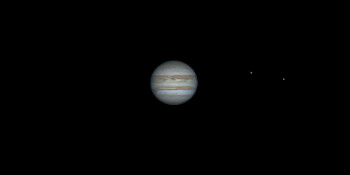
Jupiter's Rotation, by Vishal Sharma, India
Pie de foto: Third place in the 2021 IAU OAE Astrophotography Contest, category Galilean moons: Jupiter’s Rotation, by Vishal Sharma, India.
This time-lapse beautifully shows the rotation of Jupiter and the passage of two Galilean moons on the right side of the frame. Jupiter completes one rotation in just under 10 hours and we see as the Great Red Spot makes its way from left to right. The two moons travel a noticeable fraction of their orbit in this short time. This image was taken in 2020 in the North of India.
Crédito: Vishal Sharma/IAU OAE
License: CC-BY-4.0 Creative Commons Reconocimiento 4.0 Internacional (CC BY 4.0) íconos
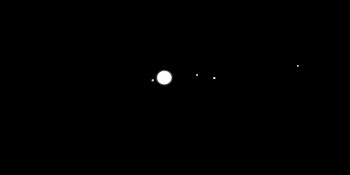
Jupiter Moons Movie2, by Nicolas Hurez, Paul-Antoine Matrangolo, and Carl Pennypacker, United States of America
Pie de foto: Second place in the 2021 IAU OAE Astrophotography Contest, category Galilean moons.
This sequence shows the orbit of the four Galilean moons around the planet Jupiter. Almost two entire orbits of the innermost moon, Io, can be seen, with the other moons (Europa and Ganymede, but in particular Callisto) being further away, orbiting noticeably slower. The images were obtained in 2018 with the Las Cumbres Global Observatory at different locations on Earth, allowing a continuous sequence of images over approximately half a week without gaps during the day. With clear skies and over the course of several nights, the motion of the Galilean moons can also be observed with binoculars (ideally steady your elbows on a surface).
Crédito: Nicolas Hurez, Paul-Antoine Matrangolo and Carl Pennypacker/IAU OAE
License: CC-BY-4.0 Creative Commons Reconocimiento 4.0 Internacional (CC BY 4.0) íconos
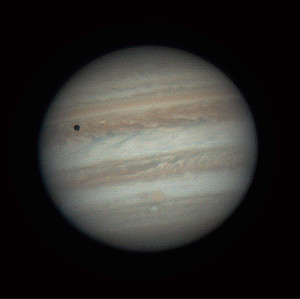
Jupiter, Io and its shadow, by Ralf Burkart, Germany
Pie de foto: First place in the 2021 IAU OAE Astrophotography Contest, category Galilean moons.
This time-lapse of Jupiter taken in 2017 from Germany beautifully illustrates the transit of one of the Galilean moons, Io, in front of Jupiter. As this is simply a moon casting a shadow on a planet it is equivalent to a lunar eclipse on Earth observed from further away. While the shadow of the moon is clearly visible from the beginning, it might be difficult to spot the moon itself against the background of the beautiful atmospheric bands of Jupiter the first time the video is seen. Watching it repeatedly allows appreciating the rapid motion and rotation in this fantastic observation.
Crédito: Ralf Burkart/IAU OAE
License: CC-BY-4.0 Creative Commons Reconocimiento 4.0 Internacional (CC BY 4.0) íconos
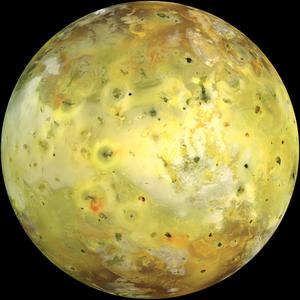
Io
Pie de foto: La sonda Galileo de la NASA captó, el 3 de julio de 1999, las imágenes de mayor resolución de Io, una de las cuatro lunas de Júpiter descubiertas por Galileo Galilei en 1610. Los colores de Io son testimonio de su intensa actividad volcánica, ya que proceden de compuestos sulfúricos. Las fuerzas de marea procedentes de Júpiter y de las lunas vecinas son la causa del vulcanismo de Io.
Crédito: NASA/JPL/Universidad de Arizona
enlace de crédito
License: PD Dominio público íconos
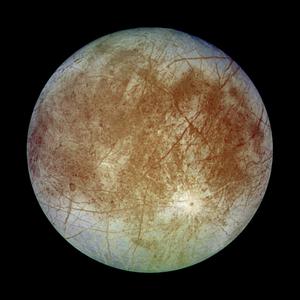
Europa
Pie de foto: This image taken by NASA's Galileo space probe in September 1996 shows Jupiter's ice-covered satellite, Europa, in approximate natural color. Long, dark lines are fractures in the crust, some of which are more than 3,000 kilometers (1,850 miles) long. The bright feature containing a central dark spot in the lower third of the image is a young impact crater some 50 kilometers (31 miles) in diameter. Europa is about 3,160 kilometers (1,950 miles) in diameter, or about the size of Earth's moon.
Crédito: NASA/JPL/DLR
License: PD Dominio público íconos