This page describes an image Hertzsprung-Russell diagram
Datei runterladen ( Bild 66.05 kB)
PDF Datei runterladen (PDF file 67.26 kB)
Untertitel Diagramm:
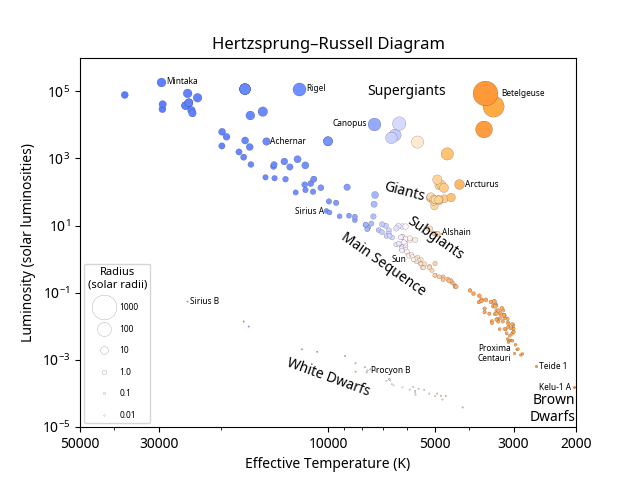
This diagram shows the temperature and luminosity of different stars. The size of each point represents the star’s radius and its colour is the colour the human eye would see. The stars range in colour from a washed-out blue to a washed-out reddish-orange. No star has a pure colour like red, green or blue as stars’ spectra include light from lots of different colours. However the reddest stars are commonly referred to as red and the bluest stars as blue. The sample of stars used to make this diagram was chosen to show a wide range of stars of different types so the relative number of each type of star is not representative of how commonly each type is found.
From the top left to bottom right there is a long line of stars burning hydrogen in their cores. This is called the main sequence. On this line, one sees the stars Mintaka, Achernar, Sirius A, the Sun and Proxima Centauri. The objects around Proxima Centauri at the lower right end of the main sequence are known as red dwarfs. To the lower right of the red dwarfs are Teide 1 and Kelu-1 A. These two objects are brown dwarfs, objects too low in mass to have cores hot enough to fuse hydrogen for a sustained period of time. As they do not burn hydrogen, brown dwarfs are not considered main sequence stars. The name brown dwarf is unrelated to their colour.
Above the main sequence, we find subgiants, giants and supergiants. These are stars that have finished burning hydrogen in their core and have evolved into larger objects. A star’s brightness depends on its temperature and size so giant stars are brighter than stars with a smaller radius but the same temperature. In time these objects will move towards the end of their lives and undergo either a planetary nebula phase or become supernovae. Stars which end their lives with a planetary nebula phase become a type of stellar remnant called a white dwarf. Such objects are much smaller than stars of the same temperature and thus are fainter and are found significantly below the main sequence. Stars which end their lives as supernovae become either black holes or neutron stars. These are not shown on this plot.
Quelle Diagramm: IAU OAE/Niall Deacon.
Diagramm Übersetzungsstatus: Noch nicht bestätigt von einer*einem Rezensent*in
Diagramm-Übersetzer*in: Simon Kraus
Diagramm-Lizenz: Creative Commons Namensnennung 4.0 International (CC BY 4.0) Creative Commons Namensnennung 4.0 International (CC BY 4.0) Symbole
Ähnliche Glossarbegriffe:
Brauner Zwerg
, Effektivtemperatur
, Farbe
, Hauptreihe
, Hertzsprung-Russell-Diagramm (HRD)
, Leuchtkraft
, Leuchtkraftklasse
, Riesenstern
, Sternentwicklung
, Unterriese
, Weißer Zwerg
, Überriesen
Kategorien:
Sterne
Möchtest Du Deine eigene Version dieses Diagramms erstellen? Dann schau dir den Code an der dieses Diagramm erzeugt hat, auf Github
Du kannst Deine eigene Version oder Übersetzung dieses Diagrammes erstellen, indem du einer textlosen Version dieses Diagrammes eigenen Text zufügst.
Downloade einfach eine dieser Dateien:
Download Text-Free File ( Bild 33.43 kB)
Download Text-Free PDF File (PDF file 53.04 kB)
Auf anderen Sprachen
Englisch: Hertzsprung-Russell diagramFranzösisch: Diagramme de Hertzsprung-Russell
Traditionelles Chinesisch: 赫羅圖
Vereinfachtes Chinesisch: 赫罗图
Spanisch: Diagrama Hertzsprung-Russell
Italienisch: Diagramma di Hertzsprung-Russell
Nepali: हर्ट्जस्प्रङ-रसेल चित्र
Die Diagramm-Unterschriften auf der OAE-Website wurden geschrieben, übersetzt und bestätigt durch einen kollektiven Aufwand vom OAE, dem OAE Zentren und Knotenpunkte, dem OAE Nationale astronomische Bildungskoordinator*innen (NAECs) und anderen Freiwilligen. Du findest eine volle Liste der Mitarbeitenden für unser Übersetzungsprojekt here. Alle Mediendatei-Unterschriften werden veröffentlicht unter Creative Commons CC BY-4.0 license und sollten "IAU OAE" zugeschrieben werden.Die Mediendateien selbst können andere Lizenzen haben (siehe oben), und sollten Quellenverweise erhalten wie oben aufgelistet "credit".
Sollte dir ein Fehler in diesem Diagramm oder seiner Unterschrift auffallen, bitte kontaktiere uns.